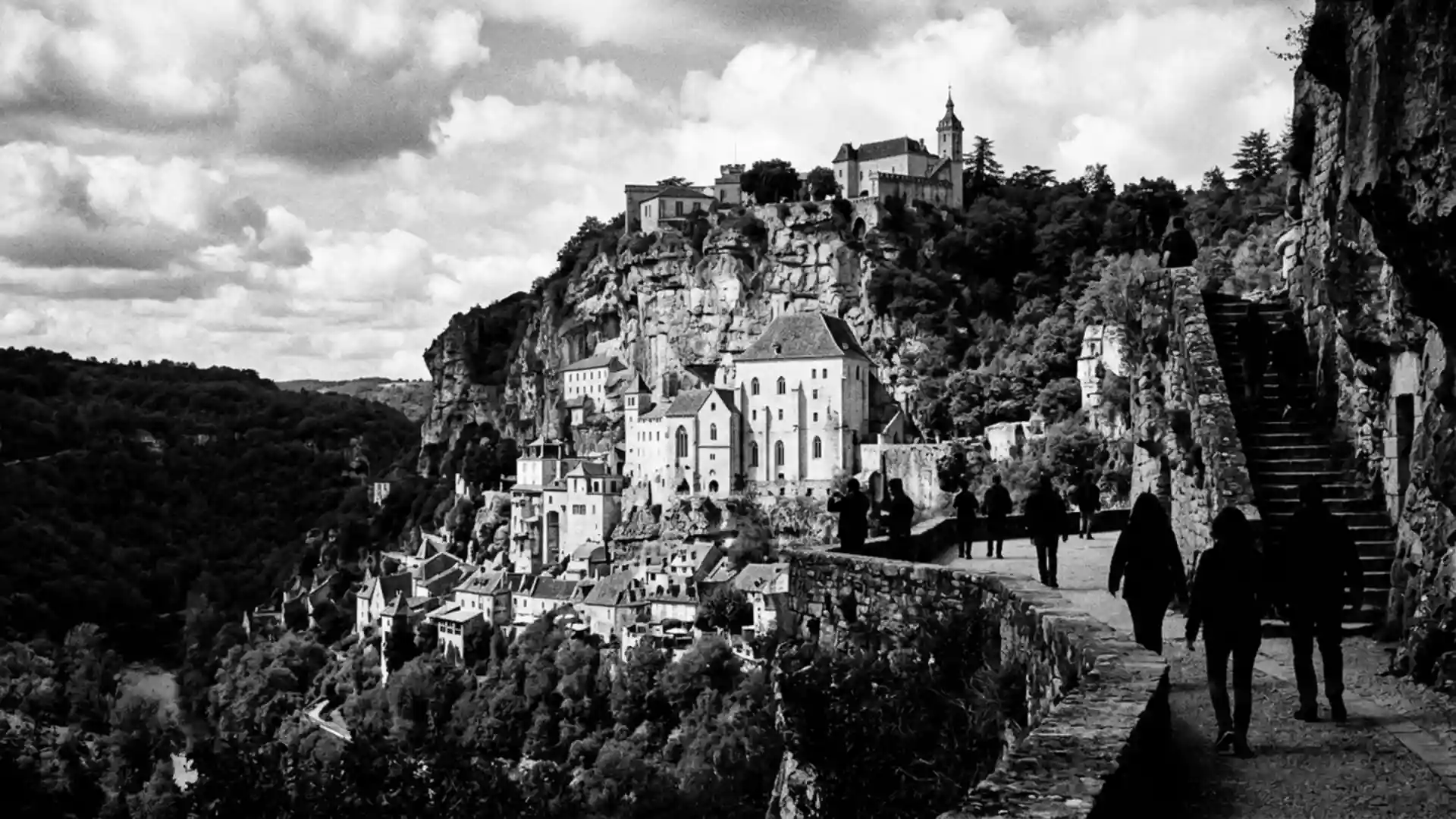
Rocamadour, the cliffside sanctuary of the Dordogne Valley
Published on 09/03/2026 at 07:42 | Editorial responsibility: Rafael Müller, Editor-in-Chief AD HOC NEWS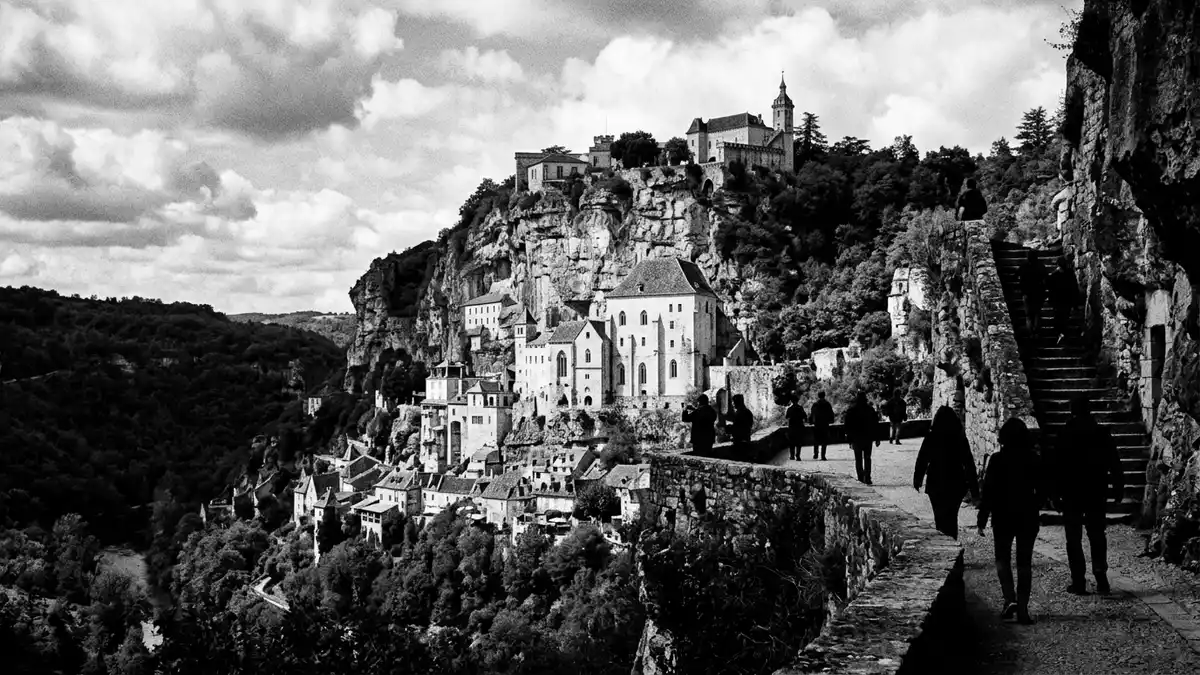
Rocamadour is a small medieval town in southwest France whose stone houses, chapels and fortifications rise in stacked terraces up a limestone cliff above the Alzou gorge. The place is best known for its sanctuary complex dedicated to the Virgin Mary, a cluster of churches and chapels halfway up the rock that has attracted pilgrims since the Middle Ages and forms part of the wider Way of Saint James across France and Spain. Set within the Lot department in the Dordogne Valley, Rocamadour combines dramatic vertical geography with a dense ensemble of religious architecture dating mainly from the twelfth century and later.
A town built into a cliff
Rocamadour occupies the right bank of the Alzou, a small river that cuts a deep gorge into the limestone plateaus of the Causses du Quercy in the Lot department of southwestern France.village in the Lot département Its buildings rise in distinct tiers: the lower town with its long main street in the valley, the sanctuary complex halfway up the cliff, and the château and ramparts crowning the summit above. The rock face here reaches around 120 m (390 ft) in height, creating a striking contrast between the river level and the defensive structures and chapels anchored into the cliff walls.rocky walls 120 metres in height
The lower town consists of a narrow street lined with stone houses and fortified gateways, reflecting the settlement’s role as both a market town and an access point to the sanctuaries above.lower town with fortified gateways From here, stairways and paths lead upward towards the religious complex set into a natural ledge on the cliff, with further passages and a path marked by the Stations of the Cross continuing to the castle at the top. The entire composition gives the impression of a town growing directly out of the rock, with each level serving a distinct function within the historic settlement.
The sanctuary and its chapels
The heart of Rocamadour is the sanctuary devoted to the Blessed Virgin Mary, accessed by a monumental staircase of 216 steps that climbs from the lower town to an esplanade of chapels and churches midway up the cliff.216 steps to the sanctuary This ensemble, sometimes referred to as La Cité Religieuse, comprises several medieval religious buildings constructed against and partly into the rock. Among them are seven chapels, including the Chapelle Notre-Dame, and the basilica of Saint-Sauveur, whose interior walls carry paintings and inscriptions recalling visits by notable pilgrims and patrons over many centuries.La Cité Réligieuse with seven chapels
The Chapelle Notre-Dame houses a wooden statue known as the Black Madonna or Our Lady of Rocamadour, which has stood at the centre of local devotion and pilgrimage since the twelfth century.cult image at the centre of the site Below the basilica lies the crypt of Saint Amadour, a subterranean church dating from the twelfth century that preserves relics associated with the hermit traditionally linked to the site.crypt of St. Amadour Both the basilica of Saint-Sauveur and the crypt of Saint-Amadour have been inscribed as UNESCO World Heritage sites as part of the Routes of Santiago de Compostela in France, reflecting their significance within the broader network of pilgrimage landmarks.basilica and crypt listed as UNESCO World Heritage Sites
Pilgrimage history and medieval heritage
Rocamadour is closely associated with the Christian pilgrimage traditions that developed in southwestern Europe from around the twelfth century, and it stands on one of the French routes of the Way of Saint James leading towards Santiago de Compostela in Spain.situated on the route to Santiago de Compostela For centuries, pilgrims from various parts of Europe have travelled to this sanctuary to venerate the Black Virgin and to seek spiritual favours linked to the shrine. Historical accounts record visits by monarchs such as Henry II of England and Louis IX of France and by religious figures connected with major medieval orders, underlining the site’s status within French Christianity.Henry II and Louis XI as visitors
The town’s origins are associated with a hermit known as Saint Amadour whose presence on the cliff is traditionally dated to the early Middle Ages, and whose relics were discovered in the rock face in the twelfth century.remains of St Amadour discovered in 1166 Over generations, the sanctuary grew in importance, and its churches and chapels were enlarged and restored, including significant nineteenth-century works on the castle and on some neo-Gothic elements visible in the upper structures.restoration efforts in the nineteenth century The result is a layered architectural ensemble in which Romanesque and later Gothic forms coexist with defensive walls and residential buildings, all conditioned by the steep terrain of the Alzou gorge.
Visiting Rocamadour: what travellers from Western Europe should know
- Rocamadour lies in the Lot department of southwest France, on the limestone plateaus above the Dordogne Valley and the gorge of the Alzou River; road access follows local routes that climb from the surrounding countryside to the town’s lower level.
- The town is built on a steep cliff face, and reaching the sanctuary involves stairways with many stone steps and sloping paths, while the ascent to the castle at the summit follows a marked route with successive viewpoints over the valley.
- The surrounding landscape forms part of the Parc Naturel Régional des Causses du Quercy, with rocky ground and narrow streets that call for sure footing when walking between the lower town, the sanctuary esplanade and the upper fortifications.
- The official language is French and the currency is the euro.
Searching for Rocamadour on social platforms
These links open searches for Rocamadour on each platform.
Frequently asked questions about Rocamadour
Where is Rocamadour located?
Rocamadour stands in the Lot department of southwestern France, in the Dordogne Valley, on a limestone cliff above the gorge of the Alzou River.
What should visitors expect when exploring Rocamadour?
Visitors encounter a steeply tiered town with a lower street of medieval houses, a sanctuary esplanade reached by flights of steps, and a castle and ramparts overlooking the valley.
What makes Rocamadour distinctive among French towns?
The combination of a long-standing Marian sanctuary, UNESCO-listed basilica and crypt, and the dramatic cliffside setting above the Alzou gorge gives Rocamadour a character closely tied to both geology and pilgrimage history.