
Rottnest Island where limestone shores meet quokka country
Published on 09/23/2026 at 10:56 | Editorial responsibility: Rafael Müller, Editor-in-Chief AD HOC NEWS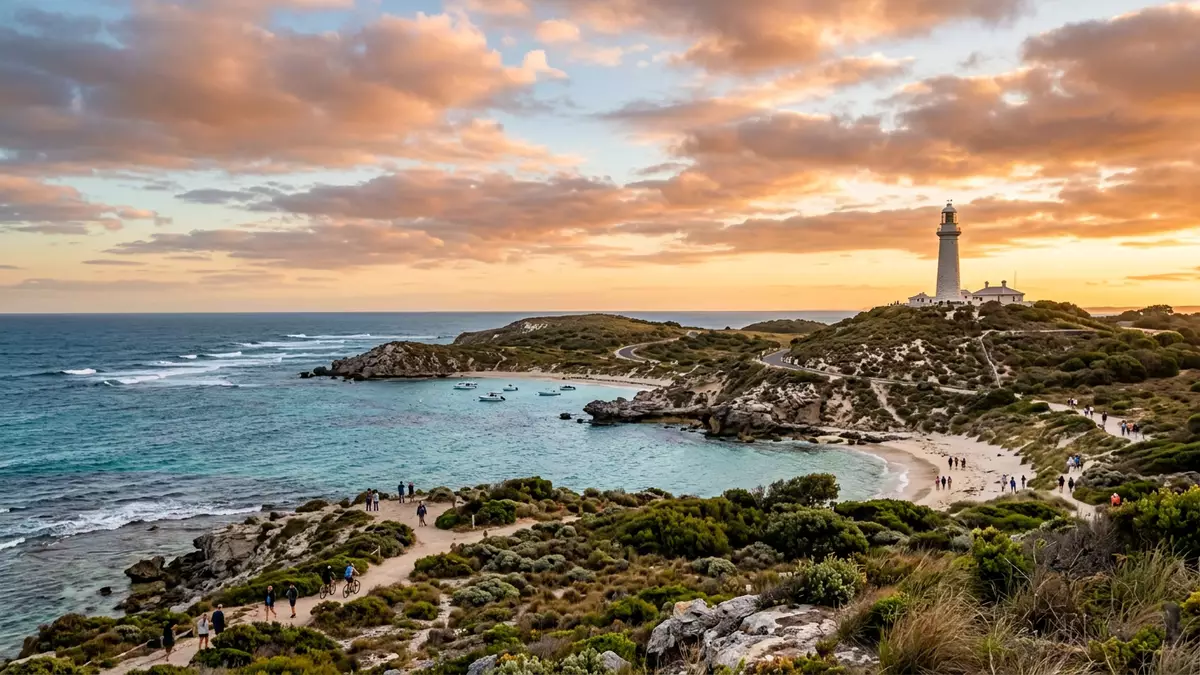
Rottnest Island lies off Perth as a low limestone island shaped by ocean, salt lakes and open coastal country. Known as Wadjemup to the Whadjuk Noongar people, it is also home to the quokka, a small marsupial that has become closely associated with the island.
The island’s landscape brings natural history and human history into the same view. Beaches, reefs, inland lakes, lighthouse structures, military installations and memorial places occupy a compact area separated from mainland Australia by the sea.
Rottnest Island’s limestone coast and inland lakes
Rottnest Island measures about 11 km from end to end and 4.5 km across, covering roughly 19 km². Its highest point rises about 45 m above sea level. The island forms part of a chain of limestone islands and reefs on the continental shelf off Western Australia, west of Fremantle.
Low dunes and limestone shores frame bays, beaches and rocky headlands. Inland, salt lakes interrupt the vegetation with broad reflective surfaces and pale edges. The Wadjemup Bidi connects coastal and inland landscapes through walking trails named in Noongar, including routes associated with the salt lakes, northern beaches and the island’s western end. Rottnest Island’s physical setting includes its low elevation, limestone geology and position near Fremantle.
The island became separated from the mainland after sea levels rose around 6,500 years ago. Before that separation, the land formed part of the mainland landscape used by Whadjuk people. Artefacts indicate a much longer human presence, reaching back tens of thousands of years.
Wadjemup, Whadjuk Noongar country and colonial history
Wadjemup is the island’s Whadjuk Noongar name. It refers to a place across the water associated with spirits. The name places the island within a cultural geography that predates European mapping and the later name Rottnest Island.
Dutch explorer Willem de Vlamingh reached the island in 1696. He mistook quokkas for large rats and recorded a Dutch name meaning “Rats’ Nest Island”. That encounter explains the English name, while Wadjemup preserves the island’s Noongar identity. Wadjemup’s Aboriginal history includes ceremonies, meetings, incarceration and forced labour.
From 1838 to 1931, colonial authorities used the island as a prison and forced labour camp for Aboriginal people from across Western Australia. The history remains present in buildings, burial places, memorial work and the cultural meaning of the island for Aboriginal communities.
Rottnest Island also contains traces of maritime and colonial administration. The settlement includes historic buildings, while lighthouses and former pilot facilities reflect the reefs and waters around the island. The island’s heritage therefore extends beyond scenery, with natural, cultural and political histories held within the same landscape.
Quokkas, lighthouses and the island’s military traces
Quokkas belong to the wallaby family and are native to Western Australia. On Rottnest Island, the absence of major land predators helped the species thrive. Their rounded faces and compact bodies make them recognisable, but they remain wild animals within their island habitat.
The island’s name is linked to these animals, while its conservation status protects the wider setting of beaches, woodland, dunes, wetlands and salt lakes. Quokkas share the landscape with native birds, reptiles and marine life around the limestone coast. The quokka’s place on Rottnest is part of the island’s natural and cultural identity.
Wadjemup Lighthouse rises on the island’s central high ground. Constructed in 1896, it reaches approximately 38 m and remains a prominent landmark across the island. Its tower and lantern recall the maritime role of the surrounding waters, where reefs and shipwrecks shaped the work of pilots and navigators.
Military history appears at Oliver Hill and Bickley Battery. Oliver Hill contains a World War II-era coastal defence installation with large naval guns and underground tunnels. The railway associated with the fortress carried equipment towards the gun battery. Rottnest Island’s military history includes batteries, searchlight positions, stores and communications facilities.
These landmarks create a visible contrast between wildlife habitat and military infrastructure. A salt lake, a quokka, a lighthouse and a gun emplacement can all belong to the same island journey, while each points towards a different chapter of Wadjemup’s history.
Visiting Rottnest Island: what travellers from Western Europe should know
- Rottnest Island lies about 19 km west of Fremantle and about 33 km from Perth. Passenger ferries depart from Perth, Fremantle, North Fremantle and Hillarys Boat Harbour, arriving at Thomson Bay.
- The island is car-free. Walking, cycling, shuttle services and island buses connect the settlement with beaches, lakes, lighthouse sites and military landmarks.
- The island’s road network covers about 22 km, while the Wadjemup Bidi links several landscapes through named walking routes.
- The terrain includes exposed limestone, sandy ground, low hills, salt lakes and coastal paths. The Wadjemup Lighthouse ascent uses a spiral staircase.
- The official language is English and the currency is the Australian dollar.
Searching for Rottnest Island on social platforms
These links open searches for Rottnest Island on each platform.
Frequently asked questions about Rottnest Island
Where is Rottnest Island?
Rottnest Island lies off the coast of Western Australia, west of Fremantle and near Perth. Passenger ferries connect it with mainland harbours.
What can visitors expect on Rottnest Island?
Visitors find beaches, limestone headlands, salt lakes, walking trails, historic buildings, the Wadjemup Lighthouse and military sites at Oliver Hill.
What makes Rottnest Island distinctive?
The island combines a quokka habitat with Whadjuk Noongar cultural history, colonial buildings, maritime landmarks and a car-free limestone landscape.


