
Royal Botanic Gardens and Melbourne’s riverside greenery
Published on 09/18/2026 at 18:02 | Editorial responsibility: Rafael Müller, Editor-in-Chief AD HOC NEWS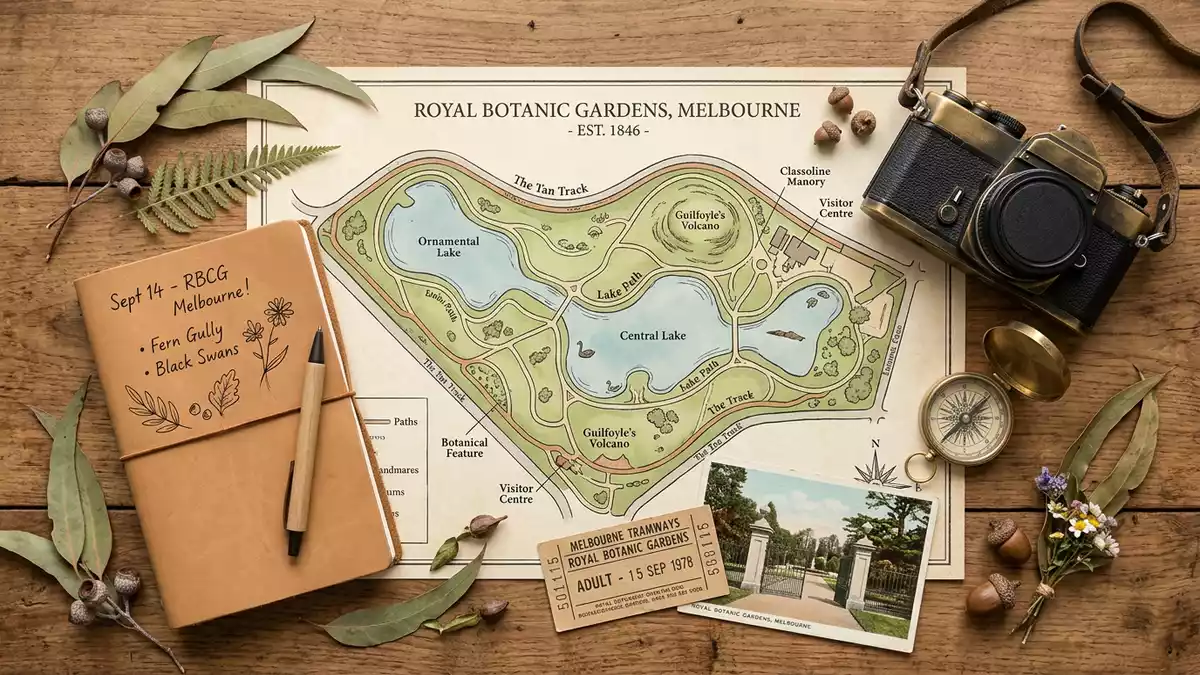
Royal Botanic Gardens in Melbourne is a nineteenth?century riverside landscape where lawns, lakes and plant collections spread across carefully shaped ground beside the Yarra River. Established in 1846 on land selected by Superintendent Charles La Trobe, it has grown into a major botanical institution and a central green space in Australia’s second?largest city.
A nineteenth?century garden shaped beside the Yarra
The Melbourne section of Royal Botanic Gardens occupies sloping ground on the south side of the Yarra River, close to Government House, the Melbourne Observatory and the broader Domain parklands.commenced in 1846 on the south side of the Yarra River The initial reserve was fenced near Anderson Street, forming a modest pleasure garden that later expanded as Melbourne itself grew from colonial town to capital of Victoria.expanded in area to 36 hectares
The gardens were founded as Melbourne Botanic Gardens and gained the “Royal” title in 1958, when Queen Elizabeth II approved the change of name.Queen Elizabeth II approved the addition of “Royal” In administrative terms they now form part of Royal Botanic Gardens Victoria, a body created under the Royal Botanic Gardens Act 1991 and governed by a board that took over management in 1992.Royal Botanic Gardens Act 1991
Directors, design and the Melbourne Gardens landscape
From the mid nineteenth century onwards, named directors and curators shaped Royal Botanic Gardens into the landscape known today. Ferdinand von Mueller, appointed director in 1857 after earlier service as government botanist, built up the scientific side of the gardens and established the National Herbarium of Victoria near the living collections.Ferdinand von Mueller as first permanent director His tenure strengthened the role of the gardens as a place for plant acclimatisation and botanical research across Victoria.centre for botanical research in Victoria
In 1873 William Robert Guilfoyle took over as director and reshaped the gardens with sweeping lawns, curving paths, ornamental lakes and subtropical planting that gave Melbourne Gardens a picturesque character.transformed the Gardens into a landscape in the “picturesque” style Guilfoyle is widely acknowledged as the architect of the Royal Botanic Gardens, and his design of lawns, vistas and varied planting has been maintained by later directors.acknowledged as the architect of the Royal Botanic Gardens
Living collections, herbarium and riverside setting
Royal Botanic Gardens is both a public landscape and a scientific institution. Around Melbourne Gardens, themed areas present plants from different regions and environments, while near the lawns the National Herbarium of Victoria holds extensive collections of preserved specimens used for plant identification and research.National Herbarium established in 1853 Together, the living and preserved collections reflect the long role of the gardens in studying plants from Australia and elsewhere.instrumental in the introduction and acclimatisation of plants
The landscape itself is composed of lawns, shrubberies, tree groups and water bodies arranged along the river frontage and across the slopes above it. Paths link open grass to more enclosed planting, while views extend towards Government House and across ornamental lakes where black swans and other waterbirds are a familiar presence.ornamental lakes and sweeping lawns The sequence of lawns and water, framed by diverse trees and shrubs, gives the gardens a layered structure that is legible on foot from many points along the river and within the Domain.site on the southern bank of the Yarra River
Visiting Royal Botanic Gardens: what travellers from Western Europe should know
- Royal Botanic Gardens lies south of central Melbourne, on the southern bank of the Yarra River near Government House and the Melbourne Observatory. It is reached on foot from the city centre and by tram routes serving St Kilda Road.
- Within the gardens, paths run over gently varied ground with some slopes and long walks between different lawn and planting areas, and there are stretches of path beside ornamental lakes.
- The broader Domain parklands surround the gardens, and the Shrine of Remembrance stands nearby on elevated ground above St Kilda Road.
- The official language is English and the currency is the Australian dollar.
- Entry requirements depend on your nationality; UK travellers can check the FCDO travel advice at gov.uk/foreign-travel-advice, Irish travellers the Department of Foreign Affairs at ireland.ie.
Searching for Royal Botanic Gardens on social platforms
These links open searches for Royal Botanic Gardens on each platform.
Frequently asked questions about Royal Botanic Gardens
Where is Royal Botanic Gardens in Melbourne?
Royal Botanic Gardens stands on the southern bank of the Yarra River in South Yarra, close to Government House, the Melbourne Observatory and the surrounding Domain parklands.
What can visitors expect during a visit?
A visit includes walks through lawns, tree groups and shrubberies, paths beside ornamental lakes and access to areas devoted to different plant collections, along with views towards Melbourne landmarks.
What makes Royal Botanic Gardens distinctive among city parks?
Its combination of nineteenth?century picturesque design by William Guilfoyle, scientific collections including the National Herbarium of Victoria and an extensive riverside setting makes it a distinctive garden landscape within Melbourne.


