Sacsayhuaman and the zigzag stone walls above Cusco
Published on 08/15/2026 at 14:40 | Editorial responsibility: Rafael Müller, Editor-in-Chief AD HOC NEWS
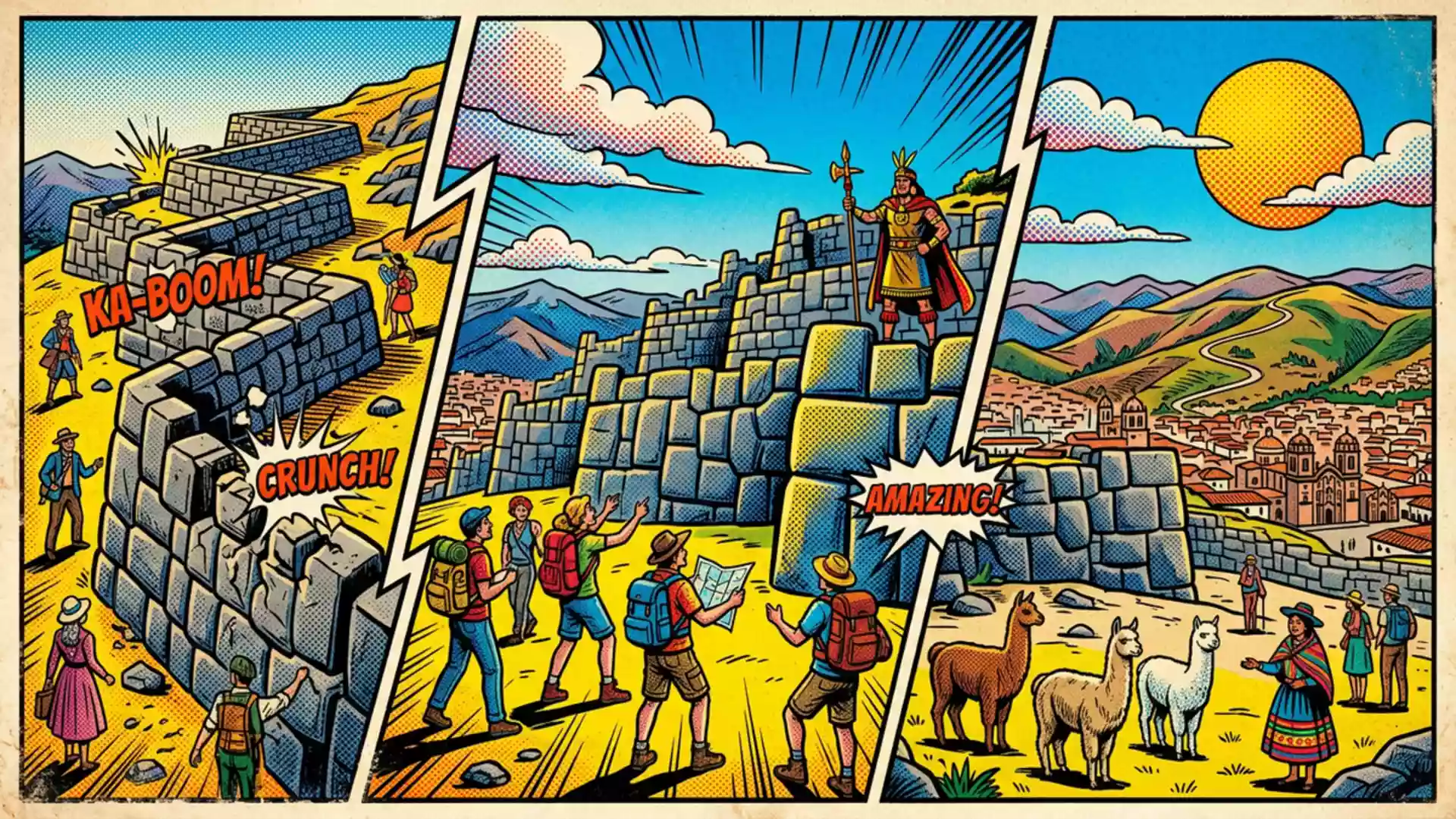
High on a hill above Cusco, Sacsayhuaman presents an Inca vision in stone: colossal zigzag terraces and broad open spaces laid out above the former imperial capital in the Andes. Built in the fifteenth century during the reign of Pachacuti Inca Yupanqui, the complex combines fortress-like walls with ceremonial platforms and viewpoints over the city below.fifteenth century fortress
Zigzag terraces and cyclopean stonework
The best-known feature of Sacsayhuaman is a sequence of massive stone terraces that cut across the slope in a dramatic zigzag pattern, forming repeated angles that read almost like teeth on the hillside.three tiers of zigzagging walls Each terrace is formed from huge blocks of limestone fitted closely together without visible mortar, some rising higher than an adult and weighing many tonnes. The faces of these walls stand in stepped lines, with recesses and projections that echo one another from level to level, so walking alongside them reveals a repeating rhythm of stone.
From the lower approaches the terraces dominate the view, their pale rock contrasting with grass and scattered boulders in the foreground. Above the main walls, additional platforms and traces of buildings mark higher ground in the archaeological park, giving a sense of a layered complex rather than a single structure.monumental archaeological park The precision of the stone joints and the scale of the blocks have long drawn attention to Sacsayhuaman as one of the strongest surviving examples of Inca engineering in Cusco.
Cusco’s hilltop citadel and ceremonial ground
Sacsayhuaman stands on the northern outskirts of Cusco, at an altitude of around 3,700 m (12,140 ft) above sea level, overlooking the grid of streets and the Plaza de Armas of the old city.archaeological center north of the main square The citadel forms part of the Parque Arqueológico Nacional de Saqsaywaman, a broad protected area that extends across the hill and includes surrounding structures and landscape. From its grassy platforms, the view stretches over roofs and church towers, linking the Inca remains visually to later Spanish architecture in the valley.
Within the complex, archaeologists distinguish several zones, including a walled section associated with military functions, an open parade ground and areas interpreted as religious or ceremonial spaces.different zones of the archaeological site The blend of defensive walls and ritual areas reflects the site’s dual role in Inca times. It was here that stone architecture, earthworks and open sky combined to frame imperial ceremonies, and the site later became a battlefield during the Spanish conquest.
Inca context, altitude and the walk from Cusco
Sacsayhuaman belongs to the period when the Inca Empire was consolidating power from Cusco across large parts of the central Andes, a process associated with Pachacuti and his successors in the fifteenth century.citadel on the northern outskirts of Cusco The complex crowns the city from a hilltop around 230 m (755 ft) above the old urban centre, giving it strategic and symbolic prominence at the head of the valley.hilltop above the city Its Quechua name is linked to the idea of a royal bird of prey, a reminder that animal imagery formed part of how the Inca framed their capital and its surroundings.
The site lies roughly 2 km uphill north of central Cusco, and a well-used route on foot climbs from the historic centre through narrow streets and past the church of San Cristóbal towards the main entrance.walking approach from the Plaza de Armas At over 3,700 m (12,140 ft), the altitude is immediately noticeable, particularly on the steeper sections of the path, and once inside the park broad grassy areas alternate with rocky outcrops and low remains of walls and foundations.
Visiting Sacsayhuaman: what travellers from Western Europe should know
- Sacsayhuaman stands on a hill north of central Cusco, and many visitors reach it on foot by following steep streets uphill from the Plaza de Armas.
- The complex lies at around 3,700 m (12,140 ft) above sea level, so any approach on foot involves a sustained climb and movement across uneven grassy and rocky terrain.
- Sacsayhuaman forms part of a wider archaeological park above Cusco, with terraces, open fields and stone remains spread across a broad area rather than concentrated in a single building.
- The official language is Spanish and the currency is the Peruvian sol.
- Entry requirements depend on your nationality; UK travellers can check the FCDO travel advice at gov.uk/foreign-travel-advice, Irish travellers the Department of Foreign Affairs at ireland.ie.
Searching for Sacsayhuaman on social platforms
These links open searches for Sacsayhuaman on each platform.
Frequently asked questions about Sacsayhuaman
Where is Sacsayhuaman located?
Sacsayhuaman is on a hill on the northern outskirts of Cusco in southern Peru, around 2 km uphill from the city’s historic centre.
What should visitors expect on a visit?
Visitors encounter expansive grassy spaces, zigzag stone terraces, scattered ruins and wide views over Cusco, with walking across uneven ground at high altitude.
What makes Sacsayhuaman distinctive among Inca sites?
The combination of colossal zigzag limestone walls, its hilltop position above Cusco and its blend of defensive and ceremonial areas give Sacsayhuaman a distinctive character.