
Sacsayhuaman and the zigzag stone walls above Cusco
Published on 09/18/2026 at 18:46 | Editorial responsibility: Rafael Müller, Editor-in-Chief AD HOC NEWS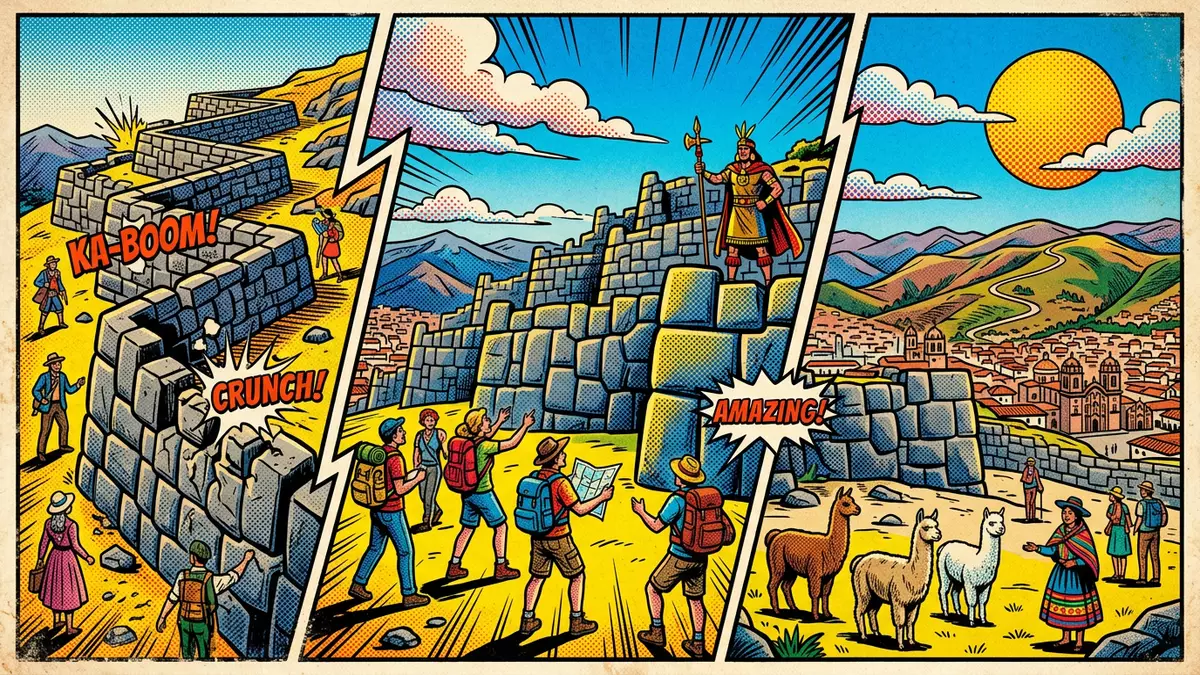
On the hillside immediately north of Cusco, Sacsayhuaman spreads across the slope as a monumental Inca complex where vast zigzag limestone walls dominate the view of the city below. Built in the fifteenth century during the reign of Pachacuti Inca Yupanqui, it forms part of the historic centre of Cusco, recognised as a UNESCO World Heritage Site alongside the former imperial capital.fifteenth century fortress
Zigzag walls and cyclopean stonework
The lower terraces of Sacsayhuaman are defined by three long zigzag walls built from massive limestone blocks fitted together without mortar, creating a stepped outline when seen from above Cusco.fortress-temple complex Many individual stones rise higher than a person and weigh many tonnes, yet their joints are cut so precisely that blades struggle to find gaps between them.zigzagging limestone walls
Above the great walls lie open grassy areas and raised platforms that give clear views over the roofs, churches and streets of Cusco, setting the intricate stonework against the urban grid of the former Inca and later Spanish city.northern outskirts of Cusco The complex sits at around 3,700 m (12,140 ft) above sea level, which adds altitude to the sense of scale as the terraces step down the hillside towards the valley.above Cusco at 3,700 m
An Inca hilltop citadel above the former capital
Sacsayhuaman stands on a hill about 2 km north of Cusco’s Plaza de Armas, forming the head of the puma-shaped layout that Inca planners gave to the city when it served as the capital of the Tawantinsuyu empire.walled complex above Cusco Construction began under Pachacuti in the fifteenth century and continued under his successors into the early sixteenth century, using labour drawn from across the highland regions incorporated into the empire.constructed during Pachacuti's reign
The site’s Quechua name is rendered in several forms, including Saqsaywaman and Saksayhuaman, and incorporates a reference to a falcon or eagle that links the hilltop location with Andean symbolism.Saksaywaman forms of the name Within Peru it is managed as the Parque Arqueológico Nacional de Saqsaywaman, and together with Cusco it anchors a wider landscape of Inca and colonial monuments that mark the transition from imperial centre to regional city.part of Cusco World Heritage Site
Ceremonial spaces and views over the Andean landscape
Behind the outer defences, Sacsayhuaman contains broad ceremonial spaces and raised areas that have been used for ritual performances based on Inca traditions, underscoring the enduring role of the complex in regional cultural life.reenactments of Inca ceremonies Walking across the grass and stone between the terraces gives alternating perspectives towards Cusco’s historic centre and outwards to the surrounding Andean peaks that frame the basin.
The topography of the hill means that approaches from the city climb steadily, first through streets of houses and small plazas and then into the archaeological park where the stonework takes over from masonry and rendered walls.archaeological site north of the centre The mixture of terraced platforms, sloping ground and large carved rocks creates varied walking surfaces and vantage points, making the complex feel like an inhabited piece of landscape rather than a single enclosed structure.
Visiting Sacsayhuaman: what travellers from Western Europe should know
- Sacsayhuaman lies on a hill north of Cusco’s Plaza de Armas and can be reached on foot from the centre or by road in vehicles and organised tours.
- The complex stands at around 3,700 m (12,140 ft) above sea level and includes sloping paths, grass terraces and stone steps, so walking involves gradients and uneven surfaces at high altitude.
- The official language is Spanish and the currency is the Peruvian sol.
- Entry requirements depend on your nationality; UK travellers can check the FCDO travel advice at gov.uk/foreign-travel-advice, Irish travellers the Department of Foreign Affairs at ireland.ie.
Searching for Sacsayhuaman on social platforms
These links open searches for Sacsayhuaman on each platform.Frequently asked questions about Sacsayhuaman
Where is Sacsayhuaman located?
Sacsayhuaman is on a hill about 2 km north of the historic centre of Cusco in southern Peru, overlooking the city from the northern outskirts.
What should visitors expect on a visit?
Visitors encounter extensive stone terraces, large limestone blocks, open grassy areas and panoramic views over Cusco, reached by sloping paths and steps at high altitude.
What makes Sacsayhuaman distinctive compared with other Inca sites?
The site is distinctive for its three long zigzag limestone walls built from exceptionally large, precisely fitted stones that form a striking terraced outline above the former imperial capital.


