
Saint Catherine's Monastery and its granite walls
Published on 09/22/2026 at 21:09 | Editorial responsibility: Rafael Müller, Editor-in-Chief AD HOC NEWS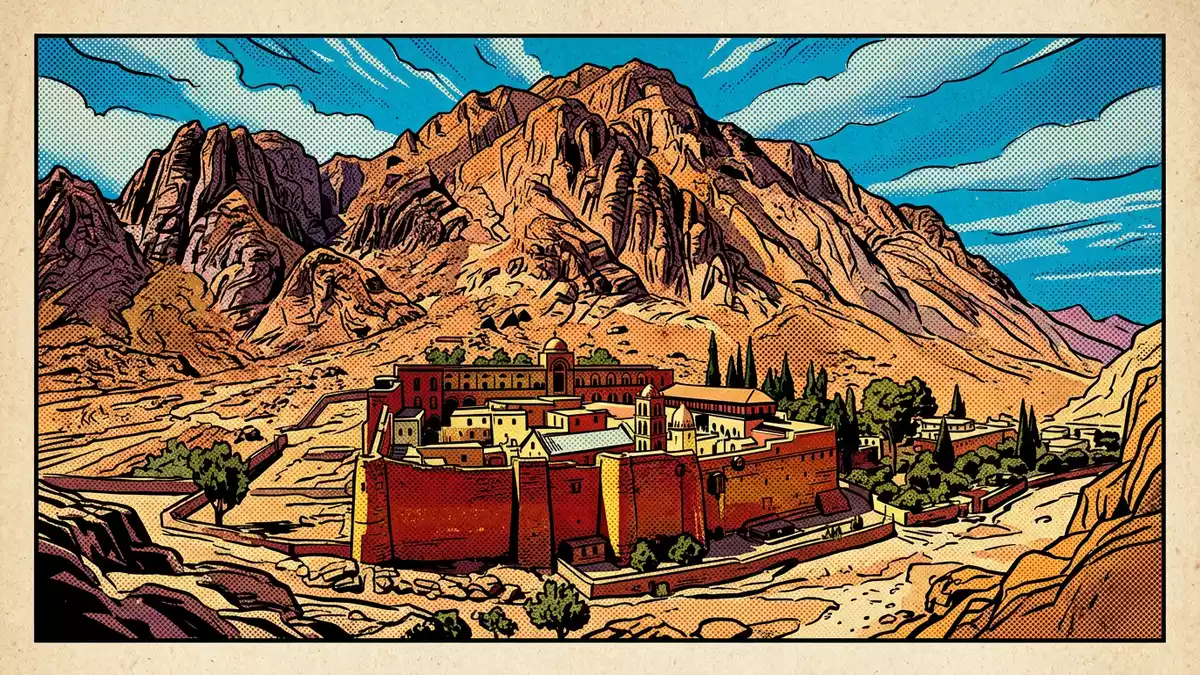
Saint Catherine's Monastery stands in a narrow valley among the granite mountains of Egypt's southern Sinai Peninsula. Its fortified walls, built in the sixth century under Byzantine Emperor Justinian I, enclose a living Greek Orthodox monastery beside the traditional site of the Burning Bush.
Granite walls beneath Mount Sinai
The monastery occupies a mountain setting near Saint Catherine, in South Sinai Governorate. Mount Sinai rises nearby, while Mount Catherine and the valley of Wadi al-Raha form part of the surrounding landscape.
The enclosure has the character of a fortress, with high stone walls and a compact interior. Within it are the Church of the Transfiguration, chapels, monastic quarters, a refectory, an olive press, ossuaries and a Fatimid mosque dating from the twelfth century. The sixth-century monastery belongs to the early Byzantine world.
Justinian's monastery and the Burning Bush
Construction took place between 548 and 565 AD, during the reign of Justinian I. The monastery's central church is dedicated to the Transfiguration of Christ the Saviour and contains chapels within the larger complex.
The site is associated with the biblical account of Moses and the Burning Bush. The Chapel of the Burning Bush occupies a place within the enclosure, while the monastery's name refers to Saint Catherine of Alexandria, whose relics are kept there. The complex of churches and chapels records the religious history of the site in its buildings.
Manuscripts, icons and a living monastery
Saint Catherine's Monastery holds a major collection of manuscripts, religious books, icons and other works of Christian art. Its library preserves texts in several languages, reflecting the eastern Mediterranean world around Sinai.
Monastic life has continued at the site since the sixth century. The monastery and its surrounding area entered the UNESCO World Heritage List in 2002, with recognition covering architecture, manuscripts, artistic treasures and the relationship between the settlement and its rugged landscape. The World Heritage inscription also records the site's importance in the history of Christian monasticism.
Visiting Saint Catherine's Monastery: what travellers from Western Europe should know
- Saint Catherine's Monastery lies near the town of Saint Catherine in South Sinai, Egypt. Road approaches connect the mountain settlement with Sharm El-Sheikh, Dahab and other Sinai towns.
- The monastery stands at roughly 1,570 metres above sea level, in a valley surrounded by steep desert mountains. The approach includes rocky ground and mountain roads.
- The surrounding area includes Mount Sinai and Mount Catherine, with walking routes extending into high granite terrain.
- The official language is Arabic and the currency is the Egyptian pound.
- Entry requirements depend on your nationality; UK travellers can check the FCDO travel advice at gov.uk/foreign-travel-advice, Irish travellers the Department of Foreign Affairs at ireland.ie.
- Conditions on the mountain change with the seasons; the local cable-car operators and alpine clubs provide information.
Searching for Saint Catherine's Monastery on social platforms
These links open searches for Saint Catherine's Monastery on each platform.Frequently asked questions about Saint Catherine's Monastery
Where is Saint Catherine's Monastery?
It stands near Saint Catherine in Egypt's South Sinai Governorate, in a mountain valley near Mount Sinai and Mount Catherine.
What can visitors expect at the monastery?
The complex contains a Byzantine church, chapels, monastic buildings, a mosque, the Chapel of the Burning Bush and collections of manuscripts and icons.
What makes Saint Catherine's Monastery distinctive?
Its sixth-century Byzantine architecture, continuing monastic use, manuscript collection and setting among Sinai's granite mountains belong to one protected cultural landscape.


