
Sainte-Chapelle and its medieval walls of stained glass
Published on 09/24/2026 at 12:33 | Editorial responsibility: Rafael Müller, Editor-in-Chief AD HOC NEWS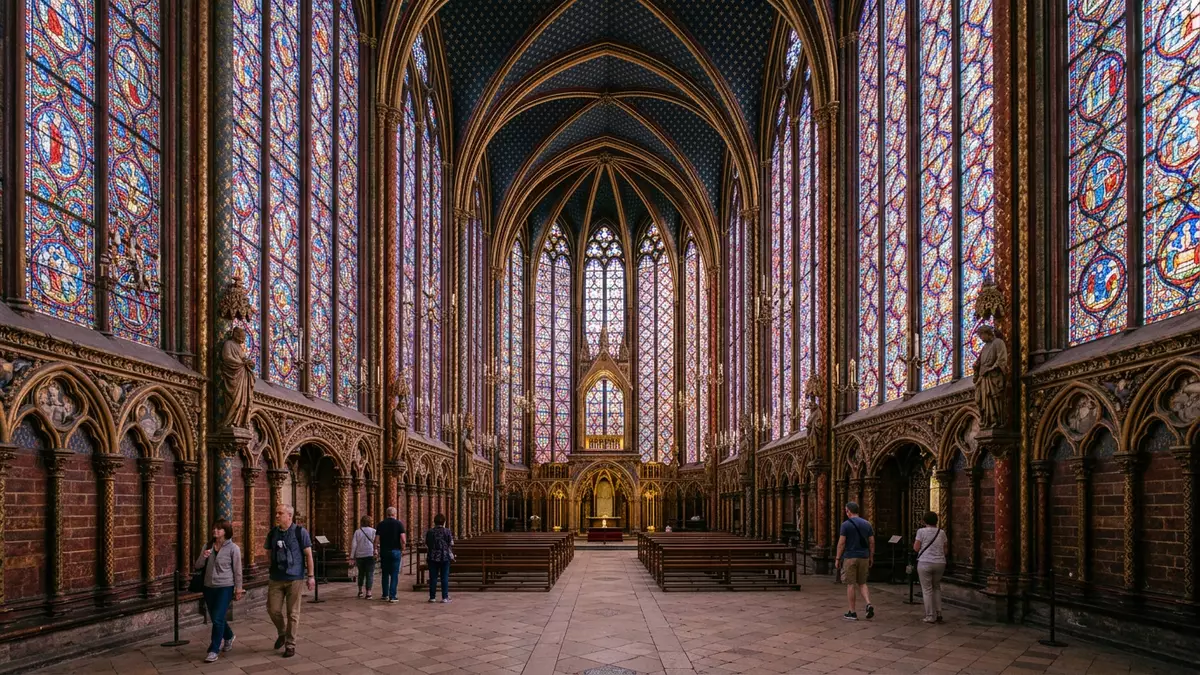
Sainte-Chapelle rises on the Île de la Cité as a Gothic chapel whose upper level is almost entirely framed by stained glass. Consecrated in 1248 under Louis IX, it formed part of the medieval Palais de la Cité and held relics associated with the Passion of Christ.
Stone tracery, painted decoration and coloured glass meet in a compact royal foundation. The chapel is not a single open hall: its lower and upper levels create two distinct spaces, with the upper chapel carrying the strongest visual impact.
Sainte-Chapelle: a royal chapel in two levels
Louis IX commissioned Sainte-Chapelle in the thirteenth century within the royal residence on the Île de la Cité. The chapel was consecrated in 1248, and its original function joined worship, dynastic ceremony and the display of sacred relics.
The lower chapel was associated with the household of the royal palace. Its ceiling, columns and painted surfaces form a more enclosed architectural setting. A narrow vertical relationship connects this lower space with the upper chapel above, where the windows dominate the walls.
The upper chapel housed the Crown of Thorns and a fragment of the True Cross among other Passion relics. The building’s religious purpose is inseparable from its architectural language, which belongs to the Rayonnant phase of French Gothic design.
The upper chapel and its stained-glass stories
The upper chapel contains fifteen tall stained-glass windows with 1,113 panels. Their scenes move through biblical history, from the Old Testament and the life of Christ towards the arrival of the relics in Paris during the thirteenth century. This history of the windows remains legible as a sequence of images set within the architecture.
Thin stone divisions separate the glass fields, while painted details identify figures, gestures and episodes. The window programme turns the upper chapel into a visual account of sacred history, read across a continuous architectural enclosure.
A later rose window occupies the western end of the upper chapel. Its tracery and coloured glass add a different pattern to the tall vertical windows along the sides and apse.
Rayonnant Gothic in stone, colour and light
Sainte-Chapelle is a major example of Rayonnant Gothic architecture. The style is visible in the emphasis on height, delicate tracery, pointed arches and large glazed surfaces. A Rayonnant Gothic chapel is described through its structural and decorative treatment, not through a plain stone exterior alone.
The interior combines painted masonry with sculpture and glass. Apostles appear along the upper chapel, while colour extends across the walls, vaults and architectural details. The result is a space where the boundary between building and image becomes difficult to separate at a glance.
The chapel also carries the marks of changing history. Damage during the French Revolution was followed by nineteenth-century restoration, which returned the building to a coherent medieval appearance while preserving its later historical layers.
Its setting strengthens the connection between architecture and Parisian history. Sainte-Chapelle belongs to the former royal complex on the Île de la Cité, close to the Conciergerie and the present Palais de Justice. The chapel therefore stands within a small area where medieval royal, judicial and religious histories remain visible together.
Visiting Sainte-Chapelle: what travellers from Western Europe should know
- Sainte-Chapelle stands at 10 Boulevard du Palais on the Île de la Cité in central Paris. Metro, RER, bus and walking routes connect the island with the surrounding city.
- The visit includes two architectural levels. The lower chapel has a low, enclosed character, while the upper chapel is reached by stairs.
- The upper chapel contains fifteen stained-glass windows and a western rose window. The window panels depict biblical scenes rather than a single decorative pattern.
- The official language is French and the currency is the euro.
Searching for Sainte-Chapelle on social platforms
These links open searches for Sainte-Chapelle on each platform.
Frequently asked questions about Sainte-Chapelle
Where is Sainte-Chapelle?
Sainte-Chapelle is on the Île de la Cité in central Paris, within the historic Palais de la Cité complex. Its address is 10 Boulevard du Palais.
What can visitors expect inside?
The visit includes a lower chapel and an upper chapel reached by stairs. The upper level contains tall stained-glass windows, painted decoration, sculpture and a rose window.
What makes Sainte-Chapelle distinctive?
Its defining feature is the concentration of thirteenth-century stained glass within a royal Gothic chapel. The 1,113 panels combine biblical storytelling with the structure of the upper level.


