
San Pedro de Atacama, an adobe oasis in Chile’s high desert
Published on 09/21/2026 at 13:19 | Editorial responsibility: Rafael Müller, Editor-in-Chief AD HOC NEWS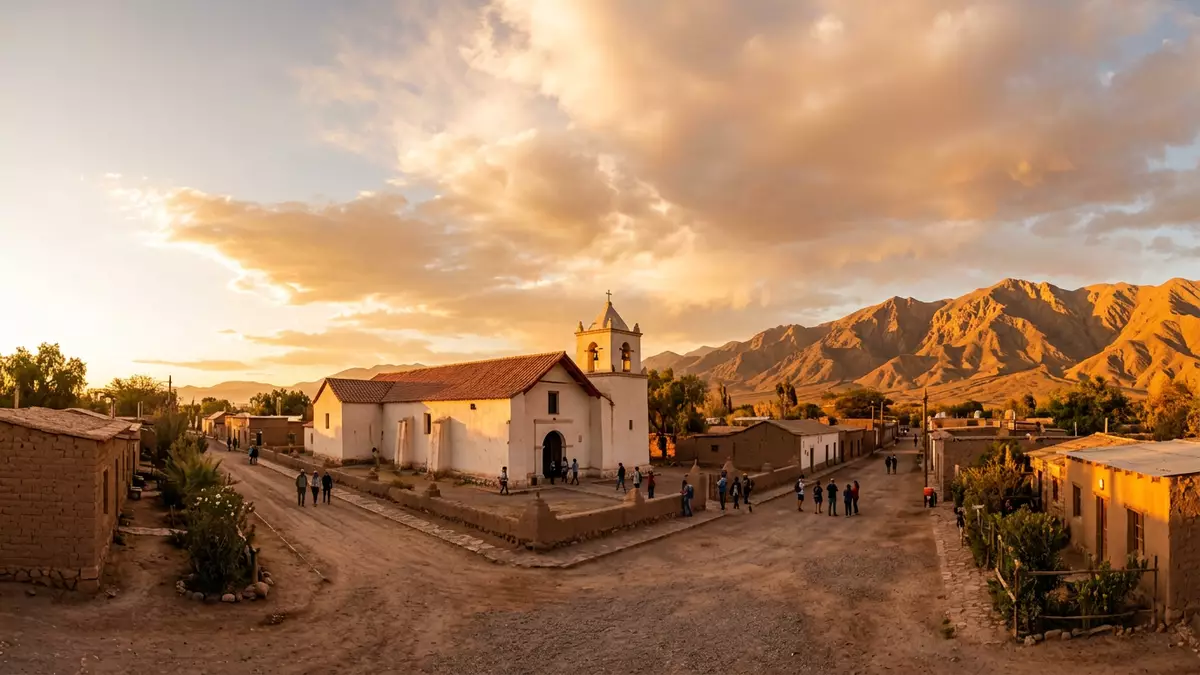
San Pedro de Atacama is a small adobe town in northern Chile, set on a high plateau of the Atacama Desert and framed by distant volcanoes and salt flats. The settlement forms part of El Loa Province in the Antofagasta Region and stands at around 2,400 m (7,874 ft) above sea level, giving travellers from Western Europe an early taste of Andean altitude within a compact desert oasis.
An oasis town of mud-brick streets and Andean horizons
San Pedro de Atacama lies in a broad valley between the Andes to the east and the Chilean Coastal Range to the west, where the desert floor is broken by a cluster of irrigated fields and low, earthen buildings. The town serves as the centre of a commune whose territory stretches far out into the surrounding plateau, covering thousands of square kilometres of high desert.San Pedro de Atacama is a Chilean town The streets close to the central square are lined with single-storey adobe houses, many with whitewashed walls and timber lintels that echo older Atacameño building traditions.
The town developed beside a small oasis fed by streams descending from the Andes, which supported agriculture long before Spanish colonial rule. San Pedro de Atacama stands at more than 2,400 m (7,874 ft), which means the light is sharp, the air is thin and the surrounding peaks dominate the skyline.The plateau setting in northern Chile Licancabur volcano rises on the horizon to the east, its cone forming a constant reference point as streets and tracks lead out towards the desert.
From oasis fields to salt valleys and lunar ridges
Beyond the last irrigation channels and crops, the land around San Pedro de Atacama gives way to salt flats, dune fields and ridges of hardened sediment shaped by wind and evaporation. One of the most easily reached landscapes is Valle de la Luna, or Valley of the Moon, inside the Cordillera de la Sal to the west of town.Valle de la Luna lies about 13 kilometres west of San Pedro Its basin of salt, gypsum and clay forms a maze of ridges, gullies and dry basins that resemble a stone sea frozen in motion.The valley sits inside the Los Flamencos National Reserve
The valley floor alternates between pale salt crusts and darker rock, while dunes rise along some of the approaches and viewpoints. From higher ridgelines, travellers can look back across the Cordillera de la Sal towards San Pedro de Atacama, seeing the oasis as a green patch amid a broad expanse of arid terrain. The same road that leads towards Valle de la Luna continues on towards Calama, linking the town’s adobe streets with the wider network of desert roads and high passes across northern Chile.
Desert archaeology, clear skies and high-altitude fields
San Pedro de Atacama has long served as a cultural centre for the Atacameño people and is noted in Chile as an archaeological hub, with finds from the surrounding valleys and plateaus displayed in local collections.The town is described as an archaeological capital Pottery, tools and textile fragments recovered from nearby sites help trace life in the desert over many centuries, where irrigation channels and terraced plots made cultivation possible in an otherwise dry landscape.San Pedro is identified as a centre of Atacama culture
The wider commune encompasses high-altitude wetlands, salt lakes and geothermal fields that form a ring of excursions around the town, including the Geysers del Tatio in the Andes and sections of the Salar de Atacama. Many of these areas sit well above the elevation of San Pedro de Atacama, with some geothermal fields reaching over 4,000 m (13,123 ft), so journeys out from the oasis bring shifts in altitude as well as landscape.The Geysers del Tatio lie in the Andes northeast of town Nights on the plateau are known for clear, dry air and open skies, which has drawn observatories and star-focused excursions to the region alongside more traditional desert journeys.
Visiting San Pedro de Atacama: what travellers from Western Europe should know
- San Pedro de Atacama stands in the Antofagasta Region of northern Chile and is reached overland from the city of Calama, whose airport El Loa connects the desert with other parts of the country.
- The town sits at roughly 2,400 m (7,874 ft) above sea level on a high plateau, so walking between streets, viewpoints and nearby fields involves gentle gradients at altitude rather than long climbs.
- Tracks and roads leading towards Valle de la Luna and the Cordillera de la Sal cross areas of loose sand and rock, and viewpoints in these landscapes may involve short walks over uneven desert terrain.
- In the wider commune, routes towards salt lakes and geothermal fields gain further height, and some excursions reach elevations above 4,000 m (13,123 ft) in the Andes northeast of town.
- The official language is Spanish and the currency is the Chilean peso. Entry requirements depend on your nationality; UK travellers can check the FCDO travel advice at gov.uk/foreign-travel-advice, Irish travellers the Department of Foreign Affairs at ireland.ie.
Searching for San Pedro de Atacama on social platforms
These links open searches for San Pedro de Atacama on each platform.
Frequently asked questions about San Pedro de Atacama
Where is San Pedro de Atacama?
San Pedro de Atacama is a high-desert town in northern Chile, in El Loa Province of the Antofagasta Region, east of the coastal city of Antofagasta.
What should travellers expect on a visit?
Travellers encounter an adobe-built oasis at around 2,400 m (7,874 ft), with views towards Andean volcanoes, access to salt flats and valleys, and clear desert skies after dark.
What makes San Pedro de Atacama distinctive?
The combination of Atacameño cultural heritage, surrounding landscapes such as Valle de la Luna and nearby geothermal fields, and the plateau’s altitude gives the town a character tied closely to its desert setting.


