
Santuario de Las Lajas: a neo-Gothic basilica over a Colombian gorge
Published on 09/18/2026 at 15:52 | Editorial responsibility: Rafael Müller, Editor-in-Chief AD HOC NEWS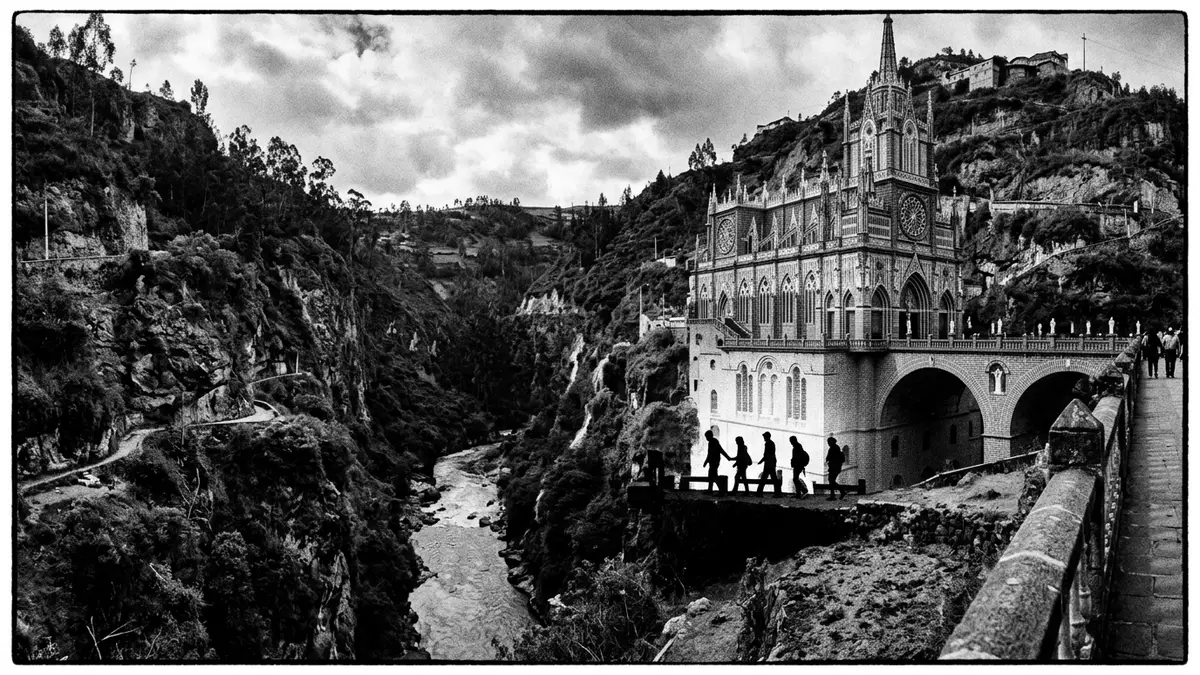
High above the Guáitara River near Ipiales in southern Colombia, Santuario de Las Lajas stretches out across a canyon on a high stone bridge, its neo-Gothic basilica appearing to rise from the gorge itself. Built in the twentieth century in ashlar masonry, the sanctuary links the rocky sides of the ravine with a single structure that combines church, bridge and plaza.
A basilica carried on a bridge through the Guáitara canyon
Santuario de Las Lajas stands within the canyon of the Guáitara River in the Nariño department, in Colombia’s far south close to the frontier with Ecuador, where the river has cut a deep ravine into the Andean foothills.stands within the canyon The basilica rises from a multi-storey stone bridge that spans the river, so that the main nave stands well above the water while buttresses and arches descend to the canyon floor.multi-storey stone bridge that spans the river
From the base at the bottom of the canyon to the top of the tallest tower, the sanctuary reaches a height of about 100 m (330 ft), so that the vertical space of the gorge becomes part of the experience of standing at the church.height of about 100 m (330 ft) The bridge itself forms an open platform in front of the façade, creating a plaza suspended above the river where visitors can look back towards the canyon walls and down towards the water.
Neo-Gothic stone architecture on an Andean pilgrimage site
The present basilica at Santuario de Las Lajas is a grey and white stone church built in a Gothic Revival, or neo-Gothic, style, drawing on fourteenth century European Gothic forms such as pointed arches, traceried windows and slender towers.constructed between 1916 and 1949 in a Gothic Revival style It is composed of three naves arranged in a basilica plan, carried on a bridge of stone arches that anchors the church to both sides of the canyon.three naves constructed over a bridge of two arches
Work on the current church took place between 1916 and 1949, bringing together Colombian and Ecuadorian designers; Ecuadorian engineer J. Gualberto Pérez and architect Lucindo Espinosa are recorded among the figures responsible for the project.neo-Gothic church built under the direction of J. Gualberto Pérez and Lucindo Espinosa The stone construction uses ashlar masonry, giving the façades a regular pattern of blocks that emphasises vertical lines, pinnacles and the rhythm of the buttresses along the canyon edge.ashlar masonry stone
From eighteenth century shrine to twentieth century basilica
Las Lajas is a Marian shrine dedicated to the Virgin Mary under the title of Our Lady of the Rosary of Las Lajas, and its religious significance is tied to an image on the rock wall of the canyon that pilgrims have visited since the eighteenth century.Our Lady of the Rosary of Las Lajas In 1754, Friar Gabriel Villafuerte built an early shrine at the site to house this image, starting a sequence of structures that would eventually lead to the present basilica.shrine built in 1754 by Friar Gabriel Villafuerte
Over generations, several small chapels and shrines occupied the rocky ledge above the river, gradually expanding as the pilgrimage grew before construction of the large stone basilica in the early twentieth century.several stages of construction over nearly two centuries The current church formalises this long devotional history in a single building, integrating the cliff face bearing the image into its interior so that the canyon wall forms part of the sanctuary itself.stone basilica constructed between 1916 and 1949
Visiting Santuario de Las Lajas: what travellers from Western Europe should know
- Santuario de Las Lajas lies south of Ipiales in the Nariño department of Colombia, within a canyon of the Guáitara River near the border with Ecuador. The site is approached by mountain roads that follow the river valley and the surrounding Andean terrain.
- The sanctuary occupies steep canyon terrain, with stairways and sloping paths connecting the bridge plaza, the riverside level and the approaches on the cliffs. Visiting involves climbing and descending stone steps between different levels.
- Spanish is the official language in Colombia and the currency is the Colombian peso.
- Entry requirements depend on your nationality; UK travellers can check the FCDO travel advice at gov.uk/foreign-travel-advice, Irish travellers the Department of Foreign Affairs at ireland.ie.
Searching for Santuario de Las Lajas on social platforms
These links open searches for Santuario de Las Lajas on each platform.
Frequently asked questions about Santuario de Las Lajas
Where is Santuario de Las Lajas located?
Santuario de Las Lajas is in the canyon of the Guáitara River near Ipiales in the Nariño department of southern Colombia, close to the border with Ecuador.
What should visitors expect at the sanctuary?
Visitors encounter a neo-Gothic stone basilica carried on a high bridge above the river, with stairways and terraces that link the church, the canyon floor and the surrounding slopes.
What makes Santuario de Las Lajas distinctive?
The sanctuary combines a twentieth century neo-Gothic basilica, built between 1916 and 1949, with the dramatic topography of an Andean gorge and a long-standing Marian pilgrimage focused on an image on the canyon wall.


