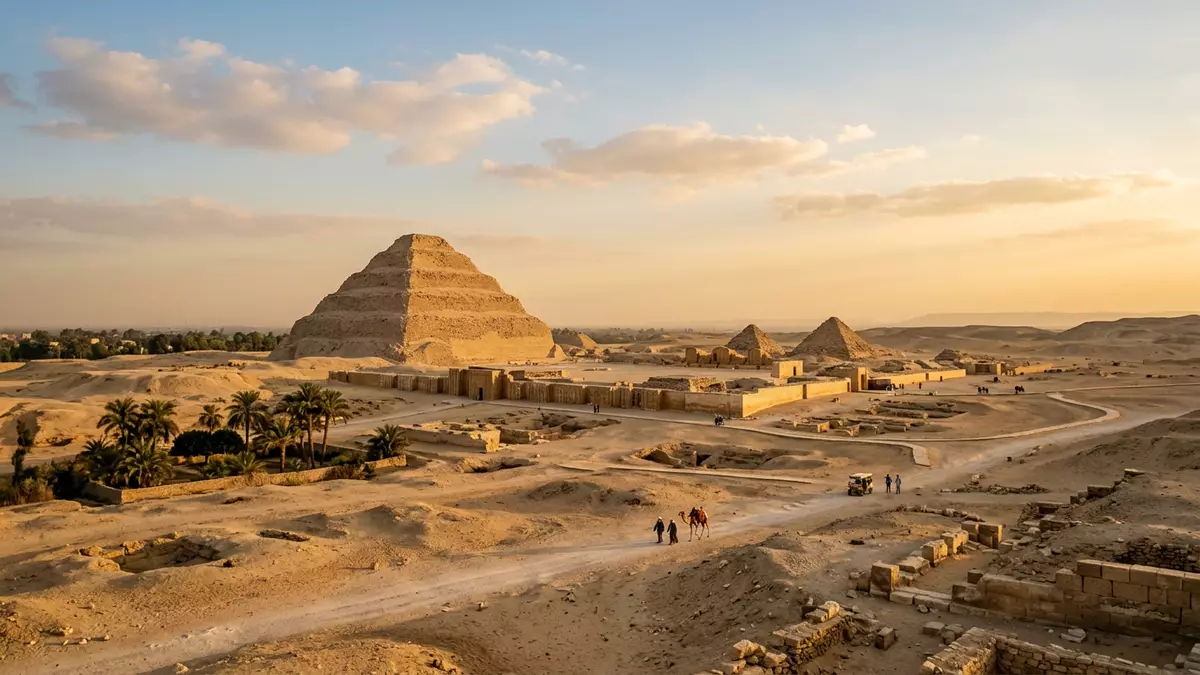
Saqqara’s stepped stone horizons on the edge of Memphis
Published on 08/12/2026 at 14:30 | Editorial responsibility: Rafael Müller, Editor-in-Chief AD HOC NEWS
On the desert edge south of Gizeh, Saqqara stretches along a limestone plateau where pyramids and flat-topped tombs rise like a second, man?made horizon. For more than four millennia this necropolis served Memphis, the ancient capital of Egypt, giving Saqqara a density of monuments that reads like a stone timeline of pharaonic history.
From village to desert plateau of pyramids
Saqqara takes its name from a village in the Giza Governorate, west of the Nile and south of Cairo, where the cultivated land gives way to desert and the plateau begins.The site forms the main necropolis of ancient Memphis and runs along the desert margin with cultivated fields below and open sand above.It extends for several kilometres between Abusir and Dahshur so a visit involves moving between separate clusters of tombs rather than a single compact complex.
The burial ground developed from the earliest dynasties of unified Egypt and remained in use through the Old Kingdom, New Kingdom and Late Period. Kings, high officials and sacred animals were buried at different sectors of the plateau, so reliefs, burial shafts and chapels from very different centuries now stand within walking distance of one another. Sand and low boundary walls separate the zones, yet the same desert light and pale stone bind them into one continuous landscape.
The Step Pyramid of Djoser: stacked stone and deep courts
At the centre of most itineraries stands the Step Pyramid of Djoser, rising in six receding layers from a broad base on the northern part of the plateau.Built in the twenty?seventh century BC for the Third Dynasty king Djoser and attributed to his architect Imhotep, it is widely recognised as Egypt’s earliest large?scale stone pyramid.The structure reaches about 60 m (around 200 ft) in height and dominates its walled precinct which contains chapels, courtyards and dummy shrines carved from limestone.
The surrounding complex reveals how radically this monument departed from earlier royal tombs. Instead of a single low mastaba, Djoser’s enclosure gathers colonnaded passageways, ceremonial courts and façades carved with projecting columns. Many elements are stone translations of earlier timber and mud?brick architecture, so details such as bundled?reed capitals and paneled walls appear here in durable limestone. From the entrance colonnade the stepped profile of the pyramid forms a constant backdrop above enclosure walls and doorways, turning every movement across the courts into a series of changing alignments with the tiers of stone.
Mastabas, later pyramids and underground realms
Beyond Djoser’s enclosure, Saqqara preserves a wide range of royal and elite tombs, many of them in the form of mastabas with sloping sides and flat roofs. Inside these low structures, painted reliefs and carved statues record banquet scenes, Nile landscapes and offering rituals, giving a close view of Old Kingdom artistic conventions. In several areas, shafts cut deep into the bedrock lead to burial chambers lined with decorated stone blocks, while chapels nearer the surface take light from small openings and carved doorways.
Saqqara also contains later pyramids that extend the Memphis story beyond the Third Dynasty. The pyramid of Teti from the Sixth Dynasty and the slightly earlier pyramid of Unas stand on different parts of the plateau, their cores eroded but their surrounding temple remains and causeways still traceable.The pyramid of Unas is known as the first to carry pyramid texts carved on the walls of its burial chambers which marked a turning point in inscribed royal funerary rituals. Separate from the royal areas, the so?called Serapeum lies in long underground corridors where massive stone sarcophagi once held sacred Apis bulls, illustrating the importance of Memphis as a cult centre in the Late Period.
Saqqara in the wider Memphis landscape
Seen on a map, Saqqara forms part of a chain of cemeteries that served Memphis, with Gizeh and Abusir to the north and Dahshur to the south along the same desert edge.Archaeologists trace continuous burial activity here for around 5,000 years of Egyptian history which makes the plateau valuable for understanding how royal and private tomb design changed between early mastabas and later rock?cut shafts. The skyline links of pyramids and the alignment with the Nile illustrate how the necropolis related to the fertile floodplain and the city of Memphis on lower ground.
Saqqara forms part of the Memphis and its Necropolis listing on the UNESCO World Heritage List, a designation that covers the stretch of desert cemeteries along this section of the Nile valley.This status recognises the combined importance of the pyramids, mastabas, decorated tombs and cult complexes rather than a single monument. For travellers based in Western Europe, Saqqara offers a complementary view to the Gizeh pyramids: the focus here lies less on one skyline and more on the layered sequence of tomb types, inscriptions and architectural experiments spread across the desert terrace.
Visiting Saqqara: what travellers from Western Europe should know
- Saqqara lies south of Gizeh on the west bank of the Nile, with most visitors travelling by road from Cairo or combining it with other Memphis?area sites.
- The archaeological zones sit on a desert plateau, so walking between complexes involves sandy paths, uneven stone underfoot and some low steps in temple and tomb areas.
- Several tombs and pyramid complexes include interior chambers reached by sloping passages or stairs, some of them confined and cut into the rock, which require secure footing.
- The official language is Arabic and the currency is the Egyptian pound. Entry requirements depend on your nationality; UK travellers can check the FCDO travel advice at gov.uk/foreign-travel-advice, Irish travellers the Department of Foreign Affairs at ireland.ie.
Searching for Saqqara on social platforms
These links open searches for Saqqara on each platform.
Frequently asked questions about Saqqara
Where is Saqqara in relation to Gizeh and Cairo?
Saqqara lies on the west bank of the Nile south of Gizeh, on the desert plateau roughly south of central Cairo in the governorate of Giza.
What should visitors expect when exploring Saqqara?
Visitors encounter a spread?out archaeological landscape with pyramids, mastaba tombs and desert paths, including some interior corridors and burial chambers reached by stairs or sloping passages.
What makes Saqqara distinctive among Egypt’s ancient sites?
Saqqara combines the Step Pyramid of Djoser, later royal pyramids, decorated mastabas and underground complexes, tracing Egyptian funerary architecture from the early dynasties through much later periods.