
Sassi di Matera and the carved landscape of Basilicata
Published on 08/25/2026 at 18:44 | Editorial responsibility: Rafael Müller, Editor-in-Chief AD HOC NEWS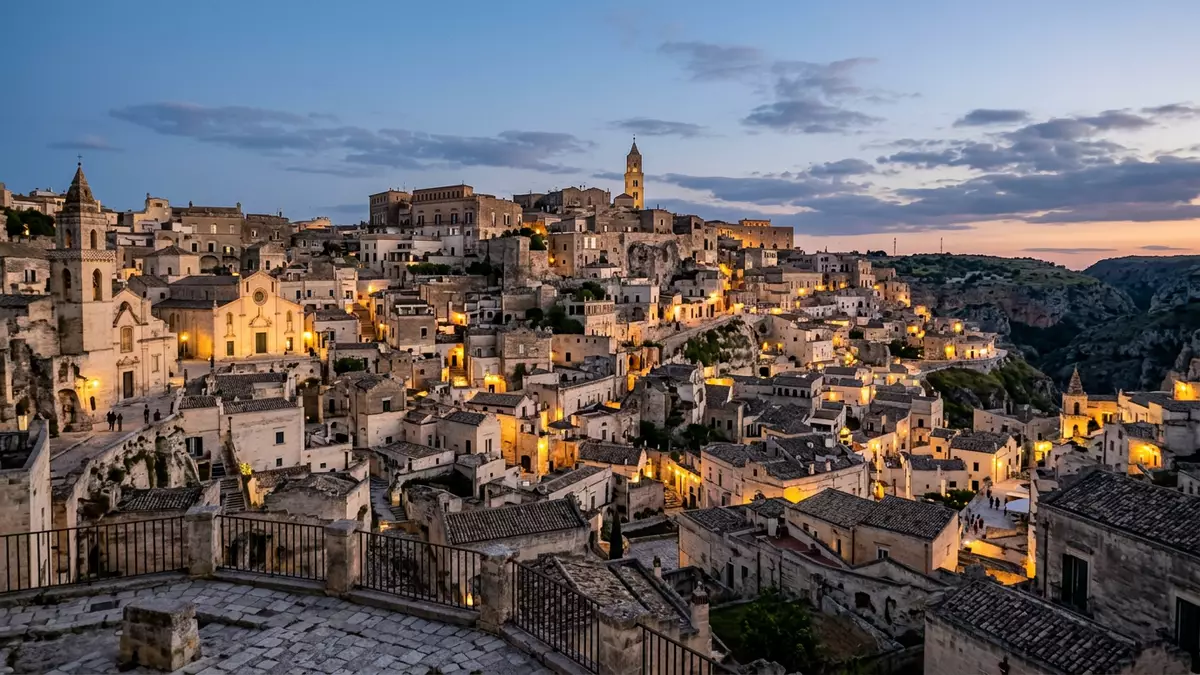
Sassi di Matera is the rock-cut quarter that gives Matera its strongest profile, with dwellings, churches and passages carved into limestone. The World Heritage property, The Sassi and the Park of the Rupestrian Churches of Matera, was inscribed in 1993 and stretches across the southern Italian region of Basilicata.World Heritage propertyinscribed in 1993
Rock-cut districts above the ravine
The Sassi are the ancient districts of Matera, organised around Sasso Caveoso and Sasso Barisano. Their caves, façades and stairways sit beside the Gravina ravine, and the historic centre also includes the Civita and later urban layers.Sasso Caveoso and Sasso Barisano
The site combines houses, churches, monasteries and hermitages. Many of them were cut into the natural caves of the Murgia, a calcareous plateau marked by fissures, rocks and ravines.natural caves of the Murgia
From Palaeolithic settlement to historic city
The first inhabited zone dates from the Palaeolithic, and occupation continued through later periods in a way that gives the place exceptional depth. The settlement also contains significant medieval fabric, including a Romanesque cathedral built on the Civita in the thirteenth century.first inhabited zonethirteenth century
The World Heritage listing recognises the Sassi as an outstanding example of a troglodyte settlement in the Mediterranean region. It also identifies the place as a landscape that records several significant stages in human history.outstanding example
Matera’s cave quarter and its living fabric
The historic districts include deep-cut lanes, entrances opened into the rock and houses built with excavated stone blocks. In many places, the built front sits above caves and terraces below, giving the quarter a layered appearance that can be read from street to cliff.excavated stone blocks
The setting is part of the attraction for travellers interested in rock-cut architecture and southern Italian urban history. Matera’s Sassi connect the scale of a city with the form of a cave settlement, and that combination remains visible in the fabric itself.
Visiting Sassi di Matera: what travellers from Western Europe should know
- The Sassi lie in Matera, in Basilicata, in southern Italy. Rail travellers usually reach Matera by changing from national lines to local services at Altamura or Ferrandina, then continuing into the city.
- The quarter sits on steep ground above the Gravina ravine. Expect stairways, uneven stone surfaces and frequent changes in level between lanes, terraces and cave fronts.
- English is not an official language in Italy. The official language is Italian and the currency is the euro.
- The area combines the old cave quarters with the park of the rupestrian churches on the Murgia plateau. The two parts belong to the same World Heritage property.
Searching for Sassi di Matera on social platforms
These links open searches for Sassi di Matera on each platform.
Frequently asked questions about Sassi di Matera
Where are the Sassi di Matera?
They are in Matera, in the southern Italian region of Basilicata. The historic quarter forms part of a wider World Heritage property that includes the rupestrian churches and the Murgia plateau.
What should a visit to the Sassi involve?
Expect a landscape of stone lanes, steps and cave-front buildings. The terrain rises and falls sharply, so the setting is read by walking through it.
What makes the Sassi distinctive?
Their most striking feature is the way houses, churches and hermitages are built into the rock. The result is a city quarter that preserves long layers of settlement in one compact fabric.


