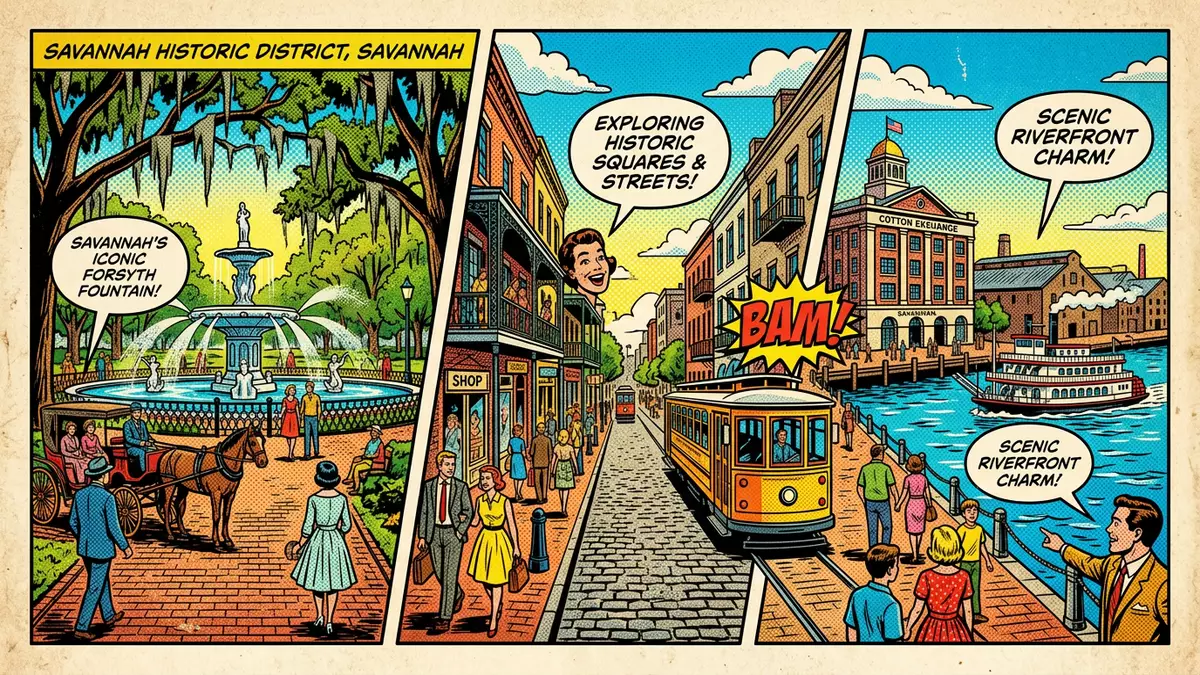
Savannah Historic District and its oak-lined streets
Published on 08/11/2026 at 15:10 | Editorial responsibility: Rafael Müller, Editor-in-Chief AD HOC NEWS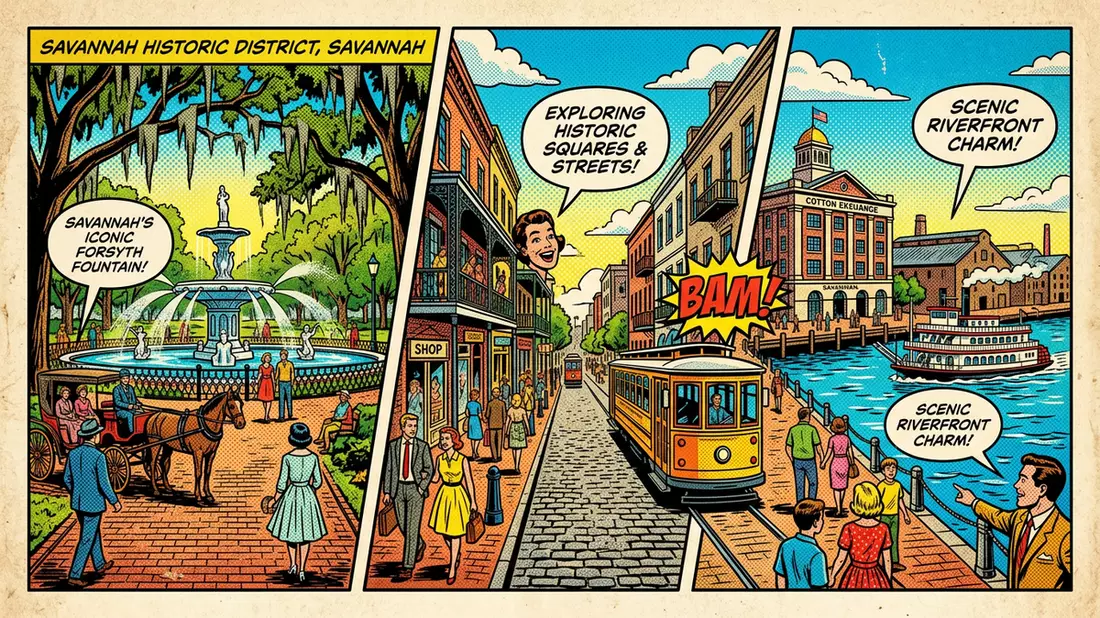
Savannah Historic District is the centrepiece of Savannah, Georgia, laid out around a grid of streets and public squares that gives the city a distinctive, ordered feel. The district contains some of the best-preserved urban fabric in the southern United States, with houses, churches and civic buildings from the 18th and 19th centuries.
Savannah’s squares and street grid
The district’s most striking feature is its sequence of squares, each opening out from the surrounding streets like small urban rooms. Oglethorpe’s 18th-century plan remains visible in the way the streets frame those spaces and keep the old city legible on foot.
Brick, stucco and painted timber recur across the district, alongside cast-iron balconies, shaded pavements and rows of live oaks. The result is a built landscape that feels cohesive without becoming uniform, because many blocks combine domestic architecture with churches, schools and public buildings.
Architecture from the colonial and antebellum city
Several layers of Savannah’s past are visible in the district’s architecture, from Georgian and Federal houses to later Greek Revival and Victorian additions. The Juliette Gordon Low Birthplace and the Owens-Thomas House are among the well-known historic properties associated with the area.
The district also reflects Savannah’s long civic life through churches, monuments and former commercial buildings. Its streets preserve a pattern that makes the old city easy to read, with each square acting as a pause between the longer north-south and east-west runs.
Walking the district as a cityscape
Savannah Historic District works as a place to walk, not only as a place to inspect individual landmarks. Distances between squares are short, and many of the most memorable views come from simple street-level movement past verandas, railings and front gardens.
Forsyth Park, at the southern edge of the district, adds a larger green space to the smaller squares. Together, the park, the squares and the surrounding streets give Savannah one of the clearest historic urban landscapes in the USA.
Visiting Savannah Historic District: what travellers from Western Europe should know
- The district is in Savannah, Georgia, and is reached by road and by air via Savannah/Hilton Head International Airport.
- Admission arrangements and opening hours are set by the site's operator and change with the season; the official website is the only binding source.
- Spring and autumn suit long walks through the squares, while summer brings stronger sun and heavier humidity.
- The district is flat in many places, but pavements, kerbs and older steps can make some routes uneven.
- English is the main language, and card payments are widely accepted in shops, museums and cafés.
- Entry requirements depend on your nationality. UK travellers should check the FCDO travel advice at gov.uk/foreign-travel-advice; Irish travellers the Department of Foreign Affairs at ireland.ie; EU and EEA citizens their own national foreign ministry.
Searching for Savannah Historic District on social platforms
These links open searches for Savannah Historic District on each platform.
Frequently asked questions about Savannah Historic District
Where is Savannah Historic District?
It lies in Savannah, Georgia, in the southeastern USA. The district covers the historic core around the city’s squares and older streets.
What should visitors expect on a visit?
Expect a walkable city centre with public squares, tree cover, historic houses and several major landmarks. A full visit works best on foot.
What makes Savannah Historic District distinctive?
Its square-based street plan gives the district a clear spatial rhythm. Georgian, Federal and later 19th-century architecture make that plan read as a living historic city rather than a preserved fragment.