
Savannah Historic District’s grid of squares and moss-draped streets
Published on 08/16/2026 at 14:26 | Editorial responsibility: Rafael Müller, Editor-in-Chief AD HOC NEWS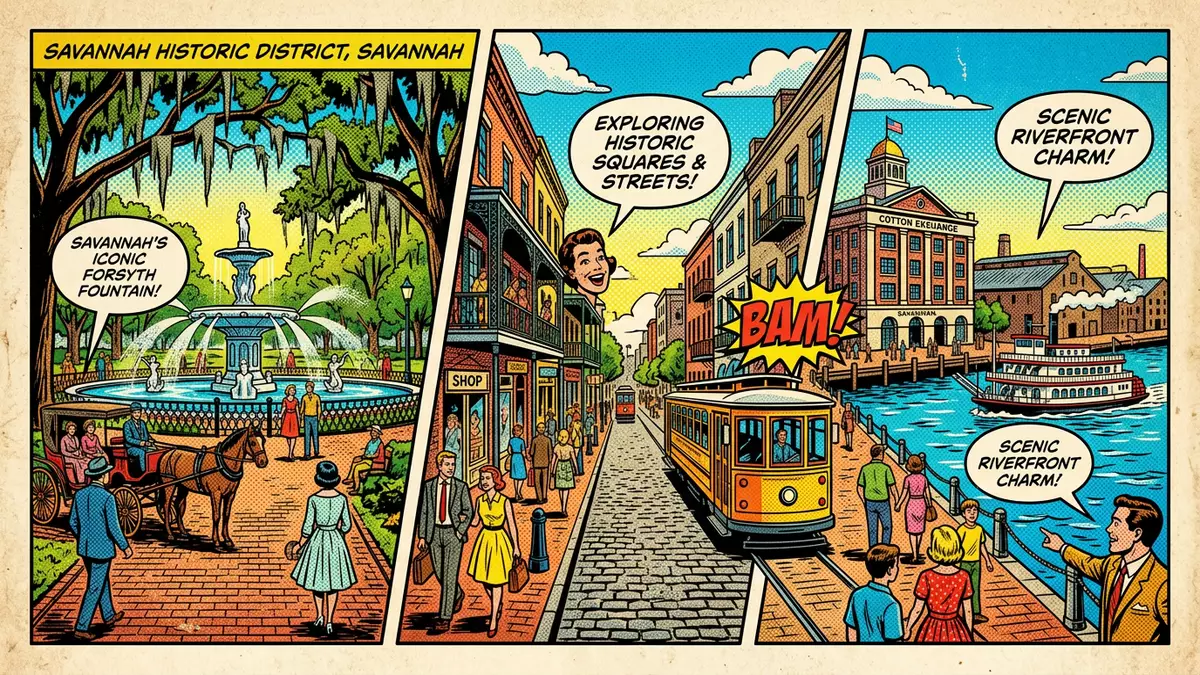
Savannah Historic District in Savannah, Georgia is a compact American city centre shaped by an eighteenth-century grid of public squares, surrounded by streets lined with historic townhouses and civic buildings. Set on bluffs above the Savannah River, it reflects the original town plan laid out in 1733 by British general James Edward Oglethorpe and forms the heart of one of the United States’ best-preserved historic urban cores.
A planned eighteenth-century town that became a landmark district
When General James Edward Oglethorpe founded Savannah in 1733 as the first colonial capital of Georgia, he organised the settlement around a repeating pattern of wards built around public squares.Savannah Town Plan Each ward combined a central green space with surrounding lots for public buildings and houses, creating a modular plan that could be extended as the city grew.first six wards Over the following century, civic leaders expanded this plan southwards from the river, adding further wards and squares as Savannah developed into a port and regional centre.
The area now known as Savannah Historic District largely follows this early plan and was formally recognised as a National Historic Landmark District in 1966 by the United States government.Savannah National Historic Landmark District The district extends from the Savannah River in the north to Gwinnett Street in the south, bounded on the east by East Broad Street and on the west by Martin Luther King Jr. Boulevard, enclosing an area of roughly one square mile within downtown Savannah.district boundaries This officially protected core preserves much of the eighteenth- and nineteenth-century street pattern and building stock, giving the historic centre a coherence that is unusual among American cities.
A grid of leafy squares, riverfront streets and residential lanes
The fabric of Savannah Historic District is defined by its squares: small urban parks set within the street grid, shaded by live oaks and edged with townhouses, churches and civic buildings.24 squares and Forsyth Park Oglethorpe’s original plan called for 24 squares; 22 survive in and around the district today, ringed by pavements and streets that visitors can cross on foot in a matter of minutes. Squares such as Chippewa, Madison and Monterey are representative, combining planting with monuments and surrounded by terraces of brick townhouses, small shops and churches.
North of these squares, streets descend towards the Savannah River and the waterfront. Here, the historic district includes riverfront lanes such as River Street, lined with former warehouses and commercial buildings that reflect the city’s trading history.riverfront warehouses Further south, the grid leads towards Forsyth Park, a large nineteenth-century park that marks the transition from the tightly built core to more open green space.Forsyth Park and River Street Across the district, the terrain is generally flat, making it straightforward to walk between squares, riverfront and park, although some streets near the river use steps and ramps to connect the higher bluff to lower levels.
Architecture, preservation and layers of American history
Architecturally, Savannah Historic District brings together houses, churches and public buildings from the eighteenth, nineteenth and early twentieth centuries, with styles ranging from Federal and Regency to Gothic Revival and Victorian.18th- and 19th-century architecture Many of these structures are built of brick or stuccoed masonry, sometimes fronted by iron balconies, stone steps and garden railings. The Cathedral Basilica of St John the Baptist, Davenport House and numerous smaller townhouses illustrate this range of styles and materials in the blocks around the squares.historic churches and houses
The district’s preservation owes much to civic efforts in the twentieth century. In 1955, local residents established the Historic Savannah Foundation after a group succeeded in saving Davenport House, an 1820 brick mansion, from demolition.Davenport House and preservation movement This organisation and allied groups went on to protect many other properties, reversing earlier losses and ensuring that the core of Savannah retained its historic streetscapes. The National Park Service recognises a period of significance extending from the mid-eighteenth century to the early twentieth century, reflecting the concentration of buildings and spaces from 1750 to 1934 within the district.periods of significance
Visiting Savannah Historic District: what travellers from Western Europe should know
- Savannah Historic District forms the central part of Savannah, Georgia, bounded roughly by the Savannah River, Gwinnett Street, East Broad Street and Martin Luther King Jr. Boulevard, and is reached by road and rail connections into the city.
- The historic centre is largely flat, with a regular street grid and squares connected by pavements; near the river, some streets and lanes incorporate sets of steps between the bluff and the lower waterfront.
- The district lies in Georgia in the south-eastern United States; the official language is English and the currency is the US dollar.
- Entry requirements depend on your nationality; UK travellers can check the FCDO travel advice at gov.uk/foreign-travel-advice, Irish travellers the Department of Foreign Affairs at ireland.ie.
Searching for Savannah Historic District on social platforms
These links open searches for Savannah Historic District on each platform.
Frequently asked questions about Savannah Historic District
Where is Savannah Historic District located?
Savannah Historic District is in downtown Savannah, Georgia, on bluffs above the Savannah River and bounded roughly by Gwinnett Street, East Broad Street and Martin Luther King Jr. Boulevard.
What should visitors expect when walking through the district?
Visitors encounter a regular grid of streets and pavements, a sequence of shaded squares framed by historic houses and churches, and routes leading between the riverfront, city market area and larger parks such as Forsyth Park.
What makes Savannah Historic District distinctive among American city centres?
Its distinction lies in the survival of Oglethorpe’s eighteenth-century ward and square plan, the density of eighteenth- and nineteenth-century architecture and its recognition as a National Historic Landmark District since 1966, forming a cohesive historic core.


