
Schloss Belvedere and its Baroque garden axis
Published on 09/23/2026 at 00:49 | Editorial responsibility: Rafael Müller, Editor-in-Chief AD HOC NEWS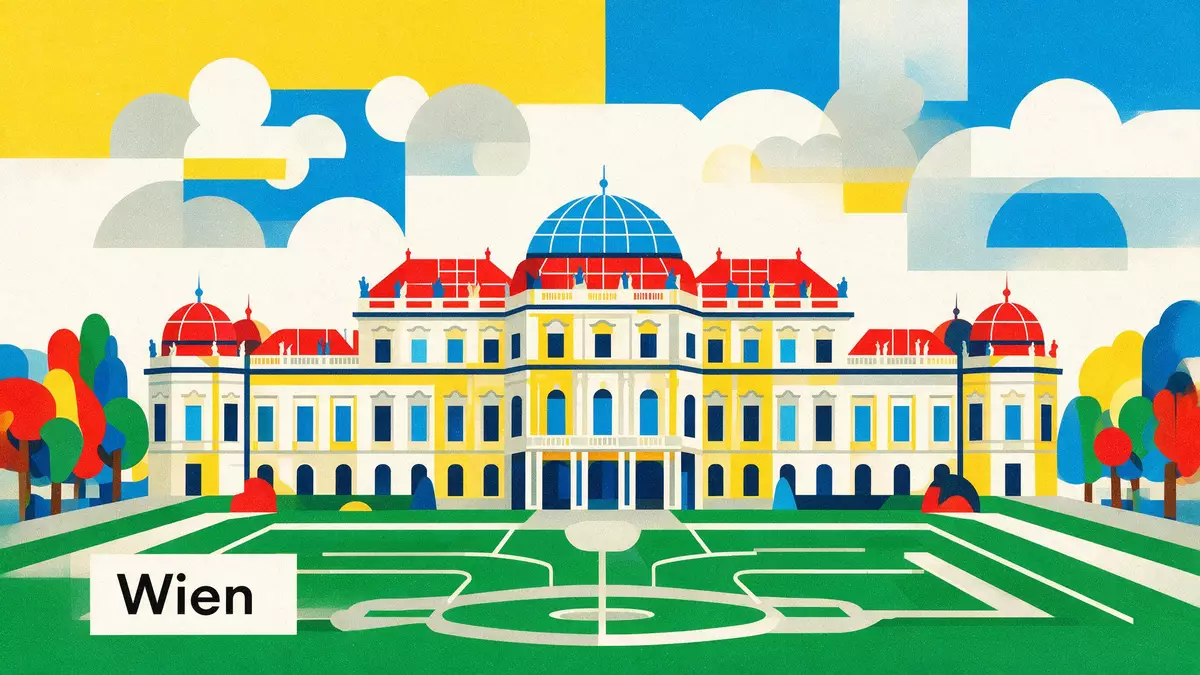
Schloss Belvedere presents two Baroque palaces across a formal garden axis in Wien. Johann Lukas von Hildebrandt designed the ensemble for Prince Eugene of Savoy, and the Upper Belvedere was completed in 1723.
Two palaces across a single garden composition
The complex consists of the Lower Belvedere, the Upper Belvedere, an orangery, stables and extensive gardens. Its buildings occupy a gentle slope south-east of Wien’s historic centre, with the palace elevations and garden terraces arranged along the same direction.
The Lower Belvedere dates from 1712 to 1716. It contains rooms associated with Prince Eugene’s residence, including the Marble Hall, the Marble Gallery and the Grotesque Hall. The Upper Belvedere followed between 1717 and 1723, with ceremonial interiors including the grand staircase and the Sala Terrena.
Johann Lukas von Hildebrandt’s Baroque language
Hildebrandt gave the two palaces related but distinct forms. The Lower Belvedere has a more residential character, while the Upper Belvedere rises as a formal palace with a central body and projecting sections. Sculptural decoration, painted interiors and stonework belong to the Baroque vocabulary of the early eighteenth century.
Prince Eugene of Savoy commissioned the complex as his summer residence. The Austrian military commander was also an art collector, and the palace interiors preserve the connection between courtly residence, ceremonial display and collecting. The Baroque palace complex was completed in 1723.
From princely residence to public museum
After Prince Eugene’s death in 1736, the estate entered the Habsburg imperial sphere. Empress Maria Theresa acquired the complex in 1752, and the Upper Belvedere became a setting for imperial collections.
An imperial picture gallery opened in the palace in 1781. This museum history gives Schloss Belvedere a second identity beyond its architecture: the former residence is also a long-established home for works from Austrian and European art history.
The museum’s collection includes major Austrian works from the nineteenth and twentieth centuries. Gustav Klimt’s paintings are closely associated with the Upper Belvedere, alongside works by Egon Schiele, Oskar Kokoschka and other artists. The history and architecture of the ensemble remain inseparable from its museum role.
Visiting Schloss Belvedere: what travellers from Western Europe should know
- Schloss Belvedere lies in Wien’s third district, south-east of the city centre. Tram lines run along Prinz-Eugen-Straße, and Wien Hauptbahnhof lies nearby.
- The grounds occupy a sloping site. The formal garden includes terraces, stairways, clipped planting and water features between the Lower and Upper Belvedere.
- The official language is German and the currency is the euro.
Searching for Schloss Belvedere on social platforms
These links open searches for Schloss Belvedere on each platform.
Frequently asked questions about Schloss Belvedere
Where is Schloss Belvedere?
Schloss Belvedere is in Wien’s third district, south-east of the historic centre. The palace grounds extend along Prinz-Eugen-Straße near Wien Hauptbahnhof.
What can visitors see there?
The complex combines the Lower and Upper Belvedere with formal gardens, Baroque interiors and museum galleries. The collection includes works by Gustav Klimt, Egon Schiele and Oskar Kokoschka.
What makes Schloss Belvedere distinctive?
Its identity rests on the relationship between two palaces and the garden axis between them. The ensemble also combines Prince Eugene’s former residence with a museum tradition dating from the eighteenth century.


