
Schloss Heidelberg and its layered Renaissance ruins
Published on 09/24/2026 at 08:44 | Editorial responsibility: Rafael Müller, Editor-in-Chief AD HOC NEWS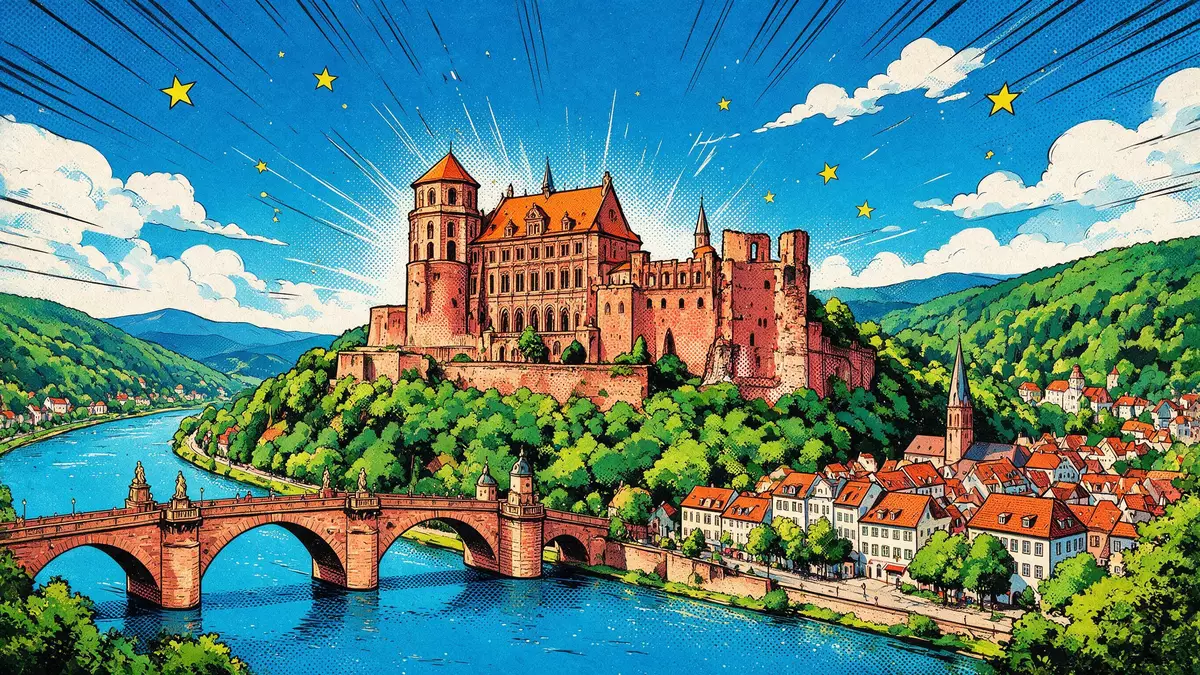
Schloss Heidelberg rises above Heidelberg as a complex of red sandstone walls, Renaissance palace fronts and open terraces. The ruins stand on the northern slope of the Königstuhl above the Neckar valley, with the city below and the Hortus Palatinus extending across the hillside.
Red sandstone palaces above Heidelberg
The castle combines fortification and residence in a single architectural group. Its history was first recorded in 1225, when the counts palatine of the Rhine held their seat above Heidelberg. Medieval defensive works formed the earliest visible layer, while later princes added palace buildings with elaborate façades.
The complex developed strongly between the late Middle Ages and the seventeenth century. The Gläserner Saalbau, Ottheinrichsbau, Friedrichsbau and Englischer Bau represent successive stages in the transformation from fortified residence to Renaissance court architecture. The castle’s Renaissance buildings remain the central architectural feature.
The Ottheinrichsbau began in 1556 under Elector Ottheinrich. Its façade carries sculpted figures associated with biblical and dynastic history, set across several levels of red sandstone. The Friedrichsbau followed between 1601 and 1607 under Elector Friedrich IV, adding another richly decorated palace front to the courtyard.
From electoral residence to Romantic ruin
Schloss Heidelberg was the residence of the prince electors of the Palatinate. Its buildings and grounds reflected the political importance of Heidelberg within the Holy Roman Empire. The complex changed through periods of construction, warfare, fire and repair, leaving distinct architectural layers beside one another.
French attacks damaged Heidelberg during the War of the Grand Alliance in 1689 and 1693. The castle’s fortifications and palace buildings suffered extensive destruction, while repairs continued in parts of the complex. In 1764, lightning strikes caused further fires, after which the residence remained a ruin.
That ruined condition became part of the castle’s identity. Nineteenth-century Romantic culture treated the broken palace walls, surviving façades and hillside gardens as a historic landscape. The building is neither a complete palace nor a bare fortress. Its courtyards contain standing Renaissance architecture beside fractured masonry and open views across Heidelberg.
Charles de Graimberg devoted much of his life to preserving the ruins. His work helped shape the castle as a monument, while the surviving buildings continued to present the history of the Palatinate through stone, sculpture and spatial arrangement.
The Hortus Palatinus and the Great Vat
The castle garden, known as the Hortus Palatinus, occupies terraces beside the palace buildings. Elector Friedrich V commissioned the garden in the early seventeenth century, and Salomon de Caus planned its elaborate arrangement between 1616 and 1619. Its terraces, retaining walls and planted areas remain part of the castle landscape.
The garden’s surviving form combines formal traces with mature trees and broad viewpoints. Ginkgoes and Lebanon cedars stand among the terraces, while paths connect garden sections above the city. The Hortus Palatinus terraces preserve the scale of a courtly garden project, even though the complete seventeenth-century design is not present.
Inside the castle, the Great Vat adds a striking object of a different kind. The wine barrel was built in 1751 under Elector Karl Theodor and is associated with the wine taxes of the Palatinate. Its enormous wooden body occupies a dedicated cellar space, with a platform above it.
The Great Vat and the palace façades belong to different moments in the castle’s history. Together they show the range of the complex: defensive walls, ceremonial architecture, garden terraces, storage spaces and the remains of an electoral residence.
Visiting Schloss Heidelberg: what travellers from Western Europe should know
- Schloss Heidelberg stands above Heidelberg’s Old Town in Baden-Württemberg. From Heidelberg Central Station, bus lines 20 or 33 reach the Bergbahn stop, where the funicular continues to Schloss station.
- The castle occupies a hillside. The approach from the Old Town includes steep streets and stairs, while the grounds contain uneven stone surfaces, terraces and changes in level.
- The Great Terrace overlooks Heidelberg’s historic district and the Neckar valley. The castle courtyard, palace façades, gardens and wine cellar form separate parts of the visit.
- The official language is German and the currency is the euro.
Searching for Schloss Heidelberg on social platforms
These links open searches for Schloss Heidelberg on each platform.
Frequently asked questions about Schloss Heidelberg
Where is Schloss Heidelberg?
Schloss Heidelberg stands above Heidelberg’s Old Town on the northern slope of the Königstuhl. The castle overlooks the Neckar valley and the historic city centre.
What can visitors see at Schloss Heidelberg?
The grounds include palace façades, defensive remains, the courtyard, the Great Terrace, the Hortus Palatinus and the Great Vat. The site combines indoor rooms with open courtyards and hillside gardens.
What makes Schloss Heidelberg distinctive?
Its identity comes from the contrast between richly ornamented Renaissance buildings and extensive ruins. The palace, garden terraces and Great Vat preserve different stages of the Palatinate’s electoral history.


