
Schloss Heidelberg and the romantic ruin above the Neckar
Published on 09/19/2026 at 09:41 | Editorial responsibility: Rafael Müller, Editor-in-Chief AD HOC NEWS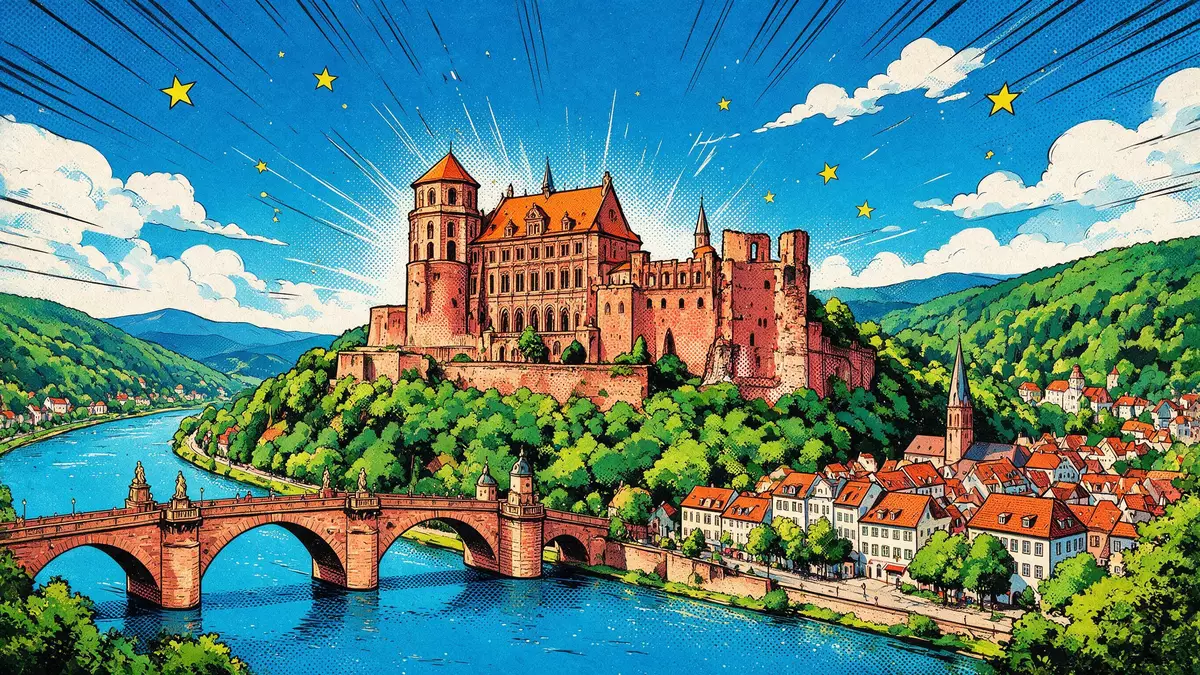
Schloss Heidelberg, the ruined castle above Heidelberg’s old town, combines a medieval fortress with Renaissance palaces in a single complex of red sandstone on the northern slope of the Königstuhl hill. Rising above the Neckar river in south-west Germany, it served for centuries as the principal residence of the Palatine prince-electors before wars and lightning strikes left much of it in carefully preserved ruin.Palatine prince-electors
A fortress that became a princely residence
The earliest written mention of a fort at Heidelberg dates to 1225, in a document naming a castle on the hill above the young town.A fort in Heidelberg was first mentioned in 1225 By 1303, records distinguish between an upper fort near the present Molkenkur and a lower fort on the site that would grow into Schloss Heidelberg.
From the late Middle Ages onwards, the lower fort evolved into a residence for the Counts Palatine of the Rhine and, later, the prince-electors. In the fifteenth century, Rupert III, King of the Romans, enlarged the residence as Heidelberg’s role within the Holy Roman Empire grew.Ruprecht III expanded the residence Military defences and domestic wings were added over generations, turning the once simple fortification into a sprawling castle complex. An upper castle on the hill burned down after a lightning strike in 1537, leaving the lower castle as the main seat.the upper one was located where the Molkenkur is today, but was struck by lightning and burned down in 1537
Renaissance façades and the Hortus Palatinus
Schloss Heidelberg’s most striking palace wings date from the sixteenth and early seventeenth centuries, when the medieval fortress was expanded into a representative Renaissance residence.in the 16th century, the medieval castle was expanded into a representative Renaissance castle Elector Ottheinrich ordered the construction of the Ottheinrichsbau, an early Renaissance palace with an elaborate front, and later electors added further palace wings and a baroque building programme around the central courtyard.Elector Ottheinrich had the Ottheinrichsbau built
On the terrace outside the palace façades, the Castle Gardens—known as the Hortus Palatinus—were laid out in the early seventeenth century. Designed with formal terraces and ornamental features above the Neckar valley, they were conceived as a showpiece garden for the prince-electors and remain a defining part of the castle landscape.magnificent Castle Gardens (Hortus Palatinus) The contrast between red sandstone palace walls and the green slopes below sets Schloss Heidelberg apart from many other German castle sites.
War, lightning and the making of a ruin
The seventeenth century brought repeated destruction to Schloss Heidelberg. During the Nine Years’ War, French troops attacked Heidelberg and the Palatinate, sacking the town and castle in 1689 and again in 1693.French forces badly damaged the castle in 1689 and again in 1693 Large sections of the complex were left in ruins, and although some reconstruction followed, the castle never fully regained its former condition.
In 1764, lightning again struck the castle, igniting fires that destroyed rebuilt roofs and interiors and contributing to its abandonment as a residence.two lightning strikes in 1764 caused major fires From the nineteenth century onwards, preservationists and writers began to conserve the ruins rather than erase them, turning Schloss Heidelberg into a carefully maintained fragment of its former self. The red sandstone walls, broken towers and exposed interiors seen today reflect that decision to retain the castle in its ruined state.its evolution into one of today's most adored ruins
Visiting Schloss Heidelberg: what travellers from Western Europe should know
- Schloss Heidelberg stands on the northern slope of the Königstuhl hill above the Neckar river, south-east of Heidelberg’s old town, and is reached by the Bergbahn funicular railway from the “Schloss” station on the hillside.
The castle address is in the Schloßhof area of Heidelberg. - The castle terraces and courtyards sit on a steep hillside, with staircases, stone steps and uneven surfaces connecting different levels, so movement around the site involves gradients rather than level ground.
- The ruins, palace façades and gardens overlook the Neckar valley, with views towards the Odenwald hills and across Heidelberg’s bridges and old town streets.
- Schloss Heidelberg is in Germany; the official language is German and the currency is the euro (EUR).
Searching for Schloss Heidelberg on social platforms
These links open searches for Schloss Heidelberg on each platform.Frequently asked questions about Schloss Heidelberg
Where is Schloss Heidelberg located?
Schloss Heidelberg stands on the northern slope of the Königstuhl hill above Heidelberg’s old town in south-west Germany, overlooking the Neckar river.
What can visitors expect at Schloss Heidelberg?
Visitors encounter extensive castle ruins, Renaissance palace façades, stone courtyards and terraces, and garden areas with views across Heidelberg and the surrounding valley.
What makes Schloss Heidelberg distinctive among German castles?
The combination of a medieval fortress, ornate Renaissance façades and a consciously preserved ruin on a hillside above a river town gives Schloss Heidelberg a distinctive character.


