
Schloss Neuschwanstein above the Bavarian Alps
Published on 09/17/2026 at 08:08 | Editorial responsibility: Rafael Müller, Editor-in-Chief AD HOC NEWS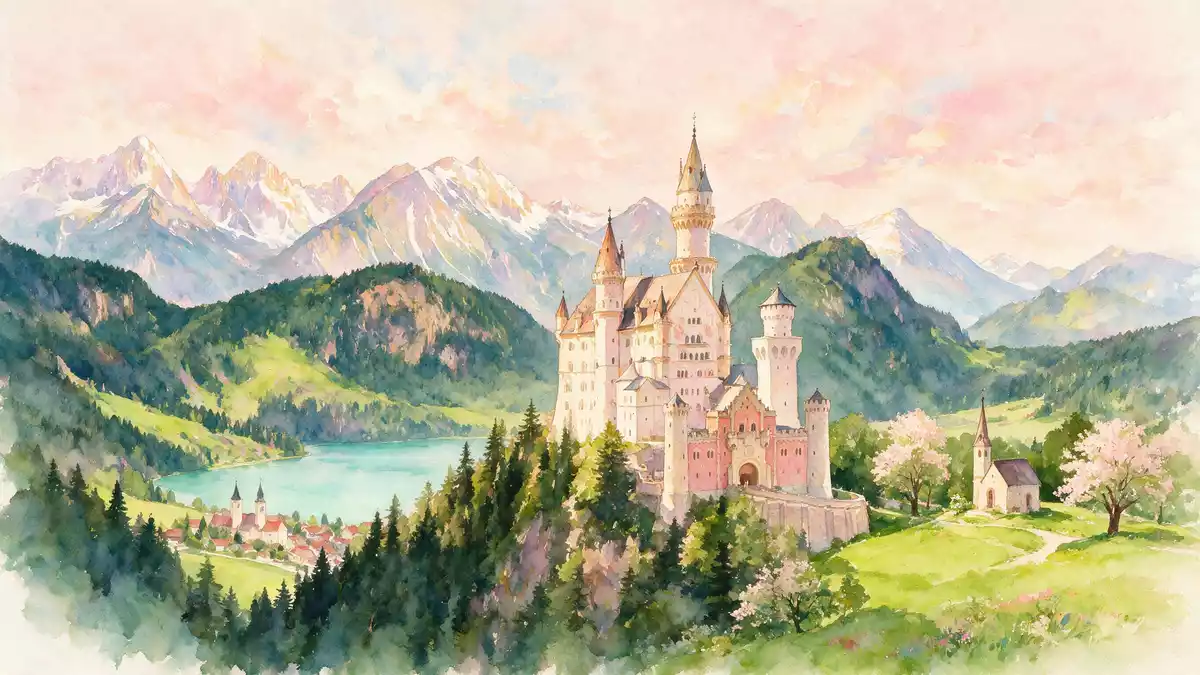
Schloss Neuschwanstein is a nineteenth?century palace on a steep hill above Hohenschwangau near Schwangau in southern Germany, framed by the foothills of the Bavarian Alps. Conceived by King Ludwig II of Bavaria and begun in 1869, it brings together Neo?Romanesque architecture, mountain terrain and romantic imagery in a single dramatic outline.
A hilltop castle shaped by stone and sky
The castle stands on a rocky ridge above the Pöllat Gorge, looking towards the Alps and down to the lakes and meadows of Schwangau. Its position on this outcrop makes the building appear almost suspended between the forested slopes below and the jagged skyline behind.rock ledge over the Pöllat Gorge
The approach runs from the hamlet of Hohenschwangau, where the road climbs towards the palace on the hill above the village.perched high on a rugged hill above the village of Hohenschwangau From below, the pale walls rise above the forest, punctuated by towers and turrets that stand out sharply against the backdrop of the Bavarian mountains.
Nineteenth?century vision in Neo?Romanesque stone
Construction of Schloss Neuschwanstein began on 5 September 1869, when the foundation stone was laid on the prepared rock terrace.foundation stone laid on 5 September 1869 The palace is a historicist project of the nineteenth century, drawing on medieval forms but executed with the building techniques of its time.
Plans for the main complex were developed by the architect Eduard Riedel in what is described as a Neo?Romanesque style, with brick walls clad in light?coloured limestone and an encased steel structure supporting the great hall inside.plans by Eduard Riedel in the Neo?Romanesque style King Ludwig II of Bavaria, born in 1845 and ruling from 1864, was closely involved in the aesthetic direction, working from sketches and ideas inspired by legend and opera.Romantic masterpiece built by King Ludwig II of Bavaria
A complex of gates, towers and great halls
The ensemble at Schloss Neuschwanstein is arranged as a multi?winged castle complex with a gateway building and an upper residence block known as the Palas. The gateway building on the access side was the first part finished and served as provisional accommodation while work continued on the higher structures.Gateway Building completed first
Behind it, the Palas rises with a series of gables, towers and roof levels that give the silhouette its irregular outline above the valley. Inside, a large throne hall occupies one end of the main block, supported by a steel framework concealed within the masonry.large Throne Hall built as an encased steel construction Other parts of the complex, including the bower and a square tower, were completed in simplified form in the 1890s, extending the castle’s profile along the ridge.simplified versions of the originally planned buildings completed until 1892
Visiting Schloss Neuschwanstein: what travellers from Western Europe should know
- Schloss Neuschwanstein stands above Hohenschwangau in the municipality of Schwangau in Bavaria, south?west of the town of Füssen and near the border with Austria.
- The castle occupies a high ridge above the Pöllat Gorge, and the access route from Hohenschwangau involves a sustained uphill walk on paved paths.
- Travellers commonly arrive via Füssen, from where roads lead to Schwangau and Hohenschwangau; trains from wider Germany serve Füssen, and buses connect the town with the area below the castle.
- The official language is German and the currency is the euro.
Searching for Schloss Neuschwanstein on social platforms
These links open searches for Schloss Neuschwanstein on each platform.
Frequently asked questions about Schloss Neuschwanstein
Where is Schloss Neuschwanstein located?
Schloss Neuschwanstein is situated above Hohenschwangau in the municipality of Schwangau in Bavaria, in the very south of Germany near the border with Austria.
What should visitors expect on a visit?
Visitors encounter a hilltop castle reached by an uphill route from Hohenschwangau, with towers and halls set high above the valley and views towards the Bavarian Alps.
What makes Schloss Neuschwanstein distinctive among German castles?
Its combination of Neo?Romanesque historicist architecture, nineteenth?century romantic imagery and prominent position on a rocky ridge above the gorge gives Schloss Neuschwanstein a particularly theatrical presence.


