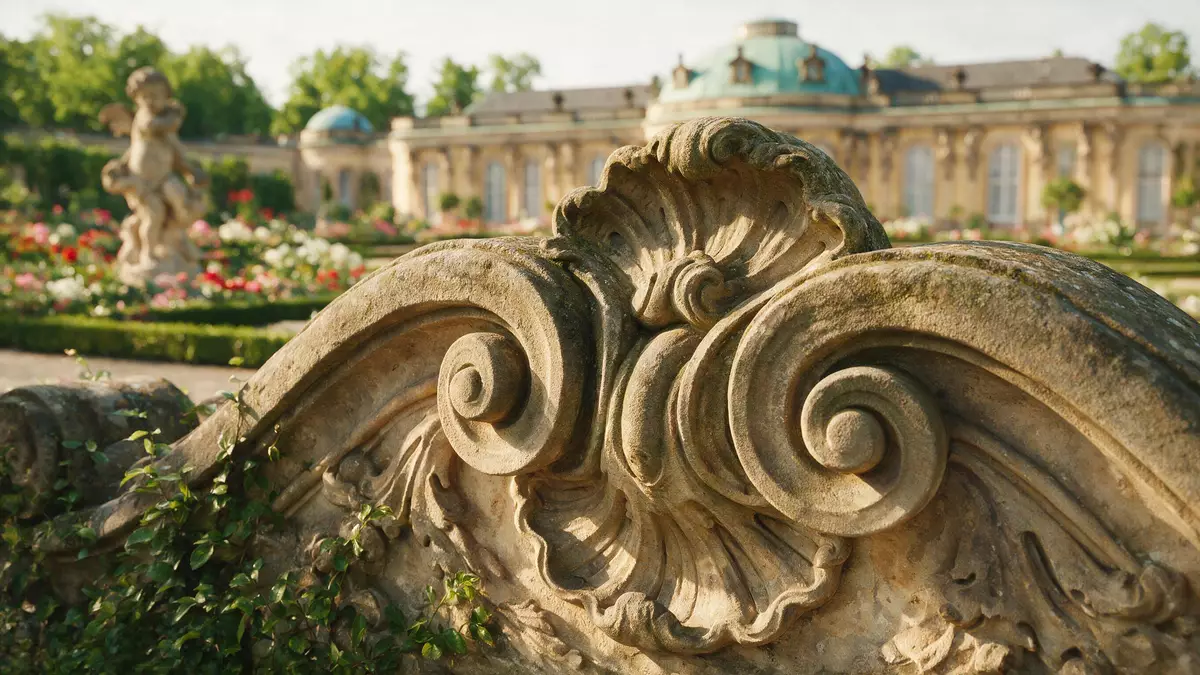
Schloss Sanssouci and its terraced palace gardens
Published on 08/11/2026 at 15:06 | Editorial responsibility: Rafael Müller, Editor-in-Chief AD HOC NEWS
Schloss Sanssouci in Potsdam is the summer palace most closely associated with Frederick the Great, completed in the 1740s under Prussian rule. Its low, single-storey body and long terrace frontage make the palace read as a garden room rather than a courtly monument.
Frederick the Great's summer retreat
The palace stands on the Vineyard Terrace, where long runs of stone steps, vine rows and retaining walls rise behind the main front. The building belongs to the Rococo period and is one of the best-known Prussian residences of the 18th century.
Its central block is flanked by curved wings, with sandstone façades, sculpted decoration and a shallow dome above the middle. The overall effect is restrained in height but dense in detail, especially along the terrace side.
Gardens, pavilions and formal paths
The surrounding park extends the palace setting with clipped hedges, avenues, fountains and small garden buildings. The Chinese House, the Orangery Palace and the New Chambers belong to the wider ensemble and add different architectural accents.
The ground falls away in ordered terraces before opening into broader parkland. That sequence from built terrace to planted park is the defining spatial experience at Sanssouci.
A royal residence with a garden scale
Unlike many palaces, Schloss Sanssouci keeps a deliberately intimate scale. The rooms, façades and garden front all maintain that more private register, even though the site belongs to the grand tradition of Prussian representation.
The name Sanssouci, meaning 'without worries', has become part of the palace's identity. It suits a place where architecture, planting and stone steps form a compact composition rather than an imposing palace front.
Visiting Schloss Sanssouci: what travellers from Western Europe should know
- Potsdam lies close to Berlin and is reached by regional rail, suburban rail and road. The palace sits within the Sanssouci Park landscape.
- Admission arrangements and opening hours are set by the site's operator and change with the season; the official website is the only binding source.
- Spring and early autumn suit the gardens, while the terraces and paths are easiest to appreciate in clear daylight.
- The site includes slopes, steps and long walking distances across parkland. Comfortable shoes are sensible, especially if you plan to move between the palace and the outlying garden buildings.
- German is the main language on site, and cashless payment is common in many visitor settings in Potsdam. Restrictions may apply on site.
- Entry requirements depend on your nationality. UK travellers should check the FCDO travel advice at gov.uk/foreign-travel-advice; Irish travellers the Department of Foreign Affairs at ireland.ie; EU and EEA citizens their own national foreign ministry.
Searching for Schloss Sanssouci on social platforms
These links open searches for Schloss Sanssouci on each platform.
Frequently asked questions about Schloss Sanssouci
Where is Schloss Sanssouci?
It is in Potsdam, in the German state of Brandenburg, within the Sanssouci Park ensemble. Berlin is the nearest major city.
What should I expect on a visit?
You can expect a palace, terraced gardens, and a larger park with several garden buildings. The terrain includes steps and slopes, so the visit is as much about walking as about viewing rooms.
What makes it distinctive?
Its low Rococo palace form, paired with vineyard terraces and formal gardens, gives it a more intimate character than many royal residences. The combination of palace and landscape is the site's defining feature.