
Schloss Sanssouci, Frederick the Great’s Rococo palace above Potsdam’s vineyards
Published on 09/21/2026 at 06:53 | Editorial responsibility: Rafael Müller, Editor-in-Chief AD HOC NEWS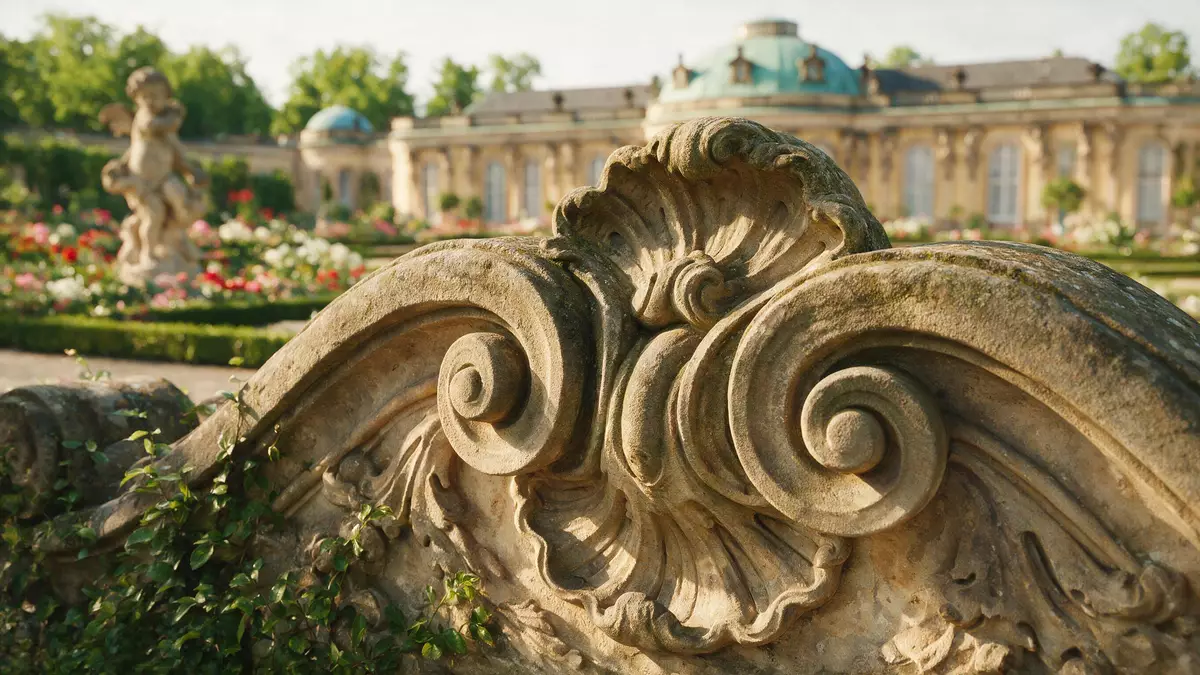
Schloss Sanssouci in Potsdam is a low Rococo summer palace commissioned by Frederick II of Prussia, better known as Frederick the Great, and laid out along vineyard terraces on a south-facing slope above the city’s northern outskirts. Built between 1745 and 1747 as a single-storey residence on terraced vines, it anchors one of Germany’s best-known ensembles of palaces and parks in an intimate, elongated form that reads almost like an architectural garden wall turned into a royal dwelling.
A Rococo palace drawn out along the hillside
The basic concept of Schloss Sanssouci is unusually horizontal: instead of rising in tiers or towers, the palace runs as a long, one-storey block following the line of the hilltop, with its garden front looking straight down over vineyard terraces. Frederick sketched the main idea himself, and court architect Georg Wenzeslaus von Knobelsdorff translated it into an elongated Rococo residence built over two years from 1745 to 1747.built between 1745 and 1747 The result is a palace whose main façade is less a grand front to a courtyard than a continuous screen above vines, with large French windows opening towards Sanssouci Park.
Architecturally, Schloss Sanssouci is considered a principal work of German Rococo architecture. The style, sometimes called Frederician Rococo, favours lightness, curved forms and rich sculpted ornament over heavy mass, and this is visible in the palace’s playful stucco decoration, gilded details and painted ceilings. The one-storey layout concentrates attention on a rhythm of doors, windows and pilasters rather than vertical hierarchy, so that visitors walking along the terrace see a continuous sequence of decorative bays rather than an overriding central block.
Frederick the Great’s summer retreat in Potsdam
Schloss Sanssouci stands in the eastern part of Sanssouci Park, a landscaped area on the Bornstedter ridge at the edge of Potsdam, and formed Frederick the Great’s favourite retreat from the formal atmosphere of Berlin’s court. The French name “Sanssouci” – literally “without worry” – reflects this character, and the palace served as his summer residence and pleasure retreat where he could devote time to private life and intellectual pursuits.summer residence and pleasure retreat Here he lived with his Italian Greyhounds and received guests, including the writer Voltaire, who stayed at the Prussian court in the early 1750s.Voltaire stayed at Sanssouci
Over the nineteenth century the palace was altered but retained its role as part of a wider royal landscape. Under King Frederick William IV, the side wings were extended in the 1840s, increasing the building’s length while preserving its low profile along the hill.side wings were extended in the 1840s Later, in 1873, Wilhelm I opened Sanssouci as a museum, adding a public function to what had begun as a strictly personal residence.opened the residence as a museum The palace and its surrounding park now form part of the ensemble of Prussian palaces and gardens in and around Potsdam and Berlin recognised by UNESCO as the “Palaces and Parks of Potsdam and Berlin”.Palaces and Parks of Potsdam and Berlin
Vineyard terraces and the wider Sanssouci Park
The setting of Schloss Sanssouci is as distinctive as the building itself. The palace occupies the upper edge of a terraced vineyard laid out on the southern slope of the Bornstedter ridge, where Frederick had broad walled platforms constructed for cultivating grapes and figs.terraced vineyard on the southern slope From the main terrace in front of the palace, visitors look down over these vineyard steps towards ornamental lawns, paths and water features that extend into Sanssouci Park, creating a clear axial relationship between architecture, horticulture and landscape.
The park surrounding the palace belongs to a larger complex of gardens and palaces developed between the 1730s and the early twentieth century, with Sanssouci as the earliest part of the ensemble.Sanssouci as the earliest part of the ensemble Within walking distance lie other royal residences such as the New Palace and Charlottenhof, as well as ornamental buildings, avenues and waterworks that link the ridge to the River Havel and the lakes north-west of central Potsdam.palaces and parks lining the banks of the River Havel From the terraces and adjoining paths, the palace is seen in interplay with statues, clipped hedges and long views across the undulating terrain, underlining how strongly its low, elongated form is tied to the hillside.
Visiting Schloss Sanssouci: what travellers from Western Europe should know
- Schloss Sanssouci stands in the eastern part of Sanssouci Park on the Bornstedter ridge at the northern edge of Potsdam in Germany, reached from the city by local transport and park paths.
- The palace itself stands on a series of vineyard terraces above a south-facing slope, and the approach from the lower park involves a steady uphill walk across steps and ramps.
- Within the wider landscaped area, other named sites such as the New Palace and Charlottenhof lie along axial avenues and paths, so a visit to Sanssouci can easily extend into longer walks across the park.
- The official language is German and the currency is the euro.
Searching for Schloss Sanssouci on social platforms
These links open searches for Schloss Sanssouci on each platform.
Frequently asked questions about Schloss Sanssouci
Where is Schloss Sanssouci located?
Schloss Sanssouci stands on the Bornstedter ridge at the northern edge of Potsdam in eastern Germany, in the eastern part of Sanssouci Park.
What should visitors expect on a visit?
Visitors encounter a low Rococo palace stretched along vineyard terraces, with interiors reflecting eighteenth-century tastes and a park landscape that links architecture, statues and long axial views.
What makes Schloss Sanssouci distinctive among European palaces?
Its combination of a single-storey Rococo residence, hillside vineyard terraces and integration into the UNESCO-listed palaces and parks of Potsdam and Berlin gives it an intimate yet formally landscaped character.


