
Seoraksan Gungnip Gongwon and its granite mountain landscape
Published on 09/22/2026 at 18:31 | Editorial responsibility: Rafael Müller, Editor-in-Chief AD HOC NEWS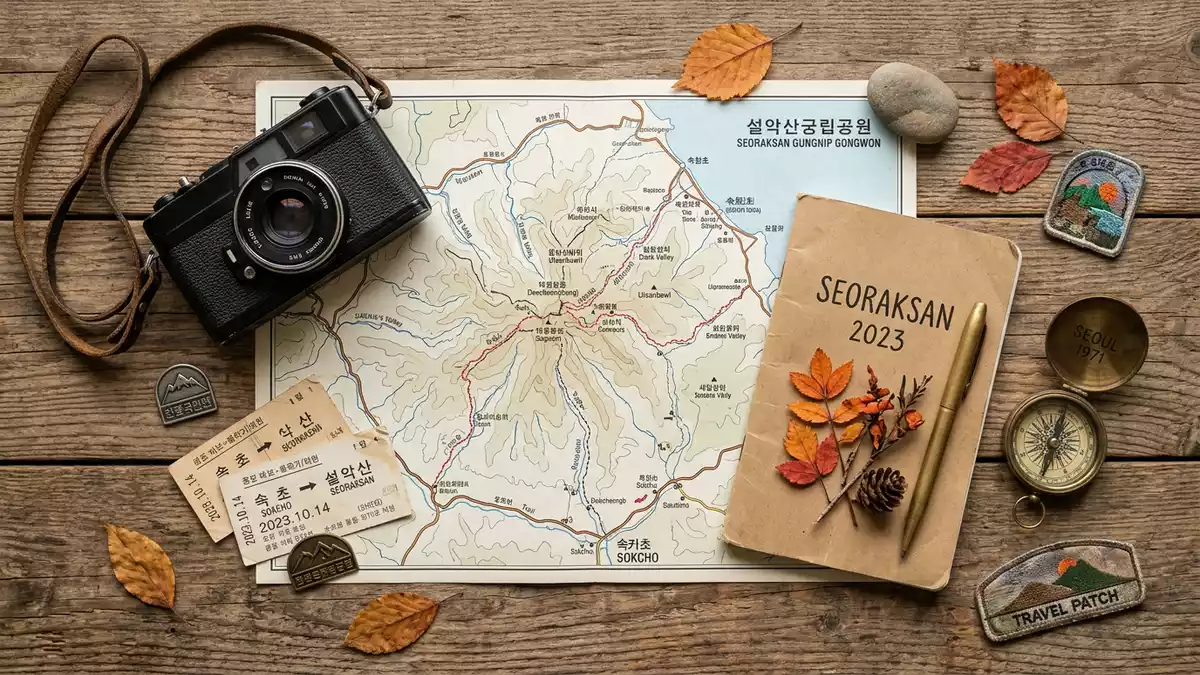
Seoraksan Gungnip Gongwon extends inland from Sokcho across a mountain landscape of granite ridges, forested valleys and steep ravines. Daecheongbong, the park’s main summit, reaches 1,708 metres, while cliffs and rock formations give the Taebaek range its visible character.
Granite ridges above Sokcho
The park lies in Gangwon Province in north-eastern South Korea, across the administrative areas of Sokcho, Inje, Goseong and Yangyang. Its protected landscape covers roughly 398 square kilometres, linking the eastern slopes of the Taebaek Mountains with valleys that descend towards the coast.
Mount Sorak consists of dissected granite and gneiss, with rocky hills, ridges and narrow valleys. Daecheongbong’s elevation makes it the central high point of the range, although the park’s identity also rests on smaller summits and isolated rock walls.
From nature reserve to national park
Seoraksan was designated a nature preservation area on 5 November 1965. South Korea established it as the country’s fifth national park on 24 March 1970, placing its forests, peaks and valleys within a national protection system.
Mount Sorak entered UNESCO’s Biosphere Reserve network in 1982. The designation covers a mountain environment recognised for its geological formations, forests and biological diversity. The park’s 1970 designation connects its conservation history with the development of South Korea’s national parks.
Ulsanbawi, Sinheungsa and the mountain’s cultural landmarks
Ulsanbawi Rock is a prominent granite formation near the eastern section of the park. Its connected summits rise above the surrounding forest, while paths and stairs approach viewpoints among the exposed rock. The formation provides a concentrated view of Seoraksan’s hard granite geology.
Sinheungsa adds a religious dimension to the landscape. The temple traces its foundation to 652 CE, when the monk Jajang established a Buddhist site under the name Hyangseongsa. Nearby stands the Great Unification Buddha, a gilt-bronze statue measuring 14.6 metres. Sinheungsa’s early foundation places the temple within the long history of Korean Buddhist practice.
Other named landmarks include Geumganggul Cave, a natural stone cave associated with religious use, Baekdamsa Temple in the inner valleys and Gwongeumseong Fortress near the eastern entrance. Towangseong Falls descends through a series of rocky stages, adding water and vertical movement to the granite setting.
Visiting Seoraksan Gungnip Gongwon: what travellers from Western Europe should know
- Seoraksan Gungnip Gongwon lies inland from Sokcho in Gangwon Province. Local buses 7 and 7-1 connect Sokcho with the Seorak-dong entrance.
- The landscape includes steep mountain paths, exposed granite, ravines and stairways. Routes range from lower valley walks to demanding ascents towards Daecheongbong.
- The park crosses Sokcho, Inje, Goseong and Yangyang. The eastern entrance near Sokcho is known as Oeseorak, while the inner valleys belong to Naeseorak.
- The official language is Korean and the currency is the South Korean won.
- Entry requirements depend on your nationality; UK travellers can check the FCDO travel advice at gov.uk/foreign-travel-advice, Irish travellers the Department of Foreign Affairs at ireland.ie.
Searching for Seoraksan Gungnip Gongwon on social platforms
These links open searches for Seoraksan Gungnip Gongwon on each platform.
Frequently asked questions about Seoraksan Gungnip Gongwon
Where is Seoraksan Gungnip Gongwon?
The park is in Gangwon Province in north-eastern South Korea, with its eastern entrance near Sokcho. Its wider protected area extends across four administrative districts.
What can visitors expect in the park?
Seoraksan combines forested valleys, granite ridges, waterfalls, temple grounds and mountain paths. The terrain ranges from valley scenery to strenuous routes towards high summits.
What makes Seoraksan distinctive?
Its identity comes from the combination of exposed granite formations and a long Buddhist heritage. Ulsanbawi Rock, Sinheungsa and Daecheongbong represent geology, culture and altitude within the same protected landscape.


