
Seoraksan Gungnip Gongwon, granite peaks above Sokcho
Published on 08/17/2026 at 14:15 | Editorial responsibility: Rafael Müller, Editor-in-Chief AD HOC NEWS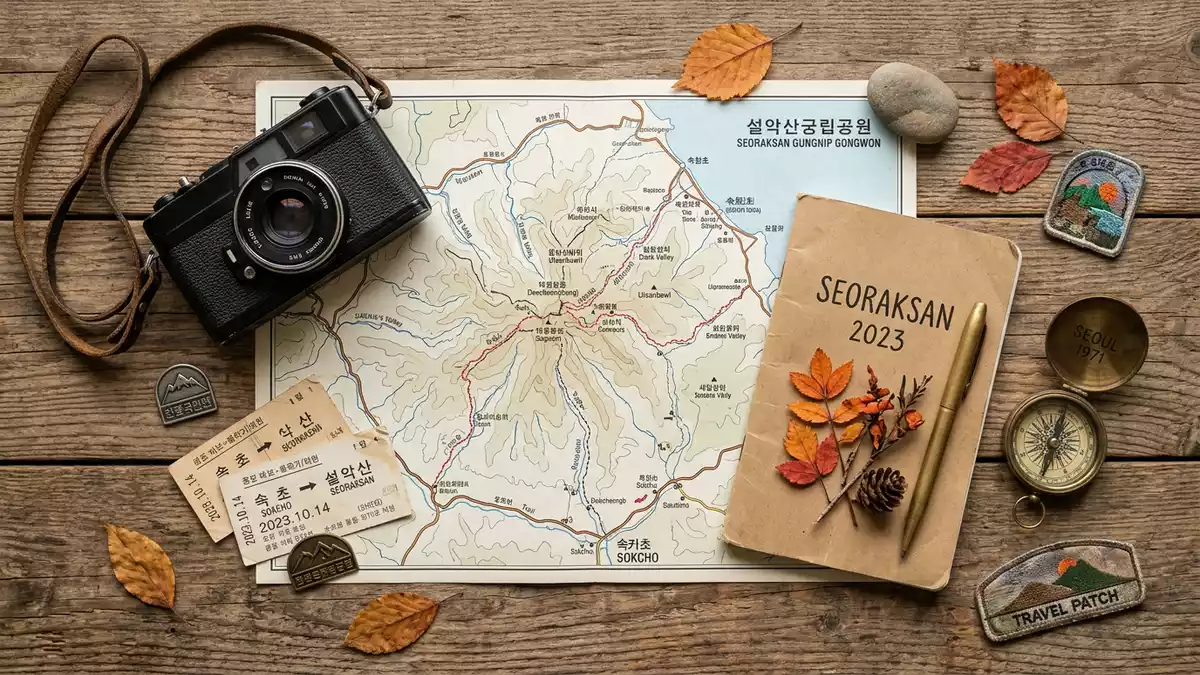
Seoraksan Gungnip Gongwon, the national park around Mount Seorak in Gangwon Province, rises inland from Sokcho with jagged granite ridges and steep forested valleys that define its character. Designated a nature preservation area in 1965 and a UNESCO Biosphere Reserve in 1982, it combines protected mountain landscapes with cultural sites in a compact but varied terrain of the Taebaek mountain range.UNESCO Biosphere Reserve
Granite ridges, deep valleys and divided regions
Seoraksan Gungnip Gongwon centres on Seoraksan, a granite and gneiss massif whose dissected ridges and rocky hills form one of the most dramatic sections of the Taebaek range in eastern South Korea.dissected granite and gneiss The park’s main summit, Daecheongbong, reaches 1,708 m (5,604 ft), giving the highest point a clear view across the east-central Korean peninsula and marking Mount Seorak as one of the country’s higher mountains.Daecheongbong at 1,708 m
The protected area covers around 398 km² and is administratively divided between Inje-gun, Goseong-gun, Yangyang-gun and Sokcho-si in Gangwon Province.398.24 km² in Gangwon Within the park, the landscape is commonly described in three broad sections: Inner Seorak to the west, South Seorak around Osaek, and Outer Seorak facing towards Sokcho and the East Sea coast.Inner, South and Outer Seorak Outer Seorak includes the main tourist entrance at Seorak-dong, while Inner and South Seorak extend the park into quieter valleys and higher interior ridges.
A protected mountain park with international recognition
Seoraksan Gungnip Gongwon was designated South Korea’s fifth national park in 1970, building on its earlier protection as a nature preservation area from 1965.fifth national park in 1970 The combination of rugged topography, dense forests and exposed rock led to international recognition when Mount Sorak was accepted into UNESCO’s Man and the Biosphere Programme in 1982, as Korea’s first site under that programme.biosphere designation in 1982
Within this framework, Seoraksan Gungnip Gongwon conserves a range of habitats from valley floors to the alpine zone around Daecheongbong. The park’s granite cliffs carry distinctive rock formations and pinnacles, while its valleys host streams, waterfalls and mixed woodland that change appearance across the seasons. Dinosaur Ridge, a serrated crest inside the park, is particularly known for its sequence of rocky teeth above steep drops, illustrating how erosion has cut into the Taebaek range over geological time.Dinosaur Ridge crest
Temples, trails and the link to Sokcho
Although Seoraksan Gungnip Gongwon is defined by its mountain scenery, it also contains long-established Buddhist temples that reflect the cultural history of Gangwon Province. These temple complexes, built at valley junctions and near rock faces, stand alongside trailheads and rest areas, so that religious architecture in timber and stone sits within sight of the surrounding cliffs. From the main Seorak-dong entrance near Sokcho, paths fan out towards viewpoints, valley walks and higher ascents, with waymarked routes leading into Outer Seorak and, for experienced hikers, towards Daecheongbong and the interior ridges.
The city of Sokcho forms the coastal counterpart to the park, connected by road to the Seorak-dong entrance and acting as the usual base for visits to Seoraksan Gungnip Gongwon.near Sokcho on the east coast The contrast between Sokcho’s harbour district and the sharply rising interior terrain is visible on clear days, when the mountain’s rocky skyline forms a backdrop behind the coastal plain. Within the park itself, facilities such as rest areas, information points and a cable car at Seorak-dong concentrate human activity into limited zones, leaving large parts of Inner and South Seorak as more remote hiking country.
Visiting Seoraksan Gungnip Gongwon: what travellers from Western Europe should know
- Seoraksan Gungnip Gongwon lies inland from Sokcho on South Korea’s east-central coast, with the main Seorak-dong entrance reached by road from the city’s bus terminals.
- The park is mountainous, with steep gradients, exposed rock and long ascents; some routes involve sustained climbs on stairways and uneven forest paths.
- Sokcho provides accommodation, bus connections and urban services on the coast, while within the park facilities cluster around Seorak-dong and a few other valley access points.
- The official language is Korean and the currency is the South Korean won.
- Entry requirements depend on your nationality; UK travellers can check the FCDO travel advice at gov.uk/foreign-travel-advice, Irish travellers the Department of Foreign Affairs at ireland.ie.
Searching for Seoraksan Gungnip Gongwon on social platforms
These links open searches for Seoraksan Gungnip Gongwon on each platform.
Frequently asked questions about Seoraksan Gungnip Gongwon
Where is Seoraksan Gungnip Gongwon located?
Seoraksan Gungnip Gongwon is in Gangwon Province in eastern South Korea, inland from the coastal city of Sokcho and forming part of the Taebaek mountain range.
What can visitors expect on a visit to Seoraksan Gungnip Gongwon?
Visitors encounter steep mountain terrain with granite ridges, forested valleys, streams and waterfalls, alongside Buddhist temples and organised trail networks radiating from the Seorak-dong entrance.
What makes Seoraksan Gungnip Gongwon distinctive among Korean mountain parks?
Its combination of Daecheongbong as a high summit, international recognition as a UNESCO Biosphere Reserve and the close link between Sokcho’s coast and rugged interior scenery sets it apart.


