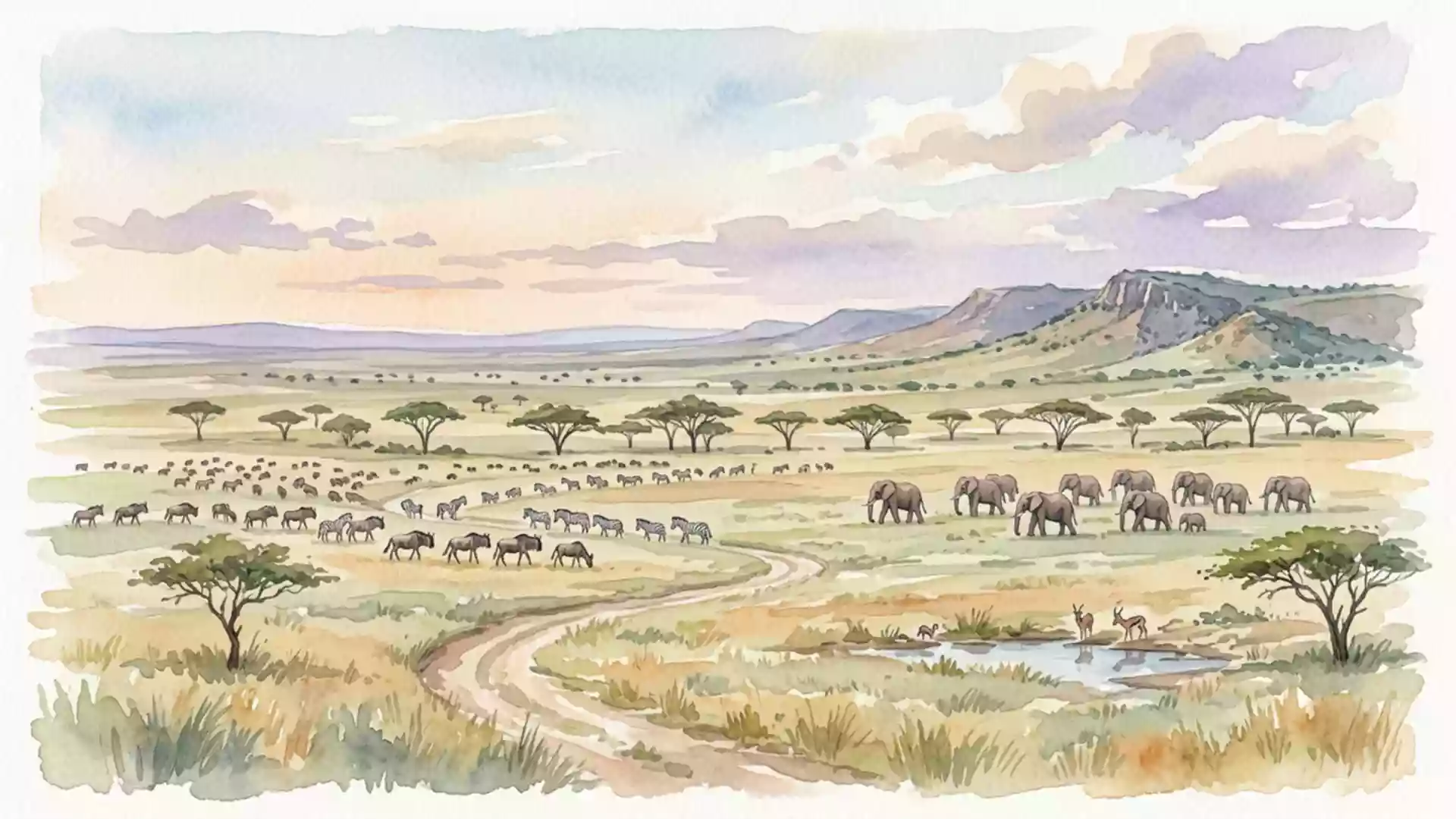
Serengeti National Park and the endless migrating herds
Published on 09/05/2026 at 21:48 | Editorial responsibility: Rafael Müller, Editor-in-Chief AD HOC NEWS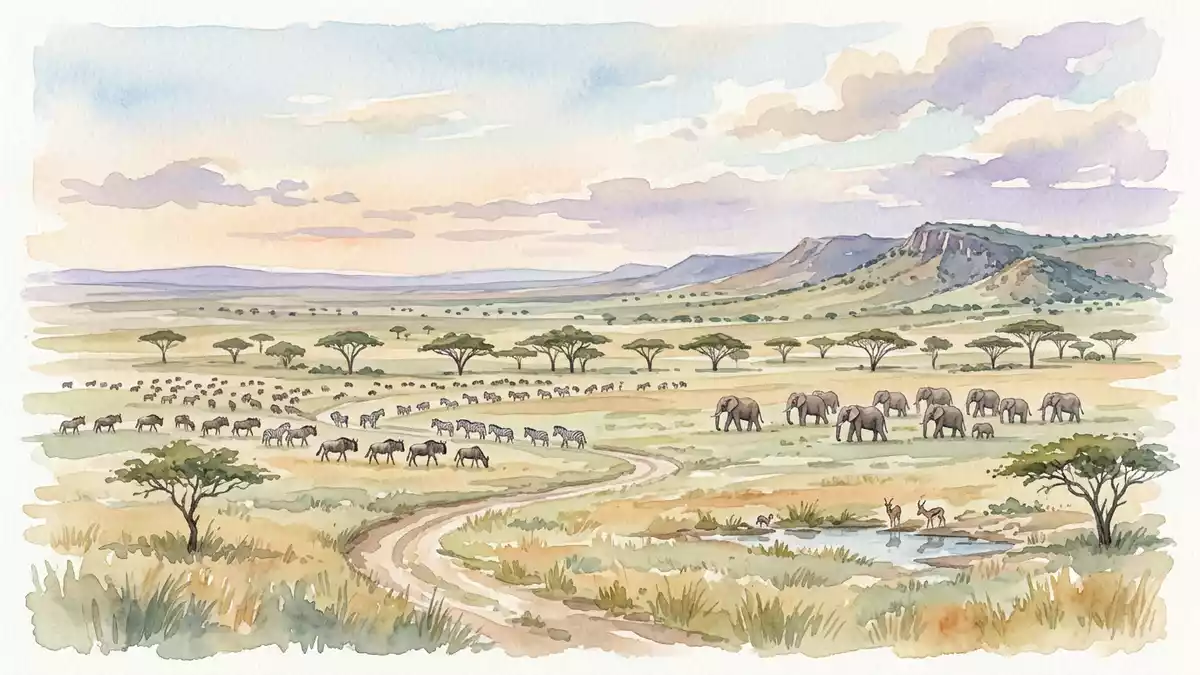
Serengeti National Park in northern Tanzania is shaped by open grassland, scattered woodlands and the long-distance movement of grazing herds across its plains. Established in the mid-twentieth century, it forms the core of a wider Serengeti ecosystem that extends into Kenya’s Maasai Mara National Reserve. As a recognised UNESCO World Heritage Site from 1981, the park holds a central place in East African conservation history.
Endless plains and a migrating savanna
The defining impression of Serengeti National Park is the expanse of the Serengeti Plain, a broad sweep of grassland broken by occasional granite outcrops known as kopjes and belts of acacia woodland. Across an area measured at about 14,763 square kilometres (5,700 square miles), the landscape ranges from short-grass plains in the south to more wooded country towards the west and north.covers 5,700 square miles Rivers such as the Mara and Grumeti carve corridors of gallery forest and permanent water through this mosaic, creating distinct habitats within a single protected area.diverse savanna communities
Across these plains, Serengeti National Park hosts one of the largest remaining long-distance migrations of land mammals. Vast herds of wildebeest, zebra and gazelles move between different parts of the ecosystem, following seasonal patterns in grazing and rainfall. UNESCO’s World Heritage listing highlights this movement across the Tanzania–Kenya border as one of the key natural values of the site.largest remaining unaltered animal migration The park forms part of the Serengeti–Ngorongoro Biosphere Reserve, recognised under the UNESCO Man and the Biosphere Programme in the early 1980s.Serengeti-Ngorongoro Biosphere Reserve
A complete savanna wildlife community
Serengeti National Park is known for a particularly rich and varied community of savanna mammals. The grazing herds include large numbers of wildebeest, plains zebra and Thomson’s gazelle, forming extensive columns when they move between different parts of the ecosystem.mammalian community Alongside these herds, other antelope such as topi, eland and hartebeest use various grassland and woodland habitats, while buffalo and elephant are present in substantial numbers in parts of the park.
Predators form another visible part of the Serengeti landscape. Lion prides, spotted hyenas and cheetahs are among the carnivores that depend on the migrating and resident herbivores, and black rhinoceros persists within the wider ecosystem.part of the Serengeti ecosystem The rivers and associated wetlands support hippopotamus and crocodiles, while scattered woodlands host giraffes, baboons and a wide range of birdlife. This combination of grazing herds, predators, riverine species and woodland dwellers underpins the park’s description as one of the most complex savanna communities documented in Africa.complex mammalian community
From early protection to World Heritage status
The Serengeti area began to receive formal protection in the first half of the twentieth century, with a game reserve established before the Second World War.Serengeti National Park In 1951 it was proclaimed a national park under Tanzanian administration, forming a legally recognised core for wildlife conservation in the region.proclaimed a national park in 1951 The park’s status was further strengthened in 1981 when it was inscribed on the UNESCO World Heritage List under natural criteria (vii) and (x), recognising its landscapes and its biodiversity.placed on the UNESCO World Heritage List in 1981
Serengeti National Park sits within a wider protected complex that includes the Ngorongoro Conservation Area to the southeast and Kenya’s Maasai Mara National Reserve to the north.runs contiguously with the Masai Mara Together these areas protect a large section of the Great Rift Valley region and the Great Lakes area of East Africa, where tectonic and volcanic forces have influenced topography and soils.within the Great Rift Valley The distinct transition from richer flat soils in the southern plains to poorer, more hilly soils in the north contributes to the diversity of vegetation and habitats visible across the park.changeover from rich flat soils
Visiting Serengeti National Park: what travellers from Western Europe should know
- Serengeti National Park lies in the northern part of Tanzania, west of the town and safari hub of Arusha, and extends to the border with Kenya’s Maasai Mara National Reserve.
- The terrain combines open grassland, patches of acacia woodland, river valleys and granite kopjes, and game drives generally follow established tracks rather than paved roads.
- Access is commonly arranged through safari programmes that use airstrips such as Seronera within the park or approach by road to gates including Naabi Hill on the eastern side.
- The official language in Tanzania is Swahili and the currency is the Tanzanian shilling.
- Entry requirements depend on your nationality; UK travellers can check the FCDO travel advice at gov.uk/foreign-travel-advice, Irish travellers the Department of Foreign Affairs at ireland.ie.
Searching for Serengeti National Park on social platforms
These links open searches for Serengeti National Park on each platform.
Frequently asked questions about Serengeti National Park
Where is Serengeti National Park located?
Serengeti National Park is in northern Tanzania on the Serengeti Plain, bordering the Ngorongoro Conservation Area and connecting with Kenya’s Maasai Mara National Reserve.
What can travellers expect on a visit?
A visit centres on wildlife viewing in open vehicles across grassland, woodland and river valleys, with the possibility of seeing large grazing herds and their predators in a wide savanna landscape.
What makes Serengeti National Park distinctive?
The park is distinctive for its extensive plains, its documented long-distance migration of herbivores between Tanzania and Kenya, and its recognised status as a UNESCO World Heritage Site since 1981.