
Setenil de las Bodegas, the Andalusian town under the rock
Published on 09/21/2026 at 20:56 | Editorial responsibility: Rafael Müller, Editor-in-Chief AD HOC NEWS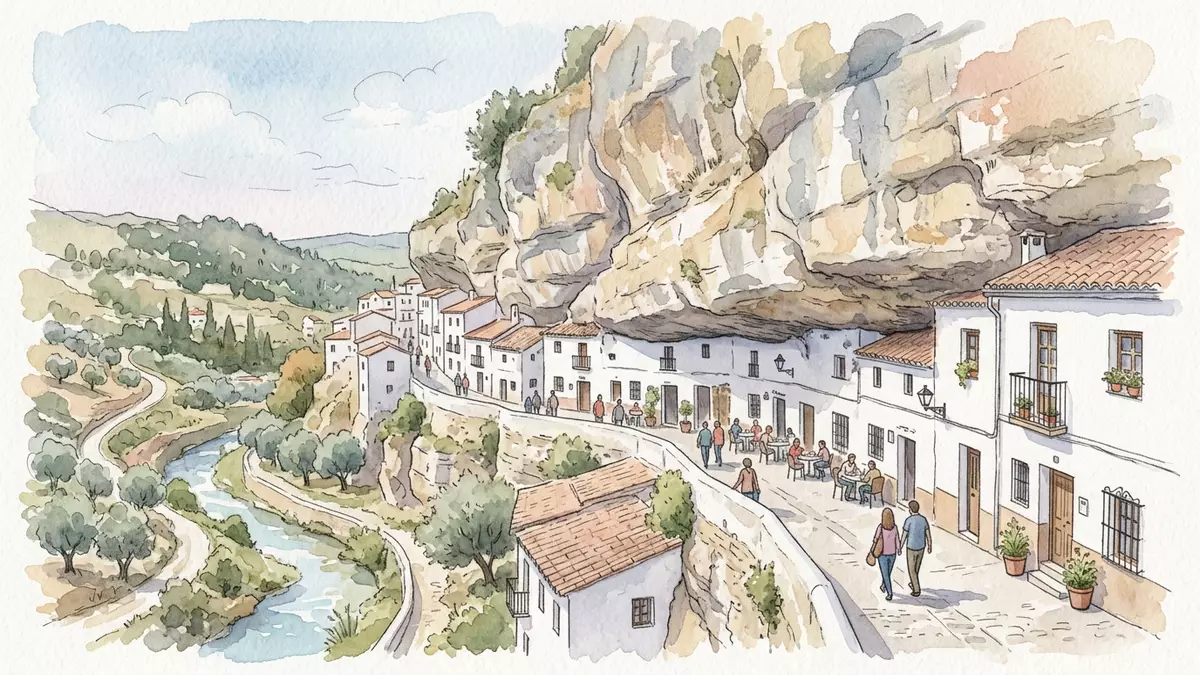
Setenil de las Bodegas in southern Spain is a small Andalusian town where everyday life unfolds beneath massive rock overhangs that double as roofs and back walls. Setenil lies in the province of Cádiz and its whitewashed houses cluster along the gorge of the Río Guadalporcún, creating a settlement whose built fabric is inseparable from the sandstone cliffs that surround it.
Living beneath the cliffs of the Río Guadalporcún
Setenil’s best-known streets trace the course of the Río Guadalporcún where the river has carved a narrow gorge into soft rock. Over centuries the water left deep recesses and pronounced overhangs, and later builders used those formations as ready-made shelter when laying out entire rows of houses along the riverbed.The gorge carved by the river now reads as a sequence of streets that pass directly under projecting cliffs.
In streets such as Cuevas del Sol and Cuevas de la Sombra, the rock does not simply sit above the roofs; it covers the carriageway itself so that the roadway, pavements and façades all lie under a continuous stone canopy.These lower streets of the village show most clearly how the settlement merges with the gorge, their white façades catching the light while the cliffs hang low overhead.
Cave houses and “shelters beneath the rocks”
The built form that defines Setenil is the so?called cave house or rock shelter, known locally as “abrigos bajo las rocas”. In these dwellings the cliff serves as an exterior wall and in many cases as the roof, while the visible façades with doors, windows and tiled roofs form only the outer skin facing the street.Troglodytic houses born in the shelter of the rocks line entire stretches of Setenil’s neighbourhoods, usually rising no more than a couple of storeys so as to fit under the overhang.
Rather than being excavated as deep caverns, many of these homes are conventional masonry constructions built lengthwise against the cliff, with the stone itself closing off the back of the interior. Some properties sit partly inside natural cavities while others tuck entirely beneath a horizontal rock ceiling that forms a kind of tunnel above the street.Whitewashed façades emerging from the sandstone give the streets a distinctive look: only front walls and small roof sections are visible, whilst the bulk of each building extends back into the cliff.
From prehistoric shelter to medieval frontier town
Archaeological finds in nearby caves indicate human occupation in the Setenil area several millennia ago, suggesting that people have long taken advantage of the natural shelters offered by the Río Guadalporcún gorge.Remains more than 5,000 years old point to early, occasional habitation before a permanent settlement emerged in the later Middle Ages.
During the Islamic period of Iberia, Setenil grew into a fortified outpost and a castle was constructed in the area known as La Villa, overlooking the gorge and controlling the approaches through the hills.A mosque and an impregnable castle marked its status as a frontier town. In the thirteenth and fifteenth centuries the site became a focal point in the struggles between the Crown of Castile and the Nasrid Kingdom of Granada, with several documented attempts to capture the stronghold before it passed into Christian hands and was repopulated under Castilian rule.
Whitewashed walls, vineyards and the name “de las Bodegas”
Setenil belongs to the group of Andalusian “pueblos blancos”, the whitewashed towns whose lime-coated façades reflect the strong sunlight of southern Spain. Narrow streets climb between houses that hug the irregular rock profiles, creating layered views where masonry and stone alternate along the slopes. Above the gorge, the upper district around the castle follows a more conventional hilltop pattern, with a parish church and former civic buildings occupying terraces on the ridge.
The town’s full name, Setenil de las Bodegas, recalls the wine industry that flourished around it from the seventeenth century onwards. Vineyards once surrounded the settlement and wine was stored in numerous cellars dug into the cliffs and built into houses, giving rise to a landscape of domestic and semi?industrial spaces tied to grape cultivation.The viticulture that gave the town its name later declined after the phylloxera epidemic, but the label “de las Bodegas” endures as a reminder of that period.
Visiting Setenil de las Bodegas: what travellers from Western Europe should know
- Setenil de las Bodegas lies in the province of Cádiz in southern Spain, north of Ronda and within the broader region of Andalusia; it is reached by road from nearby towns and forms part of local itineraries through the serranías.
- The core streets along the Río Guadalporcún are built against rock walls, with sections where the cliff overhang forms a low ceiling above the roadway; walking these streets involves passing under natural stone ledges while moving along paved surfaces.
- The upper quarter around the castle occupies higher ground above the gorge, with stepped lanes and short climbs linking the lower rock?sheltered streets to viewpoints and historic structures on the hill.
- The official language is Spanish and the currency is the euro.
Searching for Setenil de las Bodegas on social platforms
These links open searches for Setenil de las Bodegas on each platform.
Frequently asked questions about Setenil de las Bodegas
Where is Setenil de las Bodegas located?
Setenil de las Bodegas is a town and municipality in the province of Cádiz in Andalusia, southern Spain, set along the gorge of the Río Guadalporcún.
What should visitors expect on a visit to Setenil?
Visitors encounter whitewashed houses built against and beneath extensive rock overhangs, narrow streets that pass under stone ceilings, and an upper hilltop quarter with a castle and church.
What makes Setenil de las Bodegas distinctive among Andalusian towns?
The town’s most distinctive feature is its integration into the river gorge, where natural rock formations act as roofs and walls for entire streets of houses, blending cliff and architecture into a single landscape.


