
Shah-i-Zinda and the tiled slope of Samarkand
Published on 08/16/2026 at 14:07 | Editorial responsibility: Rafael Müller, Editor-in-Chief AD HOC NEWS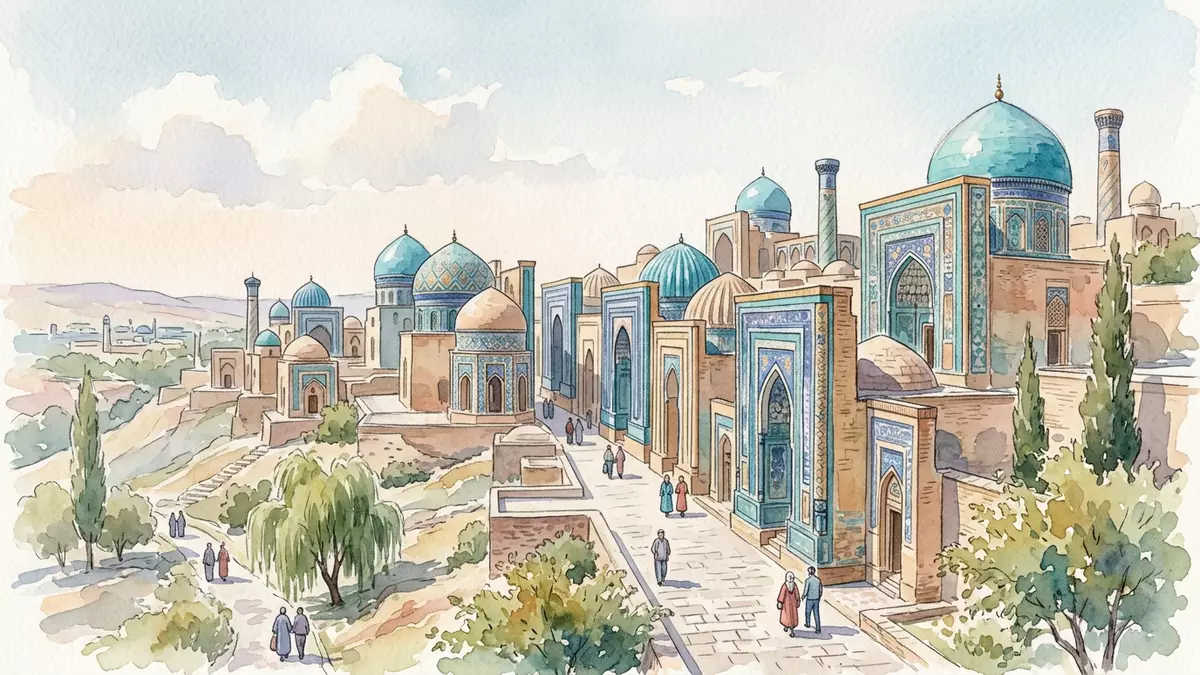
Shah-i-Zinda in Samarkand is a funerary complex on the south side of Afrasiyab hill, built around the shrine of Qusam ibn Abbas. Its tiled mausoleums line a narrow slope and give the place its strongest visual identity.
Shah-i-Zinda’s lane of mausoleums
The ensemble takes shape as a long corridor of tombs rather than a single monumental block. The surviving buildings range across the eleventh to fifteenth centuries, with later additions extending the sequence into the nineteenth century.
Qusam ibn Abbas, a cousin of the Prophet Muhammad, anchors the sacred narrative of the site. The name Shah-i-Zinda means “the Living King”, and the title is tied to that shrine.
Timurid tilework and shrine architecture
Most of the standing monuments belong to the Timurid period, especially the fourteenth and fifteenth centuries. Ulugh Beg appears in the complex’s recorded history, and his gateway helped define the southern end of the passage.
The mausoleums combine domes, portals and dense surface ornament. Brick, glaze, mosaic and carved plaster appear in different parts of the ensemble, and the tilework is one of its defining features.
Qusam ibn Abbas and the layered necropolis
The site grew over centuries rather than in one campaign, and the earliest structures are linked to the eleventh century. Karakhanid and Timurid patrons both belong to its architectural story.
The complex also remains a necropolis, with burials continuing around the sacred core. That layered use gives Shah-i-Zinda a visible combination of shrine, tomb architecture and living religious memory.
Visiting Shah-i-Zinda: what travellers from Western Europe should know
- Shah-i-Zinda lies on Afrasiyab hill in Samarkand. It is reached on foot through the necropolis area and from the city side by local transport to the district around the site.
- The approach includes a steep stairway and a narrow uphill passage. The route climbs through the line of mausoleums rather than across level ground.
- The official language is Uzbek and the currency is the Uzbekistani som.
- Entry requirements depend on your nationality; UK travellers can check the FCDO travel advice at gov.uk/foreign-travel-advice, Irish travellers the Department of Foreign Affairs at ireland.ie.
Searching for Shah-i-Zinda on social platforms
These links open searches for Shah-i-Zinda on each platform.
Frequently asked questions about Shah-i-Zinda
Where is Shah-i-Zinda?
Shah-i-Zinda is in Samarkand, on the south side of Afrasiyab hill. It belongs to a funerary complex built around the shrine of Qusam ibn Abbas.
What does a visit involve?
The visit follows a narrow uphill lane with stairs and closely packed mausoleums. The sequence is shaped by portals, domes and decorated brick surfaces.
What makes Shah-i-Zinda distinctive?
The site combines Karakhanid origins, Timurid patronage and dense tile decoration in one hillside ensemble. Its strongest impression comes from the continuous line of tomb architecture rather than a single building.
eleventh to fifteenth centuries


