
Shaolin Si at Mount Song, monastery of kung fu and Chan
Published on 09/05/2026 at 14:03 | Editorial responsibility: Rafael Müller, Editor-in-Chief AD HOC NEWS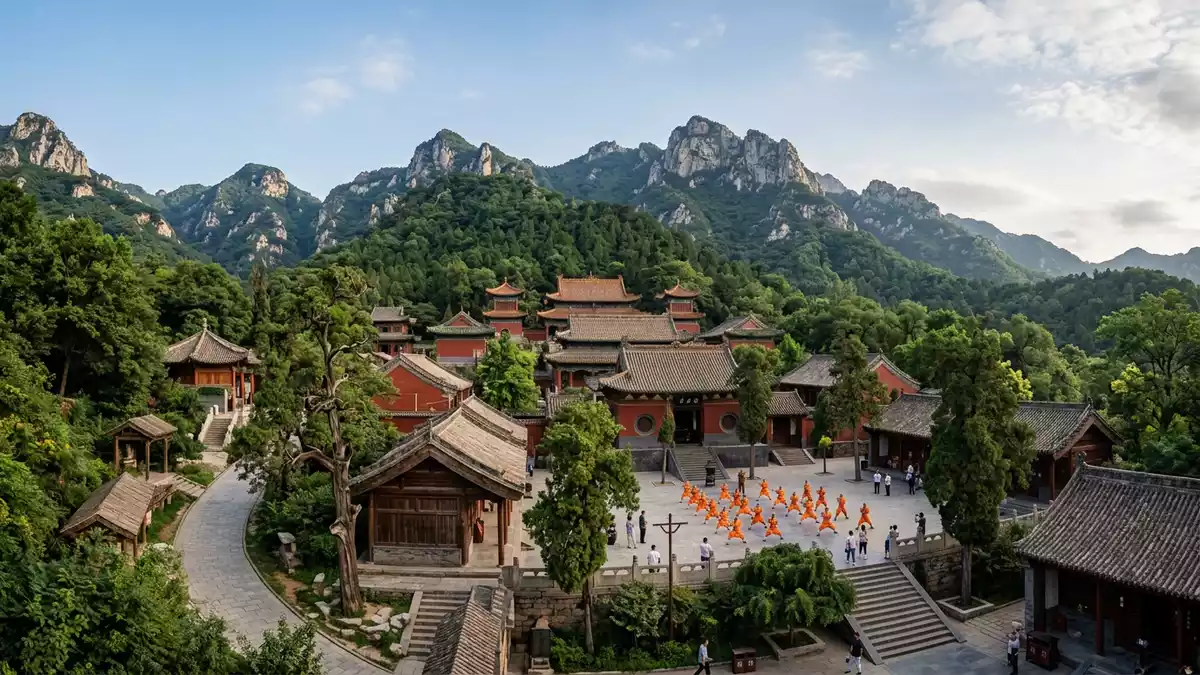
Shaolin Si in Dengfeng is a Mahayana Buddhist monastery on the slopes of Mount Song in central China, recognised worldwide for its association with Chan Buddhism and martial arts. The temple complex is part of the Historic Monuments of Dengfeng World Heritage ensemble, linking its buildings and courtyards to a landscape that has been shaped around religious practice over many centuries.
Temple courtyards beneath Mount Song
Shaolin Si stands at the foot of Mount Song, one of the sacred peaks of central China, west of Dengfeng in Henan province. The monastery occupies a valley on the southern side of the mountain range, with forests and rocky slopes rising behind its cluster of halls and gateways.Mount Song area of Dengfeng The temple’s formal status within the Historic Monuments of Dengfeng in “The Centre of Heaven and Earth” connects it to other religious and educational sites on and around the mountain, including Zhongyue Temple and Songyang Academy.Historic Monuments of Dengfeng
The main approach to Shaolin Si leads to a sequence of traditional Chinese temple buildings aligned along a central axis, with painted gateways, courtyards and halls framed by old trees. Behind the main temple zone, the valley continues towards subsidiary sites associated with the monastery, including a forest of stone pagodas marking monks’ burial places and, higher on the mountain, caves and shrines linked to the temple’s history.pagoda forest and mountain sanctuaries
Chan Buddhism and a fifth-century foundation
Shaolin Si is recognised as the cradle of Chan Buddhism, the East Asian tradition better known in Japanese as Zen, and as the main temple of the Shaolin school of Buddhism.main temple of the Shaolin school The monastery is traditionally dated to the fifth century, when it was founded on the flanks of Mount Song during the Northern Wei dynasty, giving it a documented history of more than 1,500 years.history can date back to Northern Wei Over this long period, Shaolin Si has acted as a centre for Buddhist study and practice, with its halls and pagodas reflecting successive phases of Chinese religious architecture.
The temple’s wider setting at Mount Song ties it to a landscape that has been regarded as spiritually significant since imperial times, and this context was one of the reasons the Historic Monuments of Dengfeng were inscribed on the UNESCO World Heritage List in 2010.inscribed as a World Cultural Heritage site in 2010 Within this ensemble, Shaolin Si stands alongside temples, towers and academies that illustrate how religion, astronomy and education were linked to the surrounding mountains.
Shaolin kung fu schools and stone pagodas
Beyond its religious role, Shaolin Si has a long-standing association with martial arts, and Shaolin kung fu is named directly after the monastery.cradle of Shaolin kung fu The wider valley around the temple contains schools and training halls where martial arts are practised, and performances of choreographed routines are staged in dedicated spaces within the scenic area.Shaolin Kung Fu Performance Show in Martial Hall This coexistence of temple courtyards and martial arts grounds is one of the visible contrasts at Shaolin Si, with monks’ quarters and study halls sharing the valley with open-air practice platforms and visitor seating.
On the slopes near the main temple complex, the Pagoda Forest gathers numerous stone and brick stupas, each marking the burial of an eminent monk from Shaolin Si.Pagoda Forest This collection of pagodas, built over many centuries, forms an important part of the site, and its densely spaced towers can be seen from paths leading through the scenic area. Higher up, paths and steps continue towards Sanhuang Village and other mountain sites linked to the temple’s religious and martial traditions.Sanhuang Village Scenic Resort
Visiting Shaolin Si: what travellers from Western Europe should know
- Shaolin Si lies in the Mount Song scenic area west of Dengfeng in Henan; the site is reached by road from Dengfeng and is linked by bus routes serving the Shaolin Temple terminus.
- Within the scenic area, the main temple axis is paved and largely level, while approaches to the Pagoda Forest and mountain sites involve stairways and steeper paths on stone and earth.
- Songshan forms a substantial mountain range; weather conditions on exposed paths can differ markedly from the sheltered temple courtyards, and solid footwear is advisable for walks beyond the main complex.
- The official language is Chinese and the currency is the renminbi yuan.
- Entry requirements depend on your nationality; UK travellers can check the FCDO travel advice at gov.uk/foreign-travel-advice, Irish travellers the Department of Foreign Affairs at ireland.ie.
Searching for Shaolin Si on social platforms
These links open searches for Shaolin Si on each platform.
Frequently asked questions about Shaolin Si
Where is Shaolin Si located?
Shaolin Si is a Buddhist monastery in the Mount Song area west of Dengfeng, in Henan province in central China, within the wider Historic Monuments of Dengfeng World Heritage region.
What should a visitor expect at Shaolin Si?
A visit to Shaolin Si centres on temple halls and courtyards along a main axis, with side paths leading to the Pagoda Forest, martial arts performance spaces and mountain trails within the scenic area.
What makes Shaolin Si distinctive among Chinese temples?
Shaolin Si combines an early Chan Buddhist monastery and burial pagodas with a long-established association with Shaolin kung fu, all set against the backdrop of Mount Song’s forested slopes and rocky peaks.


