
Shibuya Scramble Crossing and the choreography of Shibuya
Published on 09/05/2026 at 14:55 | Editorial responsibility: Rafael Müller, Editor-in-Chief AD HOC NEWS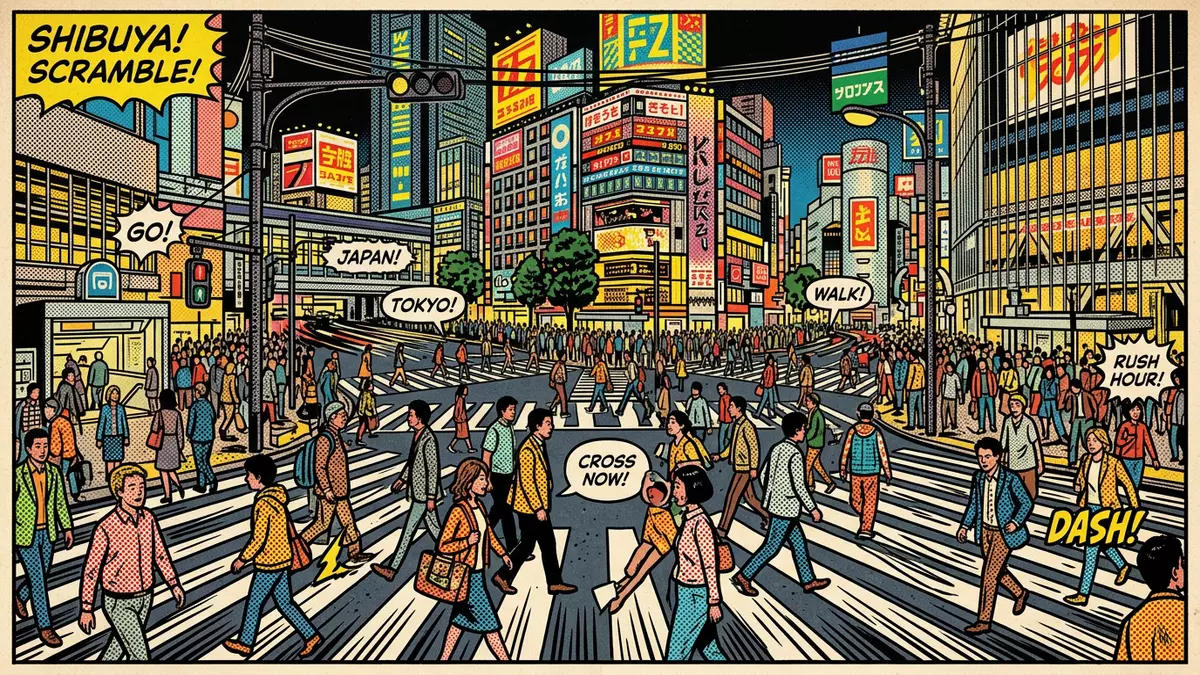
Shibuya Scramble Crossing in Tokio is a city junction where pedestrians move in every direction at once, framed by the towers, plazas and exits around Shibuya Station in Japan. The intersection’s scramble phasing was introduced in 1973, and the crossing has since become a widely recognised symbol of Shibuya’s dense commercial district.Scramble phasing was introduced in 1973
A five-way junction turned into a pedestrian scramble
Shibuya Scramble Crossing is formally designated Shibuya Ekimae Crossing, a road junction in Shibuya City where several marked pedestrian crossings intersect a cluster of traffic lanes.Nom officiel ??????? It functions as a scramble crossing: signals halt vehicle traffic so pedestrians can cross in all available directions at once, including diagonally. Standing at street level, the marked crossings converge towards the centre of the intersection, while vehicles queue on the surrounding roads awaiting the next signal change.five-way junction where ten traffic lanes meet, with five marked crosswalks
The crossing lies directly outside the Hachiko exit of Shibuya Station, at Dogenzaka in Shibuya City, placing it within one of Tokyo’s most intensively developed commercial and entertainment districts.Shibuya Crossing is located directly outside Shibuya Station's Hachiko exit On each side, station buildings, multi-storey retail blocks and advertising screens line the streets leading into the junction. Even without counting individual pedestrians, the repeated all-direction crossing phase is visible in the flow of people stepping off the kerbs, crossing diagonally and straight ahead, then clearing the intersection before the next cycle of traffic signals.
Shibuya Station, Hachiko Plaza and the urban stage around the crossing
Shibuya Scramble Crossing forms part of a larger urban ensemble around Shibuya Station, where the railway complex, plazas and towers meet at the station-front streets. The Hachiko exit leads directly onto a small plaza marked by the bronze statue of Hachiko, the dog whose story of waiting at Shibuya Station gave the square its name.The Shibuya Scramble Crossing is right in front of the Hachiko Exit From this plaza, the view opens straight onto the intersection, with the diagonal crossing running from the corner by the statue towards the QFRONT building opposite.exactly one of which is diagonal, running from the Hachiko plaza corner to the QFRONT building
On the north-eastern side, Shibuya Scramble Square rises above the station, its mixed-use tower and integrated station buildings forming one edge of the crossing. Observation facilities such as Shibuya Sky occupy upper floors and the rooftop above the tower, offering an elevated perspective on the crossing and surrounding cityscape.Address: 2-24-12 Shibuya, Shibuya-ku, Tokyo Other nearby buildings include retail complexes like Shibuya 109 and multi-level cafés overlooking the intersection, with façades used for large-format video screens and illuminated advertisements. Together, these structures turn the junction into a kind of open-air stage framed by architecture, signage and the visible train lines entering and leaving Shibuya Station.
Crossing, observing and moving through Shibuya Scramble Crossing
At Shibuya Scramble Crossing, each signal cycle includes a dedicated phase when pedestrians from all corners step into the intersection, cross diagonally or straight ahead, then clear the junction before vehicle traffic resumes. Stopwatch observations have given a full signal cycle of around 140 seconds, with the all-walk scramble phase occupying a distinct portion of that interval.full cycle of about 140 seconds — 2 minutes 20 — of which the all-walk scramble phase is around 37 seconds The diagonal crossing itself has been measured at roughly 36 m (118 ft), giving a sense of distance when walking from corner to corner across the centre of the intersection.The diagonal itself is roughly 36 metres
Access to the crossing is straightforward: as a public street outside Shibuya Station, pedestrians reach it simply by emerging from the Hachiko exit and stepping onto the marked crossings during the appropriate signal phase.scramble intersection directly in front of Shibuya Station's Hachik? Exit Elevated viewpoints are available from surrounding buildings, including observation decks on high floors and designated rooftop terraces that provide an overhead view of the flows of people and vehicles. From these vantage points, the pattern of intersecting pedestrian streams becomes visible in plan, with the five crossings radiating out from the centre and the waiting areas at each corner forming dense clusters between phases.
Visiting Shibuya Scramble Crossing: what travellers from Western Europe should know
- Shibuya Scramble Crossing sits in Shibuya City in western Tokyo, directly outside the Hachiko exit of Shibuya Station, which is served by JR and Tokyo Metro rail lines.
- The terrain around the crossing is fully urban, with level pavements, kerbs at street corners and multi-level station concourses connected by staircases, escalators and lifts.
- The crossing lies within a built-up district of towers, department stores and entertainment venues, so road traffic, pedestrian flows and bright illuminated signage form part of the immediate surroundings.
- The official language is Japanese and the currency is the yen.
- Entry requirements depend on your nationality; UK travellers can check the FCDO travel advice at gov.uk/foreign-travel-advice, Irish travellers the Department of Foreign Affairs at ireland.ie.
Searching for Shibuya Scramble Crossing on social platforms
These links open searches for Shibuya Scramble Crossing on each platform.
Frequently asked questions about Shibuya Scramble Crossing
Where is Shibuya Scramble Crossing located in Tokio?
Shibuya Scramble Crossing is in Shibuya City, Tokyo, directly outside the Hachiko exit of Shibuya Station in Japan’s capital.
What can visitors expect when crossing the intersection?
Visitors encounter marked pedestrian crossings that all enter the junction together during the scramble phase, with streams of people crossing straight ahead and diagonally before traffic resumes.
What makes Shibuya Scramble Crossing distinctive among city junctions?
The crossing’s five-way layout, diagonal pedestrian route, scramble signal phasing and setting among Shibuya’s towers and illuminated screens give it a distinctive urban character.


