
Shibuya Scramble Crossing and the geometry of movement
Published on 08/15/2026 at 14:23 | Editorial responsibility: Rafael Müller, Editor-in-Chief AD HOC NEWS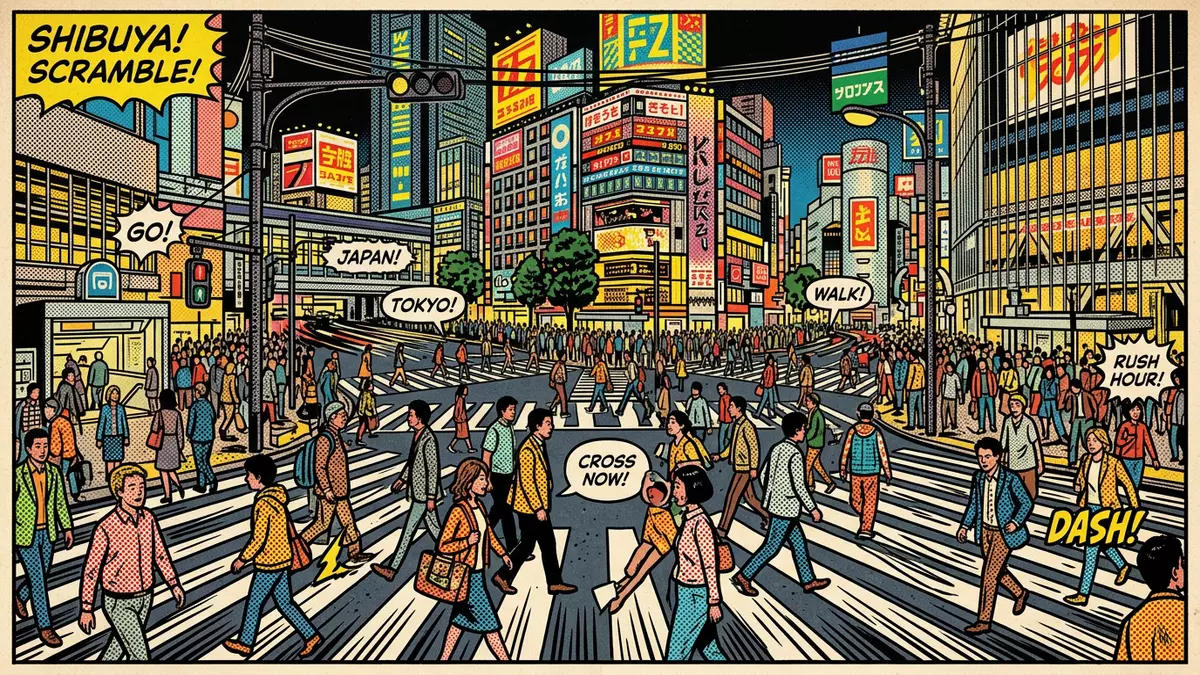
Shibuya Scramble Crossing is the broad street crossing outside Shibuya Station in Tokio, Japan. Its name is tied to the Hachik? exit, and the crossing sits where several streets meet at street level.
Shibuya’s crossing at street level
The crossing is known for its all-direction pedestrian phases, a format that lets people move across the junction from more than one side at once. It is part of the street network, with the station frontage and road markings forming the main public scene.
The crossing appears in the dense urban fabric of Shibuya, where station buildings, shopfronts and signalised roads press together around the junction. The place is defined less by enclosure than by the way its open surface holds traffic, people and signage in one frame.
Shibuya Station and the district around it
Shibuya Station is the anchor point for the crossing, and the Hachik? exit remains the most direct reference point. The district around it developed with the railway, and the crossing belongs to that layered station landscape.
The area is part of central Tokio’s rail-heavy core, and the crossing links several public streets at the edge of the station precinct. That gives it the character of a junction rather than a plaza, even though it is read like a public place in its own right.Shibuya Scramble Crossing is widely identified with Shibuya itself, and the crossing is described as a scramble crossing rather than a conventional one-way street intersection.outside Shibuya Station
The crossing as a public image of Tokio
The crossing has become one of the clearest urban views in Tokio because it condenses the city into one ground-level scene. The diagonal movement across the junction is part of what people recognise immediately.
Its significance comes from visible repetition: signals change, people stream across, and the station frontage stays fixed at the edge. The result is a place where movement and built form are read together in a single glance.Shibuya Crossing Tokio sits in central Tokyo, and the crossing’s position beside the station explains why it remains such a legible urban landmark.the Hachik? exit
Visiting Shibuya Scramble Crossing: what travellers from Western Europe should know
- The crossing is in Shibuya, beside Shibuya Station and the Hachik? exit. Rail travellers reach it through one of Tokio’s busiest station districts.
- The terrain is urban and level. The main feature is a signal-controlled road surface rather than steps, ramps or a raised viewpoint.
- English-language references to the place usually use Shibuya Scramble Crossing or Shibuya Crossing. Japanese signage in the district uses the station and crossing names of the area.
- The crossing sits in a street network with multiple approaches from the station side. That makes the junction easy to read as a place of crossings rather than a single road.
Searching for Shibuya Scramble Crossing on social platforms
These links open searches for Shibuya Scramble Crossing on each platform.
Frequently asked questions about Shibuya Scramble Crossing
Where is Shibuya Scramble Crossing?
It is in Shibuya, Tokio, directly outside Shibuya Station near the Hachik? exit. The crossing belongs to the station district rather than to a separate square.
What should visitors expect?
Expect a signal-controlled street crossing with traffic moving in several directions across a broad junction. The setting is urban, with station buildings and road frontage close to the crossing.
What makes it distinctive?
Its all-direction pedestrian phases and station-front location make the crossing easy to recognise. The place is read as a street scene, yet it carries the weight of a city landmark.


