
Shinjuku Gyoen, where three garden worlds meet in Tokyo
Published on 09/04/2026 at 11:11 | Editorial responsibility: Rafael Müller, Editor-in-Chief AD HOC NEWS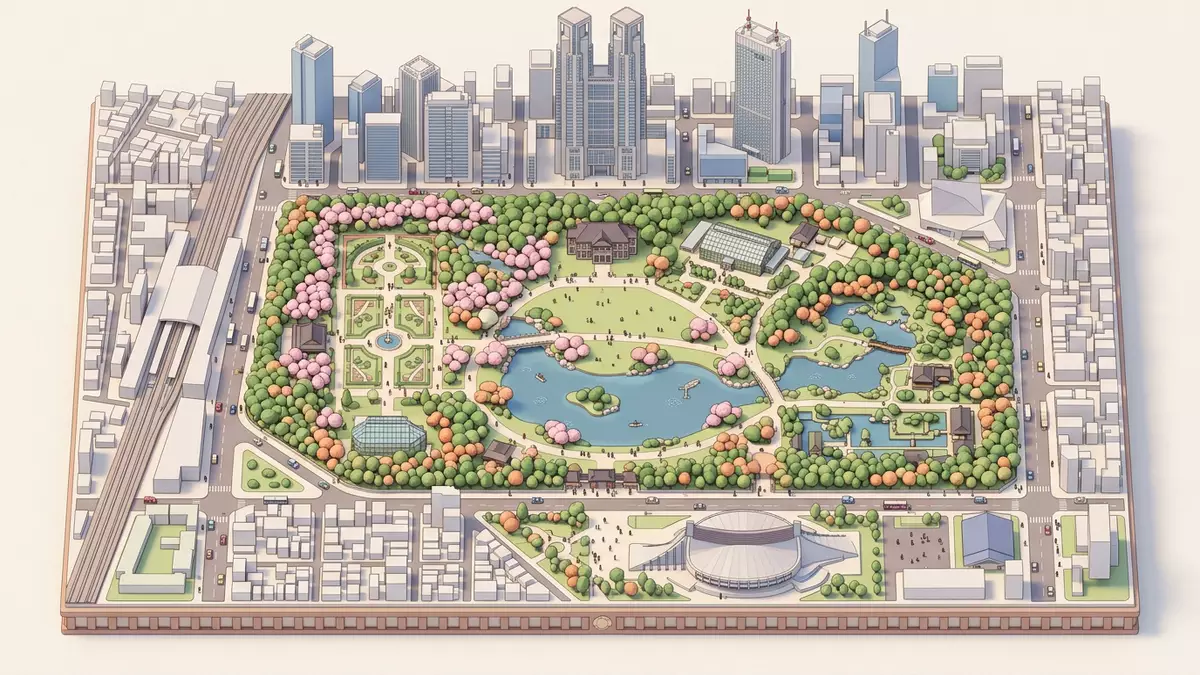
Shinjuku Gyoen National Garden is a broad sweep of lawns, ponds and tree-lined paths set between Shinjuku and Shibuya in Tokyo, on land first granted to the Nait? family in 1590 under Tokugawa Ieyasu. In its present form it brings Japanese, French and English garden traditions together inside a single enclosed park, turning a walk through the grounds into a sequence of distinct landscapes. The garden opened as a national garden in 1949 after earlier centuries as a feudal estate, experimental farm and imperial garden, and its layered history remains visible in both its layout and its surviving buildings.
From feudal estate to national garden
The story of this green enclave begins in the late sixteenth century, when Tokugawa Ieyasu granted a vast estate in the Shinjuku area to his vassal Kiyonari Nait?, establishing a residence and garden that would anchor the Nait? family in Edo. Over the Edo period the family developed formal gardens on the site, creating a landscape that prefigured the later public park.grant of land to Kiyonari Nait? After the Meiji Restoration in 1868, the grounds shifted from aristocratic retreat to state project, becoming the Naito Shinjuku Experimental Station in 1872, where new crops and horticultural techniques were tested as Japan engaged with Western science and agriculture.
In 1879 the estate entered a new chapter as the Shinjuku Imperial Botanical Garden under the Imperial Household Agency, marking its elevation from working farm to formal garden. In 1901 the head of the garden, Hayato Fukuba, invited French landscape architect Henry Martinet from Versailles to redesign the grounds, and the remodelled Shinjuku Imperial Garden opened in May 1906 with Emperor Meiji in attendance.opening of Shinjuku Imperial Garden in 1906 Much of the garden was later damaged in air raids during 1945, but it was rebuilt and, on 21 May 1949, opened to the public as Shinjuku Gyoen National Garden under the Ministry of Health and Welfare, passing to the Ministry of the Environment in 2001.
Three garden styles within one enclosure
One of the striking aspects of Shinjuku Gyoen is the way three distinct garden traditions share the same ground: a Japanese traditional garden with ponds and teahouses, a French formal garden with straight paths and ordered flowerbeds, and an English landscape garden with broad lawns and scattered trees.three distinct garden styles The French section reflects Martinet’s early twentieth-century redesign, with aligned rows of trees and geometrically arranged planting that frame long vistas. Nearby, the English-style lawns open out in gentle slopes, with solitary trees and meandering paths giving the space a parkland character.
The Japanese garden zone centres on water, islands and carefully composed planting, with pavilions and teahouses placed beside ponds so that built structures and vegetation form continuous scenes. Within these areas, paths loop around the water, crossing bridges and passing groves of cherry and other trees, so that a circuit leads through shifting combinations of open lawn, dense shade and framed views. The coexistence of these three approaches in one park gives Shinjuku Gyoen a particular rhythm: moving from clipped symmetry to looser lawns and on to pond-side paths feels like crossing borders between garden cultures without leaving central Tokyo.combination of Japanese, French and English garden traditions
Scale, layout and access gates
Beyond its stylistic variety, Shinjuku Gyoen is notable for its size and clear layout. The garden covers about 58.3 ha, equivalent to roughly 145 acres, and its perimeter runs to around 3.5 km (2.2 mi), a scale that allows broad lawns, spacious groves and long walkways to sit within a single enclosed space.58.3 ha and 3.5 km perimeter The grounds stretch broadly east–west, and three main gates – Shinjuku Gate, Okido Gate and Sendagaya Gate – provide access from different sides of the surrounding districts.three main gates
Inside the walls, wide avenues connect more intimate paths, and large open lawns sit beside denser plantings, greenhouses and small architectural elements such as pavilions. The layout reflects its early twentieth-century redesign, with the main garden zones organised so that visitors can move between them without crossing major roads, giving a sense of continuity from one style to another. The surrounding city is close in every direction, yet the internal structure – gates, perimeter and zoning – means the garden forms a distinct world of its own.
Visiting Shinjuku Gyoen: what travellers from Western Europe should know
- Shinjuku Gyoen lies in Naito-machi in Shinjuku City, west of central Tokyo Station, with Shinjuku Gate within walking distance of JR Shinjuku Station and Shinjukugyoenmae Station on the Marunouchi Line.
- The terrain inside the garden is generally level, with long, gently curving paths across lawns and around ponds; some routes include steps and slopes within the Japanese garden area.
- The official language is Japanese and the currency is the yen.
- Entry requirements depend on your nationality; UK travellers can check the FCDO travel advice at gov.uk/foreign-travel-advice, Irish travellers the Department of Foreign Affairs at ireland.ie.
Searching for Shinjuku Gyoen on social platforms
These links open searches for Shinjuku Gyoen on each platform.
Frequently asked questions about Shinjuku Gyoen
Where is Shinjuku Gyoen located in Tokyo?
Shinjuku Gyoen stands in Naito-machi in Shinjuku City, between the districts of Shinjuku and Shibuya, with its main gate near JR Shinjuku Station.
What can visitors expect on a visit to Shinjuku Gyoen?
Visitors can walk broad lawns, pond-side paths and tree-lined avenues, moving between Japanese garden scenes, French-style formal planting and English landscape-style parkland inside one large enclosed garden.
What makes Shinjuku Gyoen distinctive among Tokyo’s green spaces?
Its combination of three major garden styles, its origins in a sixteenth-century feudal estate and its scale of around 58.3 ha together make Shinjuku Gyoen a distinctive landscape within central Tokyo.


