
Shwedagon Pagoda and its golden hilltop presence in Yangon
Published on 08/17/2026 at 14:15 | Editorial responsibility: Rafael Müller, Editor-in-Chief AD HOC NEWS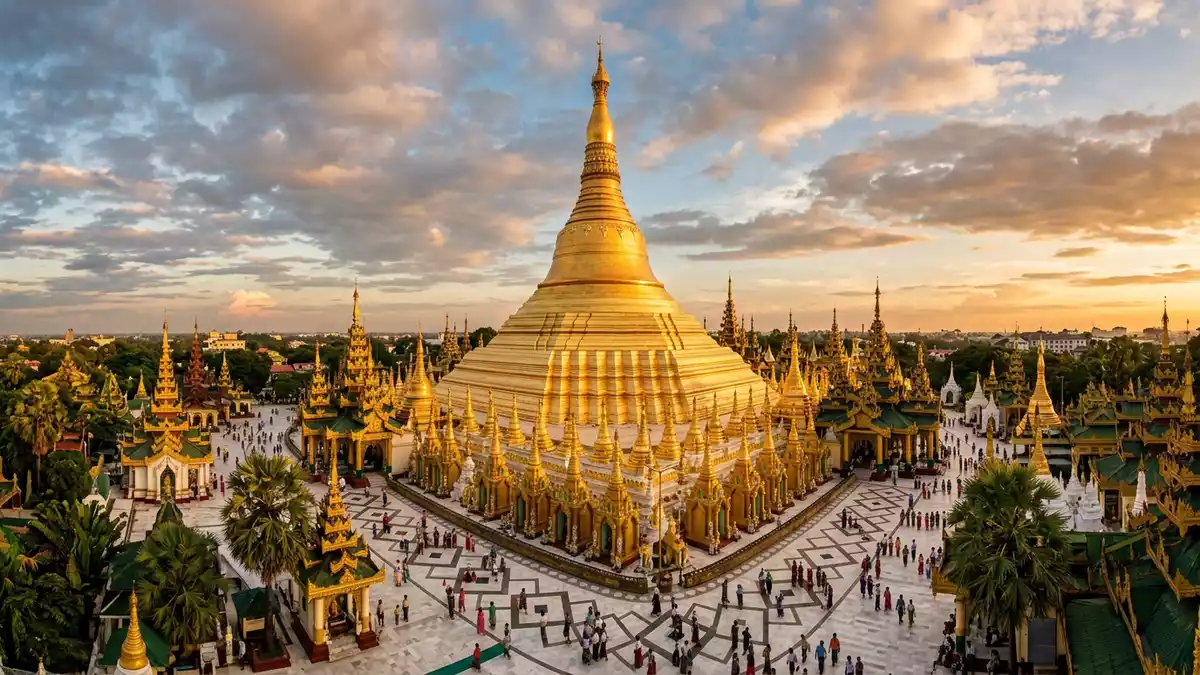
Shwedagon Pagoda in Yangon is defined by its gilded central stupa rising above a hilltop platform, surrounded by a dense ring of shrines and prayer halls that form a complete sacred precinct. The monument combines legend reaching back more than two millennia with a structure that took shape over many royal building campaigns between the medieval and early modern periods.
Gilded brick stupa on Singuttara Hill
Shwedagon Pagoda crowns Singuttara Hill in Yangon, a low rise whose summit has been turned into a continuous terrace carrying the main stupa and its surrounding structures.Singuttara Hill in Yangon At the heart of the complex stands a solid brick stupa, built as a reliquary and entirely sheathed in gold, rising to a height of about 99 m (326 ft) above its base.solid brick stupa covered with gold The stupa itself sits on a hill that is about 51 m (168 ft) above the surrounding city, so that its gilded surfaces are visible from many parts of Yangon.51 m high hill above the city
The form of the main stupa follows the characteristic Burmese bell-shaped outline, rising from a series of receding terraces and mouldings into a tapering shaft that supports a multi-tiered crown structure known as the hti. Layers of gilding cover the brick core, with gold leaf and gold plates applied over many generations as a devotional offering. Around the base of the stupa, subsidiary stupas, small pavilions and shrines cluster in a tight belt, giving the platform a continuous built edge broken only where stairways and covered walkways arrive from the slopes below.
Layers of legend and royal construction
According to long-standing Buddhist tradition, Shwedagon Pagoda is associated with relics of four Buddhas, including hair relics of Gautama Buddha, and is linked in legend to a foundation more than 2,500 years ago.legend of relics and early foundation Scholarly research places the first construction of the stupa between the sixth and tenth centuries AD, with later chronicles and inscriptions charting successive enlargements and repairs under Mon and Burmese rulers.first built between the 6th and 10th centuries By the fourteenth century the monument appears firmly in written history, when King Binnya U increased its height and strengthened its form.
In the fifteenth century, Queen Shin Sawbu, ruling in the Pegu region, is recorded as having raised the stupa further and formalised the terrace around the hill with paving and structural works.Queen Shin Sawbu’s enlargement and gilding She is closely associated with the practice of gilding the monument, having donated her own weight in gold to be beaten into leaf for the stupa’s surface. Subsequent kings continued both the physical enlargement and the gilding tradition. Earthquakes in the seventeenth and eighteenth centuries damaged the structure, and an earthquake in 1768 brought down the upper part of the stupa. King Hsinbyushin then rebuilt and raised it to its present height in the 1770s, fixing the bell-shaped form and overall profile that visitors see.
A complete hilltop pilgrimage complex
The central stupa is only one part of Shwedagon Pagoda’s spatial experience; the hilltop terrace is packed with monasteries, prayer halls, image houses and smaller stupas that together form a full religious precinct. Covered stairways and long corridors climb the flanks of Singuttara Hill from the city streets to the upper platform, with vendors and donation boxes lining sections of the approach.approach from Yangon streets to the terrace On the terrace itself, open spaces and built structures alternate, so that views to the gilded stupa are framed by tiered roofs and carved pillars.
Many of the subsidiary buildings follow traditional Burmese timber architecture, with multi-tiered roofs and ornamental woodwork, while others are masonry halls with tiled floors and colonnades. Around the perimeter, planetary shrines and zodiac shrines mark positions associated with days of the week, each with its own image and water basins for ritual offerings.planetary shrines and terrace layout The combination of the massive brick stupa, the surrounding ensemble of structures and the elevated setting makes Shwedagon Pagoda a prominent feature in the skyline as well as a layered ritual landscape.
Visiting Shwedagon Pagoda: what travellers from Western Europe should know
- Shwedagon Pagoda stands on Singuttara Hill in Yangon, in the Dagon township, reached by roads and urban public transport up to the foot of its covered stairways.
The complex forms a landmark above the surrounding city streets. - The ascent from the city level to the main terrace involves long stairways and ramps that gain about 51 m (168 ft) in height, with sections under roofs and others more exposed.
Visitors move across polished paving on the upper platform. - The official language is Burmese and the currency is the Myanmar kyat.
- Entry requirements depend on your nationality; UK travellers can check the FCDO travel advice at gov.uk/foreign-travel-advice, Irish travellers the Department of Foreign Affairs at ireland.ie.
Searching for Shwedagon Pagoda on social platforms
These links open searches for Shwedagon Pagoda on each platform.
Frequently asked questions about Shwedagon Pagoda
Where is Shwedagon Pagoda located?
Shwedagon Pagoda stands on Singuttara Hill in Yangon, in the Dagon township of Myanmar, elevated above the surrounding urban neighbourhoods.
What can visitors expect on a visit to Shwedagon Pagoda?
Visitors encounter a hilltop terrace with a gilded brick stupa, numerous shrines and prayer halls, and long stairways rising from the city streets to the main platform.
What makes Shwedagon Pagoda distinctive among Buddhist sites?
Its combination of a gold-covered bell-shaped stupa, multi-century royal patronage and a complete hilltop pilgrimage complex overlooking Yangon gives Shwedagon Pagoda a particularly marked character.


