
Shwedagon Pagoda and its golden hilltop world above Yangon
Published on 08/14/2026 at 14:19 | Editorial responsibility: Rafael Müller, Editor-in-Chief AD HOC NEWS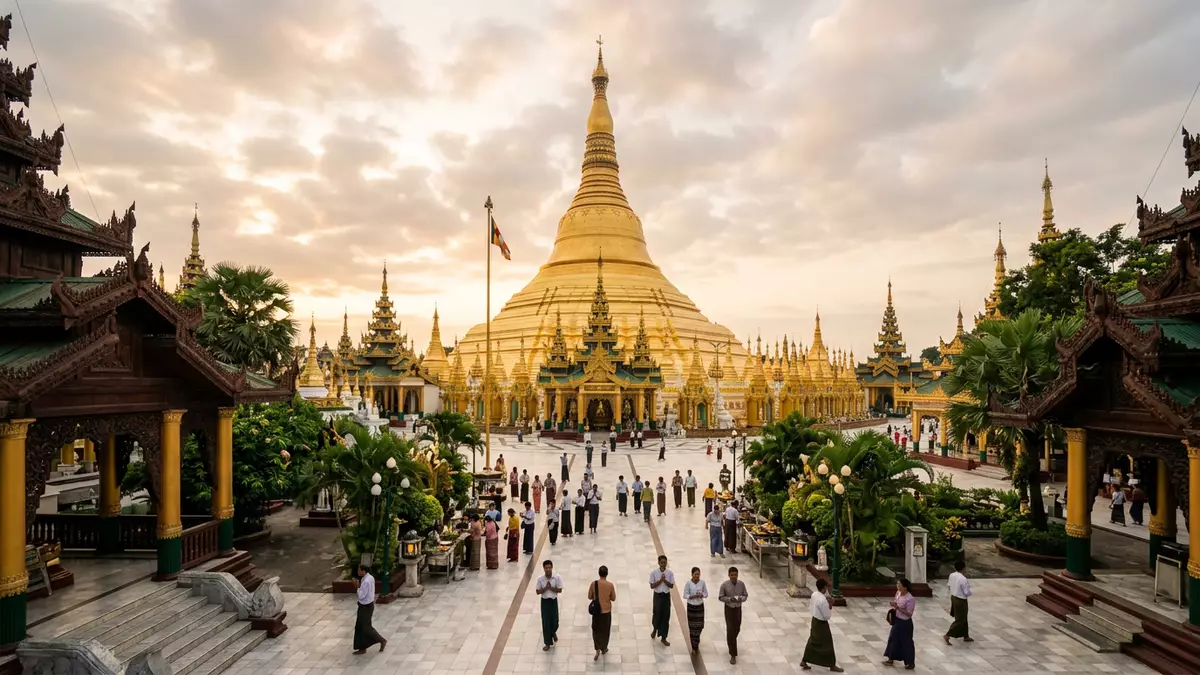
Shwedagon Pagoda on Singuttara Hill in Yangon is a vast Buddhist temple complex dominated by a golden stupa that rises above the cityscape and has grown through centuries of royal patronage and reconstruction.Shwedagon Pagoda on Singuttara Hill The hilltop setting, the gilded main stupa and the broad marble platforms together form a self-contained world of worship and ritual overlooking Myanmar’s largest city.solid brick stupa covered with gold
The golden stupa and hilltop layout
The core of Shwedagon Pagoda is a solid brick stupa entirely sheathed in gold, rising about 99 m (325 ft) above its base on Singuttara Hill and crowned by a tiered metal umbrella.solid brick stupa that is completely covered with gold The hill itself is about 51 m (167 ft) high, so the stupa and its platform stand well above the surrounding streets of Yangon.built on the 51-metre-high Singuttara Hill
The upper platform around the stupa is paved in pale marble and extends across several hectares, forming a broad terrace ringed by shrines, pavilions and subsidiary stupas.upper platform 5.66 hectares in area Approaches from the city rise through covered stairways and halls before emerging onto this open space, where the gilded stupa dominates the skyline and smaller structures crowd around its base.
Layers of history and royal rebuilding
Shwedagon Pagoda is traditionally dated to an early Buddhist period, with legend linking it to relics of the Buddha, while historians place its first construction between the sixth and tenth centuries AD.first built between the 6th and 10th centuries AD The earliest secure references in Burmese royal chronicles date to 1362/63, when King Binnya U of the Martaban–Hanthawaddy kingdom raised the pagoda to a modest height and brought it back from disrepair.first mention in the royal chronicles dates only to 1362/63
In the fifteenth century, Queen Shin Saw Pu, ruling from Bago, enlarged Shwedagon Pagoda and increased the height of the stupa, establishing it as a major focus of Buddhist devotion in Lower Burma.Queen Shin Saw Pu raised its height to 40 m Later monarchs continued to rebuild and embellish the monument; after a severe earthquake in 1768 brought down the upper part of the stupa, King Hsinbyushin of the Konbaung dynasty had it rebuilt in the eighteenth century to a height of about 99 m, a form that defines the pagoda today.King Hsinbyushin later raised it to its current height of 99 meters
A living Buddhist pilgrimage complex
The architectural form of Shwedagon Pagoda is that of a central stupa flanked by many subsidiary structures, with worship focused on relics enshrined deep within the solid core rather than in an interior hall.massive gold covered stupa Around the stupa, chapels, image houses and open prayer platforms provide space for offerings of flowers, candles and incense, while walkways on the marble terrace link the different sectors of the complex.
Shwedagon Pagoda functions as a major pilgrimage site for Buddhists from Myanmar and neighbouring regions, with the combination of gold surfaces, relic veneration and long historical continuity giving it a special status in Theravada Buddhist practice.one of Buddhism’s most sacred sites Monastic buildings, prayer halls and smaller stupas extend around the main terrace, integrating the hilltop religious space into the wider urban fabric of Yangon.
Visiting Shwedagon Pagoda: what travellers from Western Europe should know
- Shwedagon Pagoda stands on Singuttara Hill north-west of central Yangon, reached by roads climbing from the city and by covered stairways leading up from several entrances around the base.
- The temple complex is built on a hilltop terrace with long flights of steps; visiting involves walking on stone and marble surfaces and crossing broad open platforms around the main stupa.
- The official language is Burmese and the currency is the Myanmar kyat.
- Entry requirements depend on your nationality; UK travellers can check the FCDO travel advice at gov.uk/foreign-travel-advice, Irish travellers the Department of Foreign Affairs at ireland.ie.
Searching for Shwedagon Pagoda on social platforms
These links open searches for Shwedagon Pagoda on each platform.
Frequently asked questions about Shwedagon Pagoda
Where is Shwedagon Pagoda located?
Shwedagon Pagoda stands on Singuttara Hill in Yangon, Myanmar, above the urban area and near major roads and districts in the northern part of the city.
What can visitors expect when visiting Shwedagon Pagoda?
Visitors encounter a large hilltop complex centred on a golden stupa, with marble platforms, stairways, shrines and prayer spaces that form an extensive religious environment.
What makes Shwedagon Pagoda distinctive among Buddhist sites?
The combination of its gilded stupa rising about 99 m (325 ft), its position on Singuttara Hill and its documented history of royal rebuilding across several centuries gives Shwedagon Pagoda a distinctive character.


