
Shwedagon Pagoda and the golden hill above Yangon
Published on 08/19/2026 at 20:38 | Editorial responsibility: Rafael Müller, Editor-in-Chief AD HOC NEWS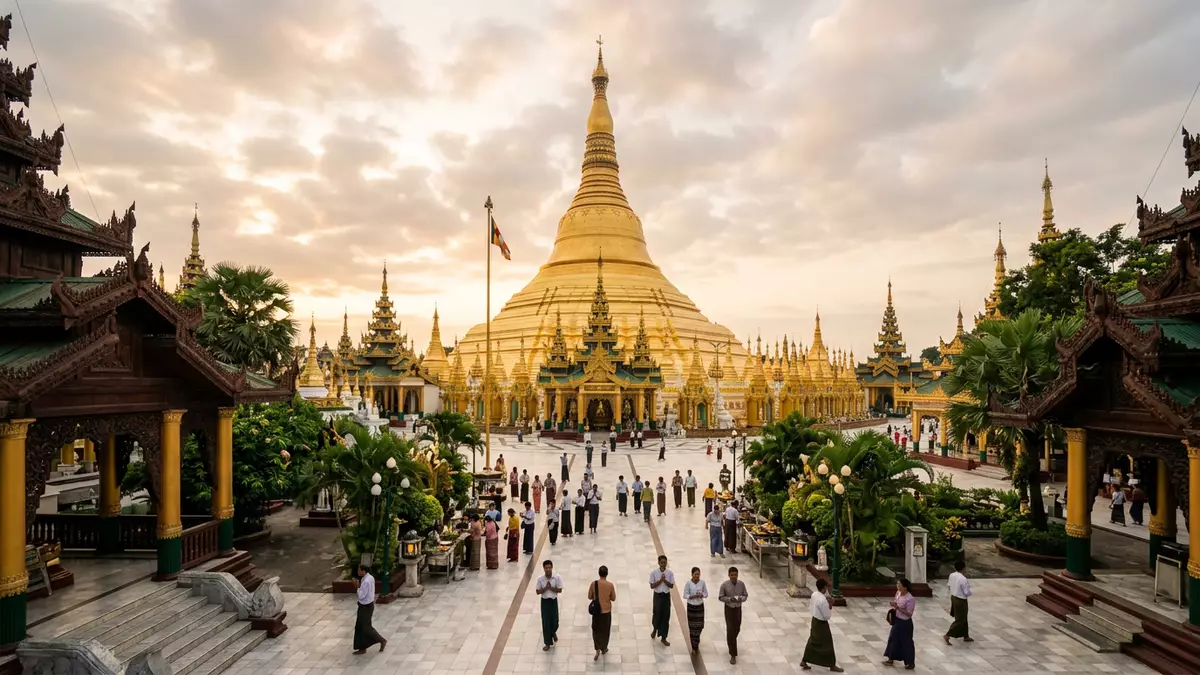
Shwedagon Pagoda rises above Yangon as a gold-clad stupa on Singuttara Hill, combining a dominant skyline presence with an intricate terrace of shrines and halls at its base. The hilltop complex developed over many centuries, with key enlargements by rulers such as King Binnya U in the fourteenth century and Queen Shin Sawbu in the fifteenth century, and the main stupa reaching about 99 m (326 ft) in height.
The golden stupa on Singuttara Hill
The core of Shwedagon Pagoda is a solid brick stupa sheathed in gold, standing on the summit of Singuttara Hill in central Yangon. The structure is described as rising about 99 m above its platform, with the hill itself adding further elevation over the surrounding city, which makes the gilded form visible from many directions.The brick stupa rises about 99 m The outer surface is renewed with gold plates and leaf, and at the summit a multi-tiered metal crown, or hti, is hung with small bells and precious stones.The upper sections are decorated with jewels and bells
Archaeological and historical studies point to a construction history stretching back many centuries. Research indicates that the first substantial stupa on this hill was built by the Mon people between the sixth and tenth centuries CE, with later kings and queens enlarging and encasing the structure.Scholars place the first stupa between the sixth and tenth centuries Royal chronicles record that King Binnya U increased the height to about 18 m in the fourteenth century, and Queen Shin Sawbu raised it further in the fifteenth century, with subsequent works bringing the stupa to its present scale.King Binnya U and Queen Shin Sawbu are named in the chronicles
Layers of relics, legends and royal patronage
Shwedagon Pagoda is closely linked with relic traditions in Theravada Buddhism. Long-established accounts describe eight strands of hair of Gautama Buddha being enshrined within the stupa, together with relics associated with three earlier Buddhas of this world age.The relics are said to include eight hairs of Gautama Buddha These narratives are tied to merchant brothers, Tapussa and Bhallika, who transported the relics to the site, and to early Mon rulers who provided the hill as a sacred location.
Over the centuries, successive rulers used gifts of gold and structural additions to reinforce their connection with Shwedagon Pagoda. Queen Shin Sawbu, who ruled in the fifteenth century, is described as donating her weight in gold several times for gilding the stupa, and King Hsinbyushin in the eighteenth century contributed a significant new hti after earthquake damage.Queen Shin Sawbu and King Hsinbyushin are associated with major donations The monument sits on the UNESCO Tentative List as Shwedagon Pagoda on Singuttara Hill, recognised for its role in the transmission of Buddhist art and architecture between South Asia and mainland Southeast Asia.Shwedagon Pagoda appears on the UNESCO Tentative List
A terrace of shrines, pavilions and processional routes
At the base of the main stupa, broad terraces form a continuous platform lined with smaller stupas, image shrines and covered pavilions. The overall composition follows a form familiar in Burmese Buddhist architecture, where a dominant central stupa is surrounded by secondary structures facing it, each sheltering Buddha images or spaces for prayer.Descriptions emphasise the central stupa with surrounding terraces The brick base is paved and raised high above the surrounding streets, so reaching the platform involves a sustained ascent from ground level.
Four processional stairways lead from the city up to the main terrace, aligned loosely with the cardinal directions and marked by monumental gateway structures. Around the edges of the platform, shrines connected with the days of the week provide focal points for visitors, while larger halls house community prayer spaces and rest areas shaded under timber or concrete roofs. The effect is of a dense sacred landscape arranged around the central gold-clad core, with sightlines back to the stupa from almost every point on the terrace.
Visiting Shwedagon Pagoda: what travellers from Western Europe should know
- Shwedagon Pagoda stands on Singuttara Hill in Yangon, in the lower part of Myanmar, and is reached by stairways and access roads that climb from the surrounding streets.
- The ascent from street level to the main terrace involves long flights of steps under covered approaches, so a visit includes sustained walking on inclined paths and staircases.
- The complex lies within the built-up area of Yangon, and the platform offers views across the city’s low-rise districts with other religious buildings visible beyond the hill.
- The official language is Burmese and the currency is the Myanmar kyat. Entry requirements depend on your nationality; UK travellers can check the FCDO travel advice at gov.uk/foreign-travel-advice, Irish travellers the Department of Foreign Affairs at ireland.ie.
Searching for Shwedagon Pagoda on social platforms
These links open searches for Shwedagon Pagoda on each platform.
Frequently asked questions about Shwedagon Pagoda
Where is Shwedagon Pagoda?
Shwedagon Pagoda stands on Singuttara Hill in Yangon, a major city in the south of Myanmar, rising above the surrounding urban districts.
What should visitors expect during a visit?
Visitors encounter a raised terrace reached by long stairways, a central gold-clad stupa and a ring of shrines, halls and smaller stupas arranged around it.
What makes Shwedagon Pagoda distinctive among Buddhist sites?
The combination of a tall gilded brick stupa, its location on a hill above Yangon and its close association with relic traditions and royal patronage give Shwedagon Pagoda a distinctive character.


