
Shwezigon Pagoda and the golden form of Bagan
Published on 09/23/2026 at 16:29 | Editorial responsibility: Rafael Müller, Editor-in-Chief AD HOC NEWS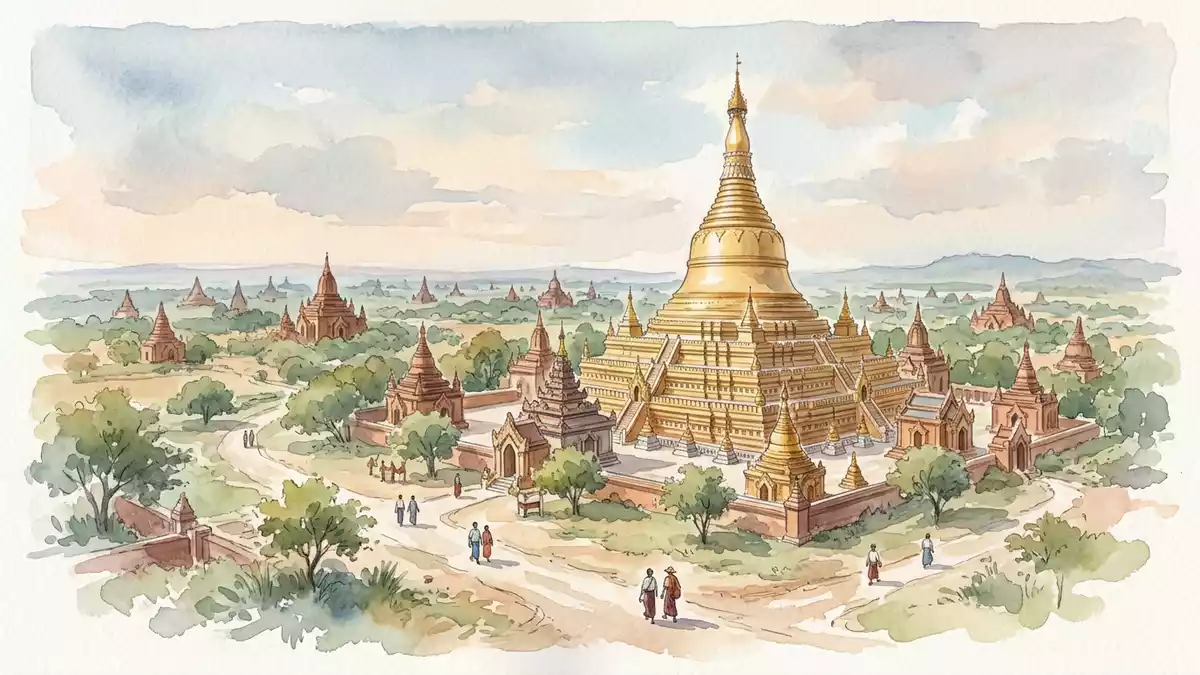
Shwezigon Pagoda rises near Nyaung-U, at the northern edge of the Bagan archaeological landscape. Its central stupa is covered in gold and shaped as a bell above stepped terraces, creating a clear vertical focus across the compound.
King Anawrahta began the pagoda in the eleventh century, and King Kyansittha completed it in 1102. The building belongs to the early Bagan period, when Theravada Buddhist architecture developed across the central plain of Myanmar.
Shwezigon Pagoda’s bell-shaped centre
The main structure combines a square lower section with a circular upper section. A bell-shaped stupa crowns the terraces, while stairways, gates and decorative spires mark the surrounding architecture. This arrangement is described in the pagoda’s terraced form.
Brick forms the core of the monument, while gilded surfaces cover the central mass. Smaller shrines, image houses and pavilions occupy the surrounding compound, placing the large stupa within a layered religious precinct.
The terraces carry decorative work associated with Buddhist storytelling. Their surfaces and surrounding buildings contain images, mouldings and architectural details that belong to the visual language of Bagan.
Anawrahta, Kyansittha and the early Bagan period
Anawrahta ruled from 1044 to 1077 and founded the Bagan Kingdom. Construction of Shwezigon Pagoda began during his reign, with the completed monument associated with his successor Kyansittha.
The pagoda’s history belongs to the Bagan Period, which UNESCO dates to the eleventh through thirteenth centuries. Bagan became a capital of a regional Buddhist empire, and its surviving monuments record religious patronage, artistic production and royal building.
Bagan was inscribed as a UNESCO World Heritage Site in 2019. The designated cultural landscape includes stupas, temples, monasteries, inscriptions, murals and sculptures across the Ayeyarwady plain, as recorded in Bagan’s World Heritage description.
Shwezigon Pagoda remains a Buddhist place of worship within this historic landscape. Pilgrimage, prayer and the care of sacred images belong to the monument’s continuing cultural life.
Buddhist relics, nat traditions and living worship
Tradition connects Shwezigon Pagoda with relics of the Buddha, including a tooth and bone relic. These traditions place the stupa within Myanmar’s long history of relic veneration and merit-making.
The compound also contains a shrine associated with the thirty-seven nat spirits of Burmese religious tradition. Nat worship predates the royal establishment of Theravada Buddhism, and the shrine stands beside Buddhist architectural forms.
Images connected with the nat tradition and Buddhist figures give the precinct a layered religious character. The relationship between these traditions is part of Shwezigon Pagoda’s historical identity, rather than a decorative detail added to the monument.
The pagoda’s architectural importance reaches beyond its own compound. Its square terraces, circular upper form and bell-shaped stupa became a reference point for later Burmese zedi design, as described in the shrine’s Buddhist context.
Gold, brick, terraced geometry and sacred imagery meet in one visible composition. Shwezigon Pagoda is therefore read through its surfaces and forms, but also through the religious practices that continue around them.
Visiting Shwezigon Pagoda: what travellers from Western Europe should know
- Shwezigon Pagoda is in Nyaung-U, near Bagan and close to the Ayeyarwady River. Road transport from Bagan reaches the town and the pagoda compound.
- The complex contains stepped terraces, stairways and uneven stone or brick surfaces. Visitors encounter an outdoor religious precinct rather than a single enclosed hall.
- Myanmar’s official language is Burmese and the national currency is the kyat.
- Entry requirements depend on your nationality; UK travellers can check the FCDO travel advice at gov.uk/foreign-travel-advice, Irish travellers the Department of Foreign Affairs at ireland.ie.
Searching for Shwezigon Pagoda on social platforms
These links open searches for Shwezigon Pagoda on each platform.
Frequently asked questions about Shwezigon Pagoda
Where is Shwezigon Pagoda?
Shwezigon Pagoda is in Nyaung-U, near Bagan in central Myanmar. The compound lies within the wider Bagan cultural landscape beside the Ayeyarwady plain.
What is the pagoda like?
The monument has stepped square terraces, a circular upper section and a gilded, bell-shaped stupa. Smaller shrines, gates and religious buildings surround the central structure.
What makes Shwezigon Pagoda distinctive?
Its identity joins early Bagan architecture with Buddhist relic traditions and a shrine for the thirty-seven nat spirits. King Anawrahta began it, and King Kyansittha completed it in 1102.


