

Sidi Bou Said and the white-blue hillside above Tunis
Published on 08/15/2026 at 14:36 | Editorial responsibility: Rafael Müller, Editor-in-Chief AD HOC NEWS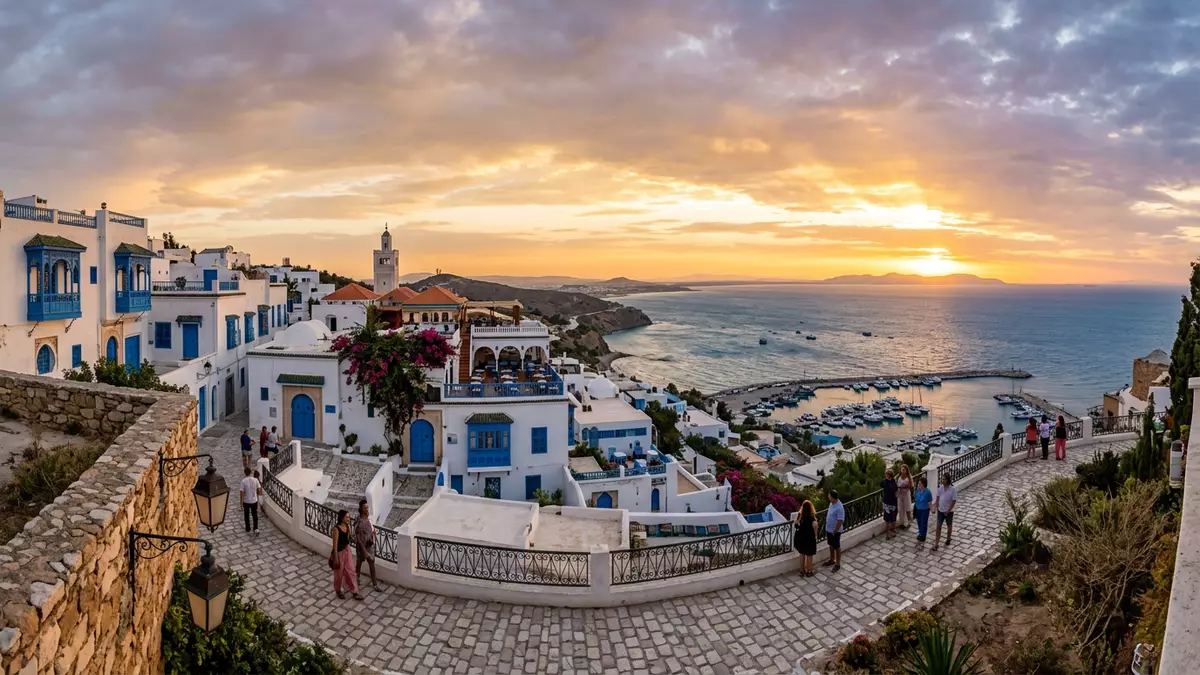
Sidi Bou Said rises above the Gulf of Tunis with white walls, blue-painted woodwork and a hillside street pattern that gives the village a clear profile. The place sits near Tunis and carries the name of the Sufi saint Abou Saïd Khalaf Ibn Yahya El Tamimi El Beji.
Sidi Bou Said on its cliff above the gulf
The village occupies a promontory above Carthage and the Gulf of Tunis, with views across the water and towards the surrounding coast. Its setting links the built village to the slope beneath it, where lanes, terraces and buildings step along the hill.
The place is rooted in the nineteenth-century urban and cultural world of the Tunis area, while its older identity is tied to the saint whose name it bears. The village developed around a religious nucleus and later gathered houses, civic spaces and places of retreat into a compact hill settlement.
White walls, blue wood and Mediterranean light
The most immediate feature is the colour contrast between the white limewashed surfaces and the blue details on doors, shutters and windows. That palette gives the village a unified appearance without flattening the variety of houses, cafés, terraces and passages.
Stone, plaster and painted timber appear together across the hill. The result is a dense streetscape rather than a single monument, with the village read as an ensemble of houses and public spaces.
Religious architecture remains part of the identity of the place. The zaouia of Sidi Bou Said stands within the village tradition, and the saint’s presence continues to frame the name and memory of the settlement.
A settlement shaped by religion and cultured visitors
The village grew from a sacred hilltop setting into a residential and cultural place associated with Tunisian elites, scholars and artists. Baron Rodolphe d’Erlanger is one of the best-known names linked with its later profile, and his presence helped define the village’s architectural reputation.
Its houses and public spaces reflect a mix of local, Arab-Andalusian and Mediterranean influences. The village therefore reads less like a single-period site than a layered hillside quarter where domestic life, devotion and aesthetic display overlap.
The name Sidi Bou Said remains tied to the saint Abou Saïd Khalaf Ibn Yahya El Tamimi El Beji, a fixed point in the village’s cultural memory. The association between saint, hill and settlement gives the place its strongest historical identity.
Visiting Sidi Bou Said: what travellers from Western Europe should know
- The village lies north-east of Tunis, above Carthage and the Gulf of Tunis. It is reached from the capital by road and by local transport from the Tunis area.
- The terrain is hilly, with lanes and steps across a steep promontory. Comfortable footwear matters more than distance here.
- The village is compact, with houses, cafés, religious buildings and viewpoints close together. Much of its interest lies in moving through the streets rather than entering a single landmark.
- Arabic and French are widely used in the area. The currency is the Tunisian dinar.
Searching for Sidi Bou Said on social platforms
These links open searches for Sidi Bou Said on each platform.
Frequently asked questions about Sidi Bou Said
Where is Sidi Bou Said?
It is a hill village north-east of Tunis in Tunisia, overlooking Carthage and the Gulf of Tunis. The settlement sits on a promontory above the coast.
What does a visit involve?
A visit means walking steep streets, seeing white-and-blue houses and moving between viewpoints, cafés and religious spaces. The village is compact rather than sprawling.
What makes Sidi Bou Said distinctive?
The strongest feature is the combination of white façades, blue details and a hillside setting tied to a Sufi saint. Baron Rodolphe d’Erlanger and the village’s layered architectural mix also belong to its identity.


