
Sigiriya and its lion rock fortress in Sri Lanka
Published on 08/19/2026 at 15:28 | Editorial responsibility: Rafael Müller, Editor-in-Chief AD HOC NEWS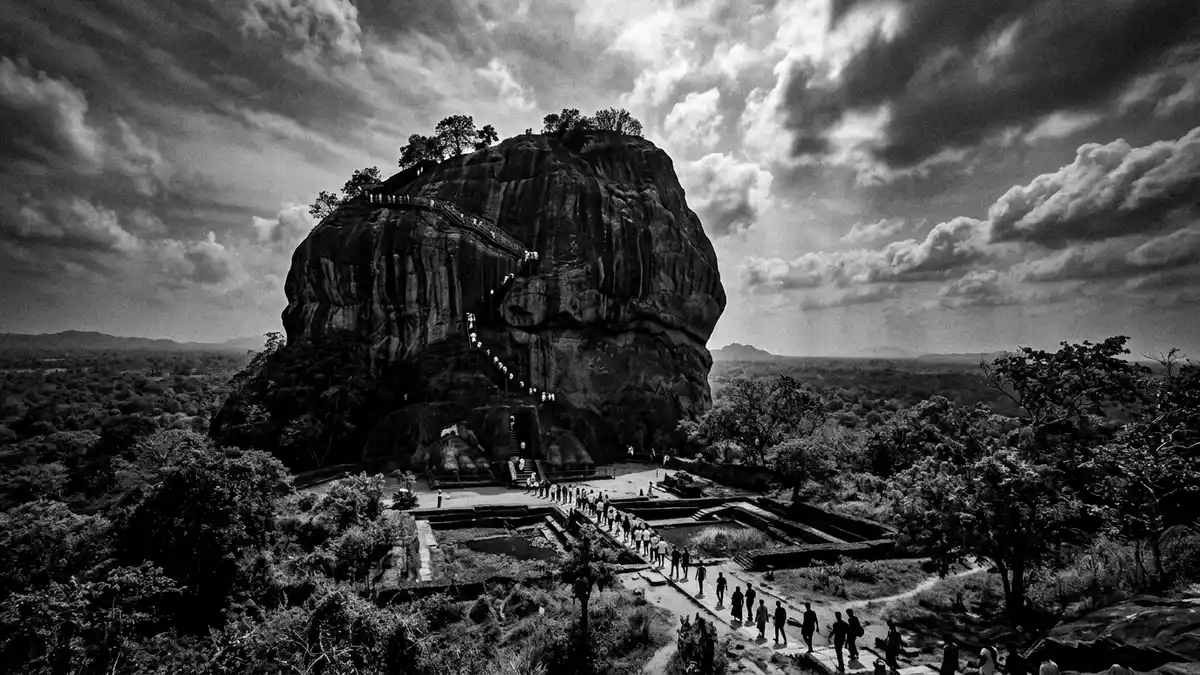
Sigiriya in central Sri Lanka is dominated by a vast granite monolith crowned with the ruins of a fifth?century royal complex, making the rock fortress itself the heart of any visit. Rising high above the surrounding plains, the “Lion Rock” brings palace remains, gardens and ancient paintings together on and around a single towering block of stone in the island’s Cultural Triangle.
The lion rock fortress above the plains
Sigiriya stands in the northern part of the Matale District, near the town of Dambulla in Sri Lanka’s Central Province, where a solitary column of granite rises dramatically above forest and farmland.northern Matale District near Dambulla The rock itself climbs by about 180 m (590 ft) from the surrounding plain, reaching an elevation that makes its summit an obvious defensive and ceremonial platform.some 600 ft above the plain From below, the sides of the rock appear steep and in places overhanging, so the built structures cling to narrow ledges and terraces.
The fortress complex integrates this natural pillar with a wider planned landscape, including formal gardens and waterworks laid out at its base.gardens and water features at ground level Paths and stairways run up the lower slopes towards the mid?level of the cliff, where decorated walls and viewing platforms mark the transition from garden to rock face. Higher still, near the upper part of the ascent, massive masonry lion paws frame the final stairway to the summit, echoing the site’s “Lion Rock” name in architecture as much as in geology.galleries and staircases from a gigantic lion
A fifth?century royal capital and its later life
Sigiriya’s main phase as a royal centre is tied to King Kassapa I, also rendered as Kasyapa, who ruled in the late fifth century AD.built by King Kashyapa I During his reign between 477 and 495, the summit of the rock was transformed into an upper palace complex, with residential and ceremonial structures laid out across the flat?topped area at the crest.upper palace built on the rock summit Below this highest zone, a mid?level terrace carried further buildings and the famous painted walls, while the foot of the rock held extensive gardens, pools and other elements of an organised capital.
After King Kassapa’s defeat in 495, Sigiriya’s role as a royal capital ended and the palace structures on the summit fell into ruin over subsequent centuries.Kashyapa defeated in 495 The site later developed as a place of religious activity, with evidence indicating long use as a Buddhist monastery until the fourteenth century.used as a Buddhist monastery until the 14th century Sigiriya’s ruins, paintings and gardens drew sustained interest, and its combined natural and cultural importance led to formal recognition as the Ancient City of Sigiriya on the UNESCO World Heritage List in 1982.World Heritage since 1982
Painted walls, mirror surfaces and planned gardens
One of Sigiriya’s distinctive features is the band of ancient wall paintings partway up the rock face, depicting figures in rich dress against flowing backgrounds.ancient frescoes on the mid?level terrace These frescoes sit above the landscaped gardens and below the summit ruins, creating a vertical sequence from water and greenery at ground level through art and passageways in the middle zone to palace remains at the top. Along the same section of the climb a long wall, once polished to a reflective sheen, gained the name “mirror wall” and carries inscriptions that document historical visitors and their responses to the site.
At the foot of the rock, planned gardens and water features showcase complex design as well as decoration.masterpiece of urban planning and hydraulic engineering Channels, pools and terraces are laid out with careful symmetry, and the arrangement of the gardens forms an axial approach towards the rock itself. This combination of hydraulic engineering, landscape architecture and cliff?side construction has made Sigiriya a reference point for studies of ancient urban planning in Sri Lanka and contributed to its description as an outstanding example of a planned historic city.World Heritage identification for the Ancient City of Sigiriya
Visiting Sigiriya: what travellers from Western Europe should know
- Sigiriya lies in Sri Lanka’s Central Province, south of Dambulla; long?distance buses and road transfers from Colombo connect with local transport towards the Sigiriya area.
- The ascent to the upper ruins involves staircases attached to the rock and metal walkways over exposed sections, so a visit includes sustained climbing with significant height exposure.
- The approach passes through formal gardens laid out on mostly level ground, followed by stone steps and narrow passages on the rock, making sturdy footwear advisable for most visitors.
- The official language is Sinhala and the currency is the Sri Lankan rupee.
- Entry requirements depend on your nationality; UK travellers can check the FCDO travel advice at gov.uk/foreign-travel-advice, Irish travellers the Department of Foreign Affairs at ireland.ie.
Searching for Sigiriya on social platforms
These links open searches for Sigiriya on each platform.
Frequently asked questions about Sigiriya
Where is Sigiriya located in Sri Lanka?
Sigiriya is in the northern part of the Matale District in Sri Lanka’s Central Province, close to the town of Dambulla within the country’s Cultural Triangle.
What should visitors expect during a visit to Sigiriya?
A visit combines walking through formal gardens at the base with a sustained climb on stairways and walkways up the rock to reach frescoes, the lion gateway and summit ruins.
What makes Sigiriya distinctive among historic sites?
Sigiriya is distinctive for its integration of a fifth?century royal palace complex, cliff?side paintings, inscriptions and planned gardens built around a single towering granite monolith.


