
Sobor Vasiliya Blazhennogo and its clustered domes in Moskau
Published on 09/08/2026 at 17:16 | Editorial responsibility: Rafael Müller, Editor-in-Chief AD HOC NEWS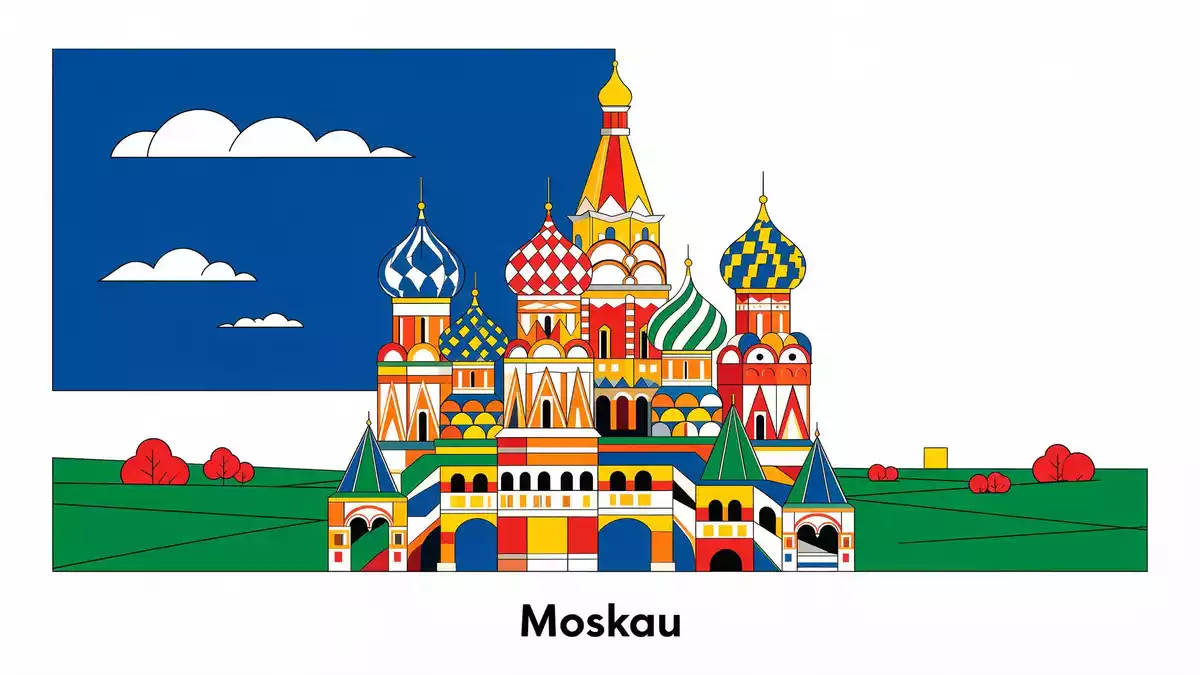
Sobor Vasiliya Blazhennogo stands on Red Square in Moskau as a clustered composition of chapels and domes, finished in the sixteenth century. Known in English as Saint Basil's Cathedral, it is one of the city’s most recognisable historic landmarks.
Red Square’s layered silhouette
The building is read first as a group rather than a single hall. Its masses rise unevenly above a shared base, and the painted surfaces make brick, vault and dome part of one dense composition. Red Square places it in the historic centre of the capital.
The cathedral belongs to the long architectural conversation of Moscow’s Kremlin edge and ceremonial square. Its present form dates from the mid-sixteenth century, and the structure remains tied to the reign of Ivan IV, known in English as Ivan the Terrible.
Ivan IV and the mid-sixteenth century
The church was commissioned under Ivan IV and completed in 1561. That date gives the building its sharp historical frame, while the name of Vasily the Blessed explains the popular title by which it is known in Russian.
The usual architectural attribution names Postnik Yakovlev and Barma among the builders. The design has also been linked to the broader world of Russian church architecture, with its clustered sanctuaries and vertically stacked forms.
A church that reads as an ensemble
Its exterior does not present a single front. Instead, the visitor sees domes, gables and small subsidiary volumes arranged around a central core, with colour carried across each surface in different patterns.
The official name is the Cathedral of the Intercession of the Most Holy Theotokos on the Moat. That title, together with the Russian name Sobor Vasiliya Blazhennogo, places the building within Orthodox devotion and Muscovite history rather than within a single saint’s cult.
Visiting Sobor Vasiliya Blazhennogo: what travellers from Western Europe should know
- It stands on Red Square in central Moskau, beside the Kremlin. Red Square in central Moskau makes it easy to place within the city centre.
- The approach is level through the square, with no mountain path or long walk attached to the site. Red Square opens directly into the architectural setting around the cathedral.
- The official language is Russian and the currency is the Russian rouble.
- Entry requirements depend on your nationality; UK travellers can check the FCDO travel advice at gov.uk/foreign-travel-advice, Irish travellers the Department of Foreign Affairs at ireland.ie.
Searching for Sobor Vasiliya Blazhennogo on social platforms
These links open searches for Sobor Vasiliya Blazhennogo on each platform.
Frequently asked questions about Sobor Vasiliya Blazhennogo
Where is Sobor Vasiliya Blazhennogo?
It stands on Red Square in Moskau, on the southern side of the Kremlin complex. The cathedral is part of the historic city centre.
What should travellers expect on a visit?
The building presents a compact sequence of chapels, stairways and painted interiors rather than one large nave. Its exterior and interior belong to a small-scale sacred ensemble.
What makes it distinctive?
The clustered domes and the mid-sixteenth-century fabric make it easy to recognise. The combination of Ivan IV’s period, the Russian Orthodox setting and the unusual massing defines its character.


