
Sri Dalada Maligawa and the palace shrine of Kandy
Published on 08/19/2026 at 20:46 | Editorial responsibility: Rafael Müller, Editor-in-Chief AD HOC NEWS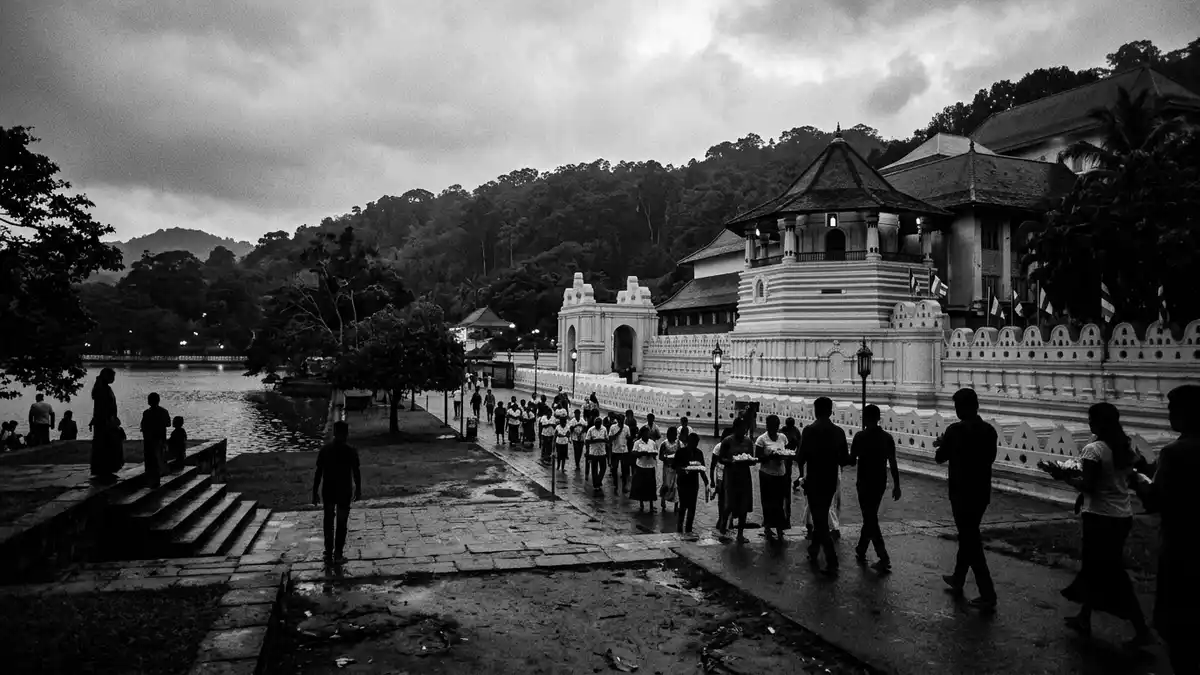
Sri Dalada Maligawa in Kandy, known in English as the Temple of the Sacred Tooth Relic, is the palace shrine where a tooth of the Buddha is enshrined within the former royal capital of Sri Lanka. Set in the old palace precinct beside Kandy Lake, the temple complex draws together royal architecture, monastic spaces and ritual halls shaped during the Kandyan Kingdom in the seventeenth and eighteenth centuries.
The royal setting of Sri Dalada Maligawa
Sri Dalada Maligawa stands within the former Royal Palace Complex of Kandy, the last capital of the Kandyan Kingdom before British rule ended the monarchy in 1815.Royal Palace Complex of Kandy The shrine occupies the eastern side of the city’s central basin, with Kandy Lake in front and the wooded slope of Udawatta Kele rising behind the palace buildings.temple near Kandy Lake
The tooth relic itself reached Sri Lanka from India in the fourth century AD during the reign of King Kithsiri Mevan, brought by Prince Dantha and Princess Hemamala according to traditional accounts.fourth century arrival of the relic It was housed in different royal centres as the island’s capitals shifted, and was brought to Kandy in the late sixteenth century under King Vimaladharmasuriya I, who created the first dedicated shrine for it within his palace.King Vimaladharmasuriya I shrine
Kandyan architecture in stone, timber and tile
The present temple complex took shape under successive Kandyan kings between the late sixteenth and early nineteenth centuries and is a showpiece of Kandyan-period architecture.Kandyan-period temple complex The main shrine building rises in whitewashed tiers capped by red tiled roofs, with deeply projecting eaves and a sequence of verandahs that lead inward towards the relic chamber. Timber pillars with carved capitals line the halls, and doorways are framed by decorated vahalkadas that mark thresholds into increasingly sacred spaces.distinctive Kandyan architectural style
One of the most recognisable elements is the octagonal Patthirippuwa pavilion, projected towards the lake and originally used as a royal audience hall by King Sri Vikrama Rajasinha in the late eighteenth and early nineteenth centuries.Patthirippuwa octagonal pavilion Nearby stands the Magul Maduwa, or Audience Hall, whose forest of wooden columns carries intricately carved floral and geometric motifs associated with the Kandyan court.Magul Maduwa Audience Hall Together, these structures connect the religious shrine to the memory of royal ceremony and government conducted in the same precinct.
Layers of courtyards and the tooth relic shrine
Approaching Sri Dalada Maligawa from the lakeside, visitors cross an outer courtyard that separates the temple group from the surrounding city streets. Within the main building, the ground floor is divided into halls that lead towards the Etulmaligawa, the inner shrine room where the relic is kept inside nested reliquaries.Etulmaligawa inner shrine The upper storey carries the principal relic chamber, reached by staircases that pass painted and carved panels depicting scenes from Buddhist lore.
Within the wider complex, subsidiary shrines, statues and monastic buildings frame further courtyards, forming a layered ensemble where palace memory, monastic life and ritual processions intersect.central Buddhist relic shrine The entire Sacred City of Kandy, including Sri Dalada Maligawa, is inscribed as a UNESCO World Heritage Site, recognising this concentration of royal and religious architecture and the long association between the tooth relic and the island’s kings.UNESCO inscription of Kandy
Visiting Sri Dalada Maligawa: what travellers from Western Europe should know
- Sri Dalada Maligawa stands in central Kandy beside Kandy Lake and within the former Royal Palace Complex, reached on foot from the surrounding city streets.
- The temple complex is built across several courtyards and levels; visiting the inner areas involves staircases and passageways within enclosed halls.
- The official language is Sinhala and the currency is the Sri Lankan rupee.
- Entry requirements depend on your nationality; UK travellers can check the FCDO travel advice at gov.uk/foreign-travel-advice, Irish travellers the Department of Foreign Affairs at ireland.ie.
Searching for Sri Dalada Maligawa on social platforms
These links open searches for Sri Dalada Maligawa on each platform.
Frequently asked questions about Sri Dalada Maligawa
Where is Sri Dalada Maligawa located?
Sri Dalada Maligawa is located in Kandy in central Sri Lanka, within the former Royal Palace Complex beside the city’s artificial lake.
What can visitors expect inside the temple complex?
Visitors encounter layered courtyards, timber-pillared halls, painted and carved interiors and the inner shrine rooms where the tooth relic is kept within nested reliquaries.
What makes Sri Dalada Maligawa distinctive among Buddhist shrines?
The temple combines the housing of the Buddha’s tooth relic with royal palace architecture and forms part of the Sacred City of Kandy UNESCO World Heritage Site.


