
Stari most, the stone arch binding Mostar across the Neretva
Published on 09/19/2026 at 16:00 | Editorial responsibility: Rafael Müller, Editor-in-Chief AD HOC NEWS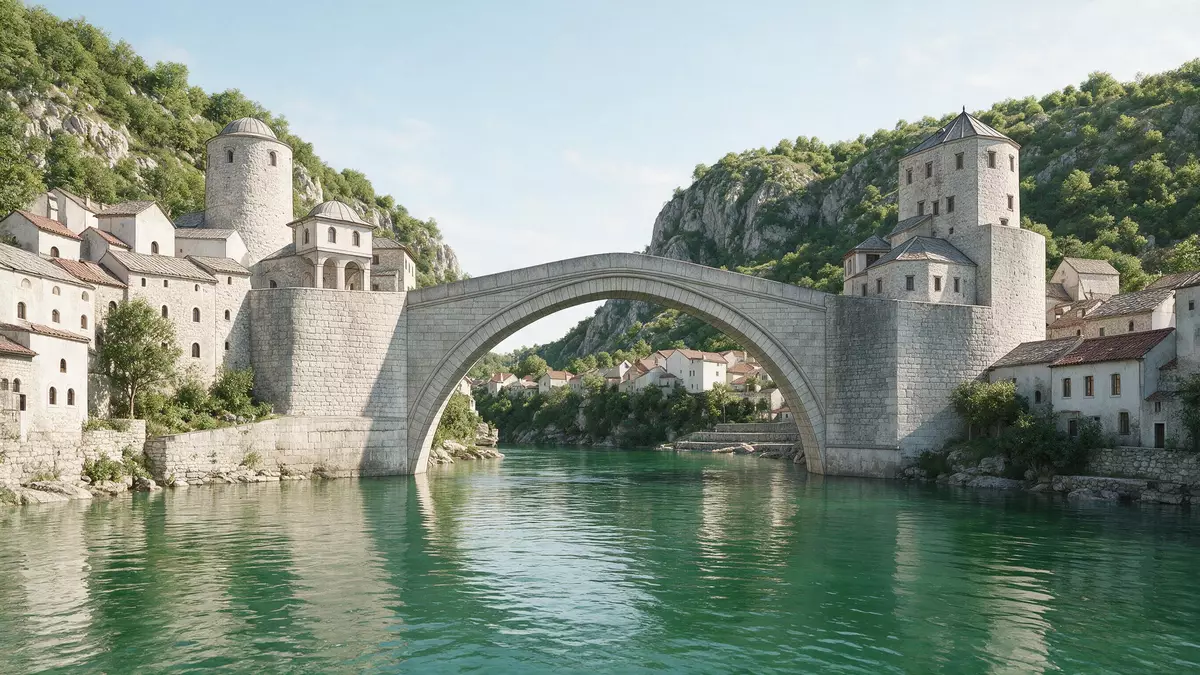
Stari most, the Old Bridge of Mostar in Bosnia and Herzegovina, is a single stone arch that spans the Neretva river and links the medieval core of the city on both banks. Built in the sixteenth century under Ottoman rule and reconstructed in the early twenty?first century after wartime destruction, it remains the defining structure of Mostar’s skyline and street plan.
An Ottoman stone arch over the Neretva
The bridge known as Stari most is a masonry arch of pale limestone carrying a narrow roadway across the Neretva at the gorge’s tightest point, where the river bends between steep banks and buildings rise directly from the rock. It forms a high arc between fortified approach towers, creating a crossing that is both elevated above the water and visually dominant within the old town’s dense fabric.connects the two banks of the Neretva River The stone used for the arch is a local limestone, shaped into blocks that follow the curve and are locked together by their geometry and the weight above.
Stari most was commissioned in the mid?sixteenth century by the Ottoman sultan Suleiman the Magnificent and constructed under the direction of the architect Mimar Hayruddin, a pupil of the master builder Sinan, whose work defined classical Ottoman architecture.constructed the bridge in 1566 Construction began in the late 1550s and the bridge was completed in 1566, replacing an earlier wooden crossing and giving Mostar a durable stone span as the town grew into a regional centre between the Adriatic coast and the interior of the Balkans.completed in 1566
Destruction, reconstruction and World Heritage
For more than four centuries after its completion, Stari most carried traffic across the Neretva through successive political eras, from the late Ottoman period through Austro?Hungarian administration and the twentieth century states that followed. During the Bosnian War in the 1990s the front line in Mostar ran along the river, and the bridge was subjected to sustained shelling; on 9 November 1993 the arch collapsed into the water under tank fire.the bridge collapsed into the river on 9 November 1993 Its fall became one of the best?known images of the conflict, because the structure had long symbolised the link between the communities on each bank.
After the war, a detailed reconstruction programme rebuilt Stari most on its original foundations, using archival documentation, surviving fragments and traditional techniques to recreate the single?span limestone arch. The rebuilt bridge was opened to traffic in July 2004, restoring the physical crossing and the continuity of the old town’s street network.reopened on 23 July 2004 In 2005, the site encompassing the bridge and the surrounding old town of Mostar was inscribed on the UNESCO World Heritage List, with the listing recognising both the sixteenth?century engineering achievement and the reconstruction as a symbol of reconciliation and coexistence.UNESCO World Heritage List
Bridge, townscape and river
Seen from the riverbanks or from the terraces of nearby houses, Stari most appears as a high, slender arch of stone framed by the towers and townhouses of Mostar’s old quarter. The deck of the bridge rises steeply from each end to the crown, where the parapets give views up and down the course of the Neretva and across the tiled roofs and minarets that mark the historic streets above the water.single-arch bridge in the city of Mostar The structural form creates a continuous arc, with the roadway curving over the river and stone steps at each end marking the transition from the town’s cobbled lanes to the bridge deck.
The bridge stands at the centre of a protected urban ensemble, with the old town’s stone houses, religious buildings and bazaar streets filling the slopes above the gorge and facing the river on both sides. The Neretva below carries clear, fast?moving water between the footings of the bridge, and the river’s flow and colour are a central part of the experience of the structure; the arch frames views of the current and of the rocky banks downstream while forming a key vantage point back towards the city.single arch of white stone that spans the Neretva river
Visiting Stari most: what travellers from Western Europe should know
- Stari most stands in the historic centre of Mostar in southern Bosnia and Herzegovina, spanning the Neretva river between the old town quarters on the east and west banks; it is reached on foot along cobbled streets that lead directly to the approaches.
- The crossing itself is pedestrian, with a stone deck that rises to the middle of the arch and stone steps at either end, so the surface is uneven and can feel steep underfoot, particularly in wet weather.
- Mostar is linked to other cities in the region by road and rail, and the bridge lies within walking distance of the main riverside streets and market area once in the city.
- The official language is Bosnian, and the currency is the Bosnian convertible mark.
Searching for Stari most on social platforms
These links open searches for Stari most on each platform.
Frequently asked questions about Stari most
Where is Stari most located?
Stari most stands in the city of Mostar in southern Bosnia and Herzegovina, crossing the Neretva river between the historic quarters on its east and west banks.
What can visitors expect when crossing the bridge?
Visitors cross a high stone arch via a steep, stepped deck, with stone parapets giving views of the Neretva and the clustered roofs and towers of the old town around the gorge.
What makes Stari most distinctive among European bridges?
Its sixteenth?century single?span limestone arch, its wartime destruction in 1993 and meticulous reconstruction by 2004, and its inscription as a UNESCO World Heritage Site give it a combination of historic engineering and symbolic significance.


