
Stone Town’s coral streets and carved doors in Sansibar
Published on 09/18/2026 at 07:51 | Editorial responsibility: Rafael Müller, Editor-in-Chief AD HOC NEWS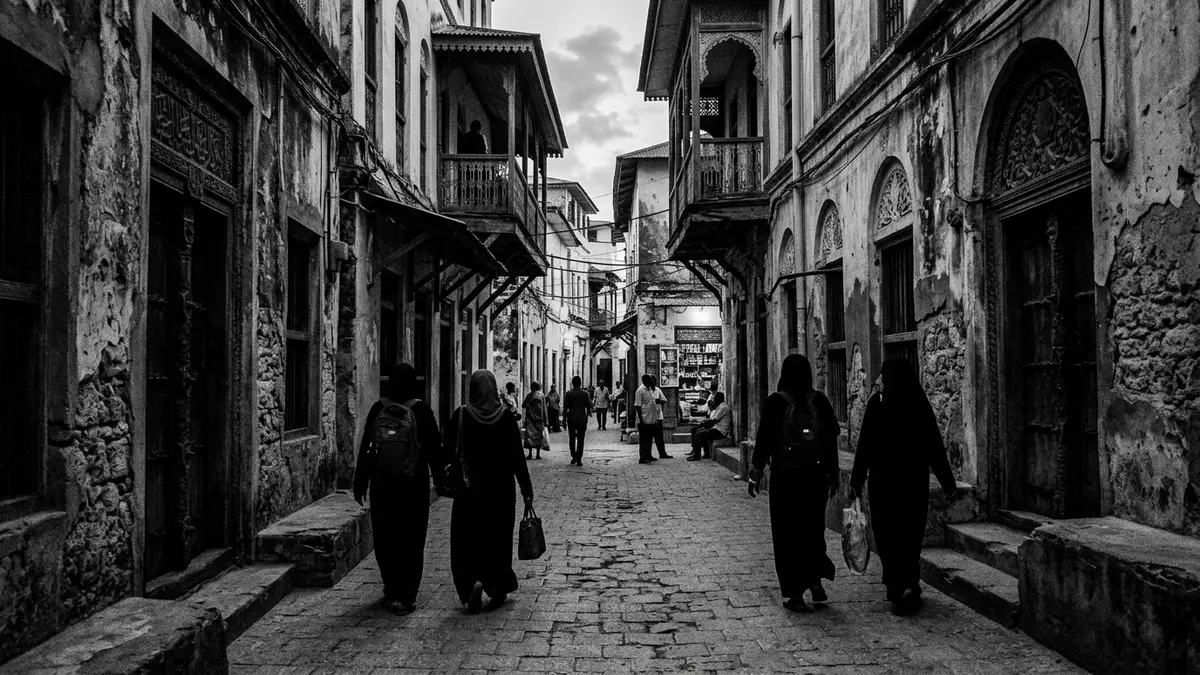
Stone Town in Sansibar is the historic centre of Zanzibar City on the west coast of Tanzania, a dense maze of coral-built streets and carved wooden doors shaped by Indian Ocean trade over many centuries. In 2000 it was inscribed as a UNESCO World Heritage Site for its Swahili urban fabric and its role in the intertwined histories of commerce and the slave trade along this coast.
Coral ragstone, mangrove beams and Swahili streets
At street level Stone Town is defined by its building fabric: houses and civic buildings raised in coralline ragstone held in thick lime mortar, then plastered and lime-washed to a soft, pale finish. Many structures also use mangrove timber beams, a material drawn from coastal ecosystems and visible in exposed ceilings and upper floors of older houses.Coralline ragstone and mangrove timber Narrow lanes run between these walls, bending and intersecting in ways that reflect centuries of incremental growth rather than any imposed grid.
From above, the town reads as a compact urban patch bordered by the Indian Ocean, with mosques, churches, palaces and commercial houses sharing the same tight footprint. Stone Town occupies roughly one square kilometre of the west coast of Unguja, the main island of Zanzibar, and its sheltered position helped it grow as a port city on the Swahili coast.Area and west-coast location Inside this small area, streets taper into alleys that sometimes end at the sea, sometimes open into small squares framed by verandas and projecting balconies.
Port city of sultans, traders and missionaries
Stone Town’s urban core reflects political and economic shifts across the Indian Ocean. The Portuguese Empire took control of Zanzibar in the early sixteenth century and began fortifying the waterfront, laying foundations for the Old Fort that later rulers expanded.Portuguese control and the Old Fort In the seventeenth century the Sultanate of Oman moved into the archipelago, turning Stone Town into the capital of its wider realm and a hub for trade in ivory, spices and enslaved people.
Many of Stone Town’s major monuments date from the eighteenth and nineteenth centuries, when Omani rule and British influence overlapped. The ceremonial palace known as the House of Wonders was commissioned by Sultan Barghash in this period, facing the seafront with colonnades and wide verandas. Nearby stand the Old Fort, Christ Church Anglican Cathedral built on the site of the former slave market, St Joseph’s Roman Catholic Cathedral, the Old Dispensary and several important mosques and bathhouses.Eighteenth- and nineteenth-century monuments Together they anchor the townscape and mark the layers of Swahili, Arab, Indian and European presence.
Carved doors, mixed architecture and living heritage
The houses of Stone Town display the fusion of architectural traditions that UNESCO recognised at inscription. Swahili layouts blend with Arab and Indian influences, Persian baths sit near European-influenced civic buildings, and churches share skyline space with minarets. One distinctive feature is the large, ornately carved wooden doors, some framed by metal studs, which signal wealth and status as well as craftsmanship from local and imported traditions.Swahili architecture and carved doors Above many doors, projecting balconies and covered verandas shade windows and link interior spaces with the street.
UNESCO cited Stone Town under cultural criteria for its long-term interchange of human values, its testimony to Swahili coastal culture and its association with the history and suppression of the slave trade.UNESCO inscription and criteria Historic sites connected to that trade, such as the former slave market and the residence of the trader Tippu Tip, sit within the same streets as markets, residential houses and small shops. The result is an urban area where living commercial and domestic uses occupy buildings whose materials, forms and doorways speak directly to a millennium of maritime exchange.
Visiting Stone Town: what travellers from Western Europe should know
- Stone Town forms the historic centre of Zanzibar City on the west coast of Tanzania’s Unguja Island, reached by flights into Abeid Amani Karume International Airport and by ferries from Dar es Salaam.
- Within Stone Town the streets are narrow, with irregular paving and frequent steps; many lanes are only wide enough for walking and small two-wheeled vehicles.
- The seafront area around the House of Wonders, Old Fort and Forodhani gardens offers open views across the harbour, while inland streets are densely built with limited long sight-lines.
- Arabic and Swahili are widely used in Stone Town alongside English, and the national currency is the Tanzanian shilling.
- Entry requirements depend on your nationality; UK travellers can check the FCDO travel advice at gov.uk/foreign-travel-advice, Irish travellers the Department of Foreign Affairs at ireland.ie.
Searching for Stone Town on social platforms
These links open searches for Stone Town on each platform.
Frequently asked questions about Stone Town
Where is Stone Town and what is its setting?
Stone Town is the historic centre of Zanzibar City on the sheltered west coast of Unguja Island in Tanzania, facing the Indian Ocean along a small natural harbour.
What can a visitor expect when walking through Stone Town?
Visitors encounter narrow streets lined with coral-built houses, carved wooden doors, mosques, churches and waterfront spaces where historic monuments stand close to everyday markets and homes.
What makes Stone Town distinctive among coastal cities?
Stone Town is distinctive for its Swahili coastal trading heritage, its fusion of African, Arab, Indian and European architectural elements and its dense collection of eighteenth- and nineteenth-century monuments within a compact urban area.


