
Sukhothai Historical Park and the shape of a lost capital
Published on 08/25/2026 at 19:37 | Editorial responsibility: Rafael Müller, Editor-in-Chief AD HOC NEWS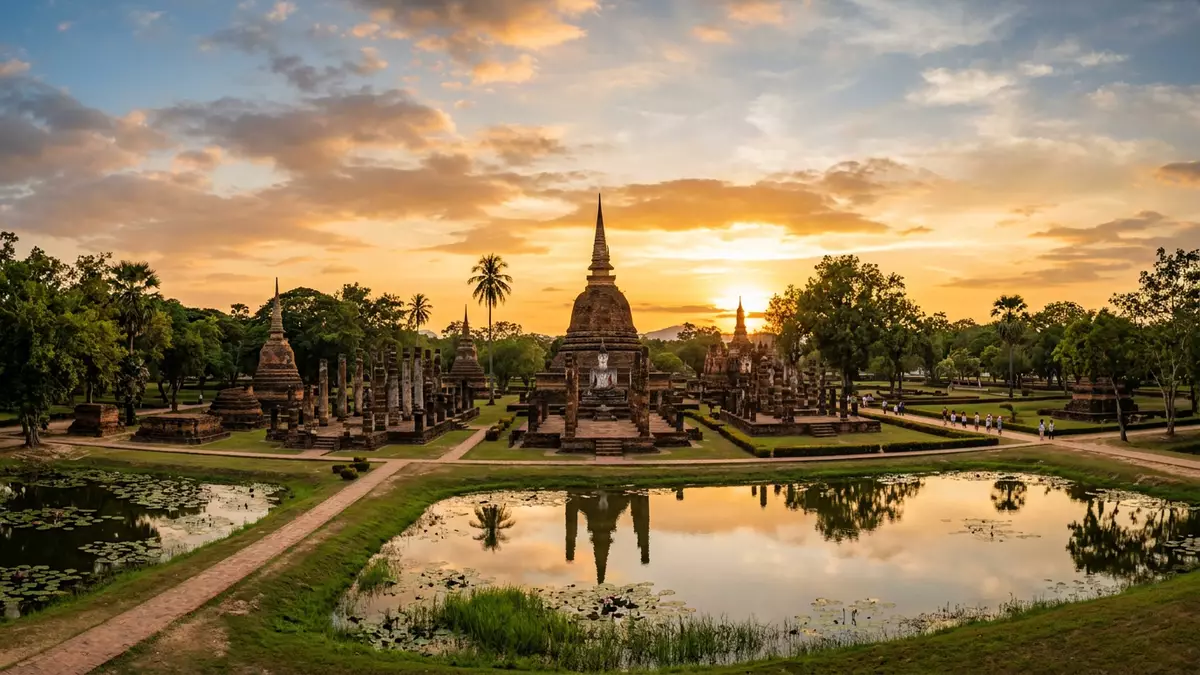
Sukhothai Historical Park lies in Sukhothai, Thailand, across the ruins of the old capital of the Sukhothai Kingdom. The park’s spread of walls, moats, temples and reservoirs gives it a clear outline that still reads on the ground.
A capital laid out in walls and water
The park sits in lower northern Thailand and belongs to the Historic Town of Sukhothai World Heritage property. That wider inscription links Sukhothai with Si Satchanalai and Kamphaeng Phet, while Sukhothai itself remains the principal historic core.
The old city is remembered through its brick ramparts, moats and temple compounds. Wat Mahathat stands at the centre of that pattern, with the royal and religious remains gathered around it.
Temples, stucco and the Sukhothai style
The monuments belong to the thirteenth and fourteenth centuries, the period when the Sukhothai Kingdom shaped much of its architectural identity. The UNESCO description links the site with the beginnings of Thai architecture and the development of the Sukhothai style.
Brick and stucco dominate the surviving religious buildings. That combination appears in temple towers, seated Buddha images, and the remains of assembly halls, all set within a landscape that once carried a capital city’s civic and sacred functions.
Ramkhamhaeng is one of the names most closely tied to the kingdom’s reputation, and the historical setting also belongs to the age of the first Kingdom of Siam. The park preserves that association through the ruins rather than through reconstructions.
Waterworks, inscriptions and the ruined cityscape
Water management is part of Sukhothai’s historical character. The serial World Heritage property includes dams, reservoirs, ponds and canals, and the park’s moats and lakes remain part of the visual setting.
The site is also linked with the earliest Thai writing through stone inscriptions found among the ruins. That makes Sukhothai more than a field of temples: it is a record of court culture, religion and language in a single archaeological landscape.
Wat Si Chum and Wat Sa Si show how varied the remains are. One rises as a massive sanctuary, the other sits by water, and together they give the park its mix of scale, material and setting.
Visiting Sukhothai Historical Park: what travellers from Western Europe should know
- The park lies in Sukhothai province in lower northern Thailand. Rail and air travel reach the wider region, and the historic area sits around the old city of Sukhothai.
- The terrain is flat for much of the park, but individual monuments can involve raised platforms, brick stairways and moats. Wat Si Chum has a narrow passage inside its mandapa.
- The official language is Thai and the currency is the Thai baht.
- Entry requirements depend on your nationality; UK travellers can check the FCDO travel advice at gov.uk/foreign-travel-advice, Irish travellers the Department of Foreign Affairs at ireland.ie.
Searching for Sukhothai Historical Park on social platforms
These links open searches for Sukhothai Historical Park on each platform.
Frequently asked questions about Sukhothai Historical Park
Where is Sukhothai Historical Park?
It is in Sukhothai province in lower northern Thailand, centred on the ruins of the old capital. The historic park forms part of the World Heritage property named Historic Town of Sukhothai and Associated Historic Towns.
What does a visit involve?
The park is an archaeological landscape rather than a single monument. Expect temples, walls, moats, ponds and brick remains spread across the old city area.
What makes it distinctive?
Its importance lies in the early Sukhothai style, the surviving water system and the association with Ramkhamhaeng and the first Kingdom of Siam. The ruins also preserve some of the earliest Thai inscriptions.


