
Sultan Qaboos Grand Mosque and its stone courtyards
Published on 09/23/2026 at 23:29 | Editorial responsibility: Rafael Müller, Editor-in-Chief AD HOC NEWS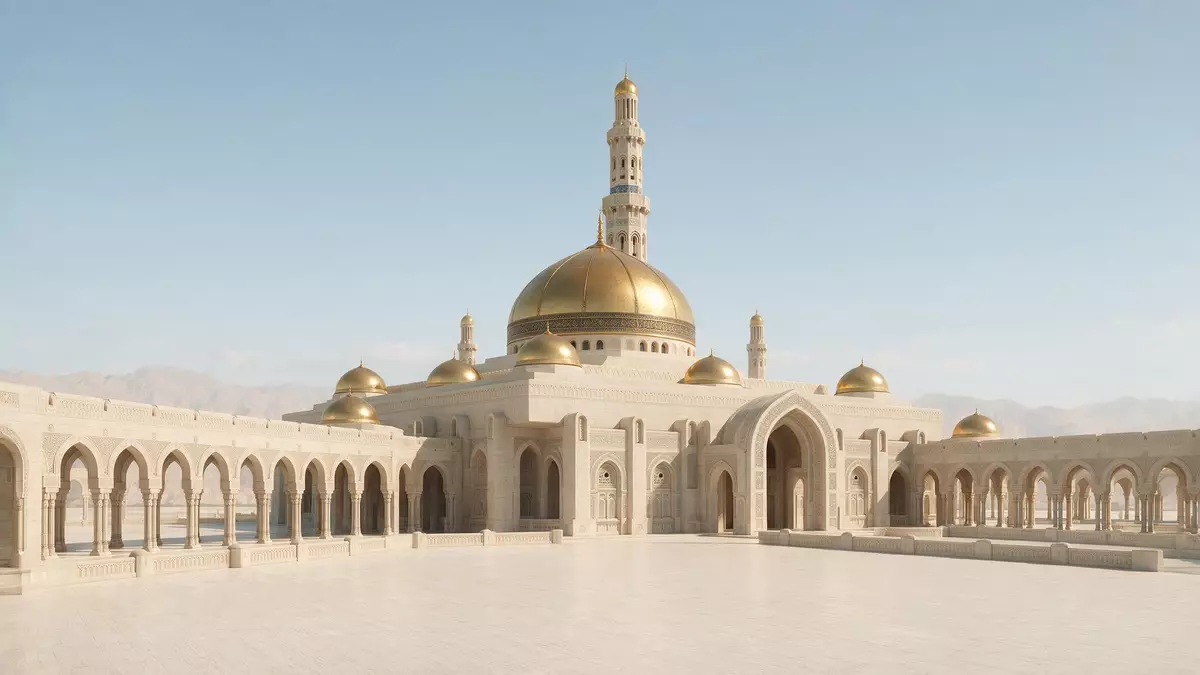
Sultan Qaboos Grand Mosque presents Maskat through a vast composition of Indian sandstone, white marble, domes and arcades. Completed in 2001, the mosque combines a monumental exterior with a prayer hall known for its woven carpet and crystal chandelier.
Indian sandstone across a vast mosque complex
The mosque stands in Bawshar, along Sultan Qaboos Road, within the metropolitan area of Maskat. Its grounds cover 416,000 square metres, creating a broad architectural setting of courtyards, gardens, arcades and paved approaches. The mosque grounds form a substantial part of its visual identity.
Nearly 300,000 tonnes of Indian sandstone were used in the complex. White marble, coloured stone, carved surfaces and timber details appear across the buildings, while the arrangement of domes and minarets gives the site a clear Islamic architectural vocabulary.
Mohammed Saleh Makiya’s Omani landmark
Sultan Qaboos bin Said commissioned the mosque, and Iraqi architect Mohammed Saleh Makiya led the design with Quad Design. Construction began in the 1990s, and the completed mosque was inaugurated in May 2001 during the thirtieth year of Sultan Qaboos’s reign. Mohammed Saleh Makiya’s design connects the complex with twentieth-century Islamic architecture and Omani building traditions.
Five minarets mark the mosque, with the principal tower rising above four smaller examples. A central dome reaches 50 metres, while the main prayer hall measures 61 by 71 metres. The exterior therefore works through repeated vertical and horizontal elements, rather than a single isolated tower.
The prayer hall’s carpet and crystal chandelier
The main prayer hall contains the mosque’s most recognisable interior features. A single hand-woven Persian carpet covers the floor, carrying a pattern drawn from Persian traditions associated with Tabriz, Kashan and Isfahan.
Above the carpet hangs a large Swarovski crystal chandelier, suspended beneath the central dome. The chandelier contains 1,122 lamps, and its scale establishes a strong vertical relationship between the patterned floor, the open volume of the hall and the decorated ceiling. The prayer hall interior also includes marble mosaics, carved details and carefully arranged geometric ornament.
The wider complex contains a women’s prayer room, a library, a lecture theatre and spaces connected with Islamic information and education. These rooms give the mosque functions beyond the central prayer hall, while the arcades and courtyards link the different parts of the site.
Visiting Sultan Qaboos Grand Mosque: what travellers from Western Europe should know
- The mosque is in Bawshar, Maskat, beside Sultan Qaboos Road. Taxis and private vehicles reach the complex from the city’s main roads.
- The approach crosses broad paved areas and courtyards. Visitors entering the prayer hall remove their shoes, and modest clothing is part of the religious setting.
- The official language is Arabic and the currency is the Omani rial.
- Entry requirements depend on your nationality; UK travellers can check the FCDO travel advice at gov.uk/foreign-travel-advice, Irish travellers the Department of Foreign Affairs at ireland.ie.
Searching for Sultan Qaboos Grand Mosque on social platforms
These links open searches for Sultan Qaboos Grand Mosque on each platform.
Frequently asked questions about Sultan Qaboos Grand Mosque
Where is Sultan Qaboos Grand Mosque?
Sultan Qaboos Grand Mosque is in Bawshar, within Maskat, beside Sultan Qaboos Road. The site lies within the city’s wider urban area.
What can visitors expect inside?
The complex contains arcades, courtyards, marble decoration and a large prayer hall. The hall contains a hand-woven Persian carpet and a crystal chandelier beneath the central dome.
What makes the mosque distinctive?
Its identity comes from the combination of Indian sandstone, five minarets, a 50-metre dome and an elaborately decorated prayer hall. The completed complex dates from 2001 and bears the name of Sultan Qaboos bin Said.


