
Suomenlinna: Helsinki’s island fortress of three realms
Published on 08/15/2026 at 14:50 | Editorial responsibility: Rafael Müller, Editor-in-Chief AD HOC NEWS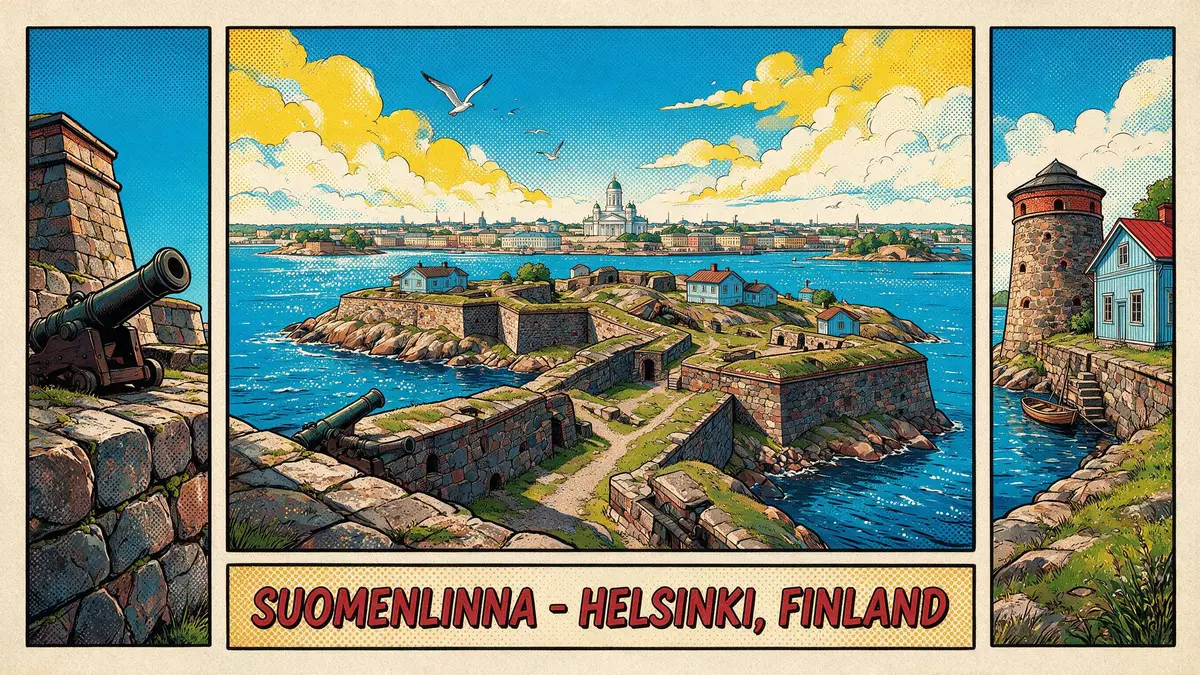
On the low islands off Helsinki, Suomenlinna unfolds as a broad belt of ramparts, barracks and harbours that grew from the mid?eighteenth century onwards. Built under Swedish rule as a maritime stronghold, it later served Russia and independent Finland in turn, and is now inscribed as a UNESCO World Heritage Site for its military architecture and layered history.
An eighteenth?century fortress on the Baltic approaches
Suomenlinna began as a Swedish project in 1748, when Finland formed part of the Kingdom of Sweden and the Baltic was a contested frontier. Work started on the rocky islets off Helsinki, with the fortification laid out as a bastioned work facing the open sea and the approaches to the harbour. The scheme was directed by Augustin Ehrensvärd, a Swedish military officer whose name still appears on memorials and interpretive displays around the islands.Work on the fortress began in 1748 The Swedish crown later gave the stronghold the name Sveaborg, rendered in Finnish as Viapori, reflecting its role as a fortress of Sweden rather than a local town wall.The fortress received the name Sveaborg in 1750
The fortifications spread across several islands south-east of central Helsinki and were shaped in the idiom of eighteenth?century European bastion design, influenced by French fortification practice. Earth ramparts, stone walls and angular bastions protect sheltered anchorages and dock areas, forming a combined sea fortress and naval base. Cannon batteries face channels between the islands, while internal courtyards and barracks line protected lanes. From the water, the ensemble reads as a continuous defensive belt between the open Gulf of Finland and the harbour.
Defending Sweden, Russia and Finland in succession
Suomenlinna’s fabric records changes in sovereignty as plainly as its inscription stones. In the late eighteenth century, during wars between Sweden and Russia, the fortress served as a key base for Swedish naval operations in the eastern Baltic. During the conflict at the turn of the nineteenth century, Russian forces besieged the islands and compelled their surrender, after which Finland was detached from Sweden and became an autonomous part of the Russian Empire.Finland became an autonomous part of the Russian Empire in 1809 Under Russian administration, the fortress operated as a naval base for more than a century, its guns and docks integrated into imperial defences around the Gulf of Finland.The fortress became a Russian naval base for about 110 years
The nineteenth century left scars as well as structures. During the Crimean War in the 1850s, Anglo?French fleets bombarded the fortress, damaging ramparts and casemates along the seaward sides. Later, during the Finnish Civil War in 1918, parts of the islands served as a prison camp, before the newly independent Finnish state annexed the site and adopted the name Suomenlinna, “Fortress of Finland”.The fortress was named Suomenlinna in 1918 The Second World War brought further military use as a base for coastal artillery, anti?aircraft batteries and submarines, though the garrison finally left in 1973, when responsibility passed to civilian authorities and the emphasis shifted towards conservation and everyday life.Military use ended in 1973 when the garrison left
World Heritage site and lived?in district of Helsinki
Suomenlinna’s dual character as fortress and neighbourhood is central to its appeal. In 1991, the fortification was inscribed on the UNESCO World Heritage List as an outstanding example of European military architecture from the second half of the eighteenth century on a group of islands at the entrance to Helsinki’s harbour.Suomenlinna was inscribed on the World Heritage List in 1991 The listing recognises not only the bastions, tunnels and docks, but also the overall landscape ensemble: earthworks rolling into rocky shorelines, formal parade grounds leading towards gun lines, and narrow streets framed by long, low barrack buildings.
Alongside this historic infrastructure, the islands form a residential district of Helsinki with several hundred inhabitants. Former officers’ houses, storehouses and administrative buildings accommodate flats, workshops and services, and there are museums exploring different phases of the fortress’s story. Paths cross between former military zones, linking harbours, courtyards and open grassed areas, and in many places the Baltic lies only a short walk from heavy stone walls. The combination of fortified topography and everyday uses makes Suomenlinna distinct among Baltic coastal sites.Suomenlinna is both a World Heritage Site and a residential district
Visiting Suomenlinna: what travellers from Western Europe should know
- Suomenlinna lies on islands off Helsinki and is reached by boats running from the city’s harbour areas. Services connect the Market Square and other quays with the fortress wharves.
- The terrain combines cobbled lanes, grassed ramparts and rock, and many routes include sections on uneven surfaces or flights of steps between different levels.
- Suomenlinna forms part of Finland, where the official languages are Finnish and Swedish and the currency is the euro.
Searching for Suomenlinna on social platforms
These links open searches for Suomenlinna on each platform.Frequently asked questions about Suomenlinna
Where is Suomenlinna located in relation to Helsinki?
Suomenlinna occupies several islands off the coast of Helsinki, positioned at the entrance to the city’s harbour and reached by boat from central quays.
What should visitors expect when exploring Suomenlinna?
Visitors encounter extensive fortifications, former military buildings, museums and residential areas linked by paths over ramparts, rock and shoreline, with views across the Gulf of Finland.
What makes Suomenlinna distinctive among European fortresses?
Suomenlinna combines eighteenth?century bastion architecture, service under Swedish, Russian and Finnish rule and its present role as both World Heritage Site and lived?in Helsinki district.


