
Suwon Hwaseong, a planned fortress city of the Joseon dynasty
Published on 09/17/2026 at 08:21 | Editorial responsibility: Rafael Müller, Editor-in-Chief AD HOC NEWS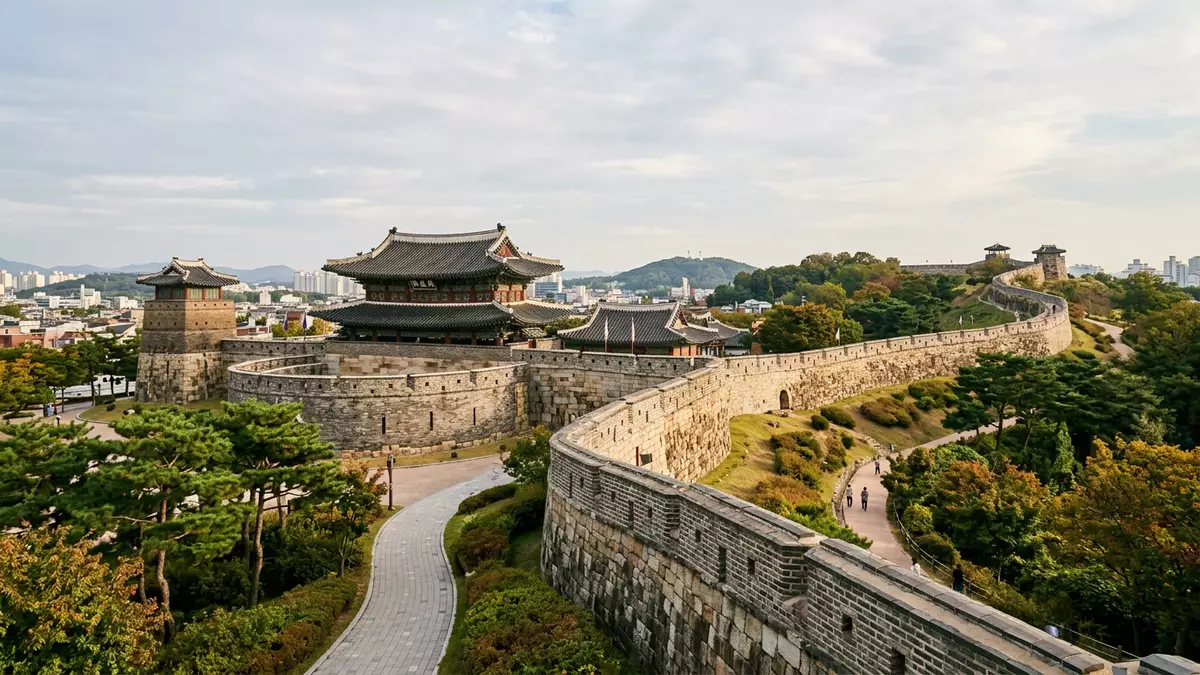
Suwon Hwaseong is a piled?stone and brick fortress encircling the centre of Suwon in Gyeonggi Province, Korea, created in the late eighteenth century under King Jeongjo of the Joseon dynasty as the framework for a planned fortress city and a royal memorial landscape.piled?stone and brick fortress The long walls, gates and watchtowers run over hill slopes and through urban streets, turning Suwon Hwaseong into a continuous walk through military architecture and everyday city life.
A brick and stone ring around Suwon
The defining feature of Suwon Hwaseong is the ring of fortifications that encloses a sizeable area of the modern city, with walls following the local topography rather than cutting straight lines across it.walls of the fortress Built between 1794 and 1796, these walls stretch for about 5.7 km (3.5 miles) and enclose an area around 130 ha, combining earthworks, stone sections and brick ramparts along their length.5.74 km in length
The fortifications are organised into sections with bastions, artillery positions and various defensive structures, reflecting eighteenth?century developments in military architecture that brought together influences from East Asia and Europe.pinnacle of 18th?century military architecture Four principal gates puncture the circuit to align with major routes into Suwon, each gate flanked by defensive works and pavilions that give the fortress a rhythmic sequence of enclosed and open points.
King Jeongjo’s eighteenth?century fortress city
Suwon Hwaseong belongs firmly to the late Joseon period and to the reign of King Jeongjo, who ordered the construction as part of a wider reorganisation of Suwon and the relocation of his father’s tomb to Hwasan Mountain in 1789.relocation of Prince Sado’s tomb Preparation for the wall began in 1793, construction started in 1794 and the fortress was completed in 1796, giving the city a new fortified outline within roughly two and a half years.completed in 1796
The fortress incorporates both residential and military functions, planned as a town in the eupseong tradition of fortified settlements that stretches back to earlier Joseon practice.fort town tradition Within the walls, King Jeongjo envisaged Suwon as an economic centre with local government offices, a Confucian school and a temporary palace for royal visits, so the defensive ring frames administrative courtyards and streets rather than an isolated fortress compound.
Design, inscription and walking the circuit
The design of Suwon Hwaseong was led by Jeong Yak?yong, a scholar and engineer associated with the School of Practical Learning, drawing on contemporary theories of fortification and using a mix of stone and brick construction to resist arrows, blades and firearms.designed by Jeong Yak?yong Detailed records of the construction survive in the Hwaseong Seongyeok Uigwe, an official compilation produced in 1801 that documents the works and later contributed to the accurate restoration of damaged sections.
In 1963 Suwon Hwaseong was designated a historic site in Korea, and in 1997 it was inscribed on the UNESCO World Heritage List as a cultural property under criteria ii and iii, recognising both its architectural significance and its role in urban planning.UNESCO World Heritage inscription Walking the circuit today reveals long stretches of rampart, steep ascents over Paldalsan Mountain, and sequences of towers and pavilions that overlook Suwon’s streets and low?rise districts, keeping the eighteenth?century outline legible within a modern urban landscape.
Visiting Suwon Hwaseong: what travellers from Western Europe should know
- Suwon Hwaseong surrounds central Suwon in Gyeonggi Province, south of Seoul, and is reached by rail services from the capital to Suwon Station, followed by local transport or a walk towards the fortress gates.
- The fortress circuit includes climbs over Paldalsan Mountain and sections of wall with stairways and ramps, so parts of a visit involve sustained walking on uneven ground and steps.
- Within the walls lie residential neighbourhoods, administrative buildings and the site of the former temporary palace, meaning that a circuit of Suwon Hwaseong often alternates between quieter hillside stretches and busier streets.
- The official language is Korean and the currency is the South Korean won.
- Entry requirements depend on your nationality; UK travellers can check the FCDO travel advice at gov.uk/foreign-travel-advice, Irish travellers the Department of Foreign Affairs at ireland.ie.
Searching for Suwon Hwaseong on social platforms
These links open searches for Suwon Hwaseong on each platform.
Frequently asked questions about Suwon Hwaseong
Where is Suwon Hwaseong and what kind of place is it?
Suwon Hwaseong is a brick and stone fortress encircling central Suwon in Gyeonggi Province, South Korea, forming both a defensive ring and a structured urban area.
What should visitors expect on a walk around the fortress?
A walk along Suwon Hwaseong mixes stretches of wall over Paldalsan Mountain, stairways and pavilions with sections that run beside streets, markets and residential districts inside the fortifications.
What makes Suwon Hwaseong distinctive among Korean historic sites?
Suwon Hwaseong is distinctive for combining an eighteenth?century planned fortress city, detailed construction records in the Hwaseong Seongyeok Uigwe and an inscribed UNESCO World Heritage status that recognises both its military architecture and urban planning.


