
Suzhou Yuanlin and the classical gardens of Suzhou
Published on 09/21/2026 at 06:15 | Editorial responsibility: Rafael Müller, Editor-in-Chief AD HOC NEWS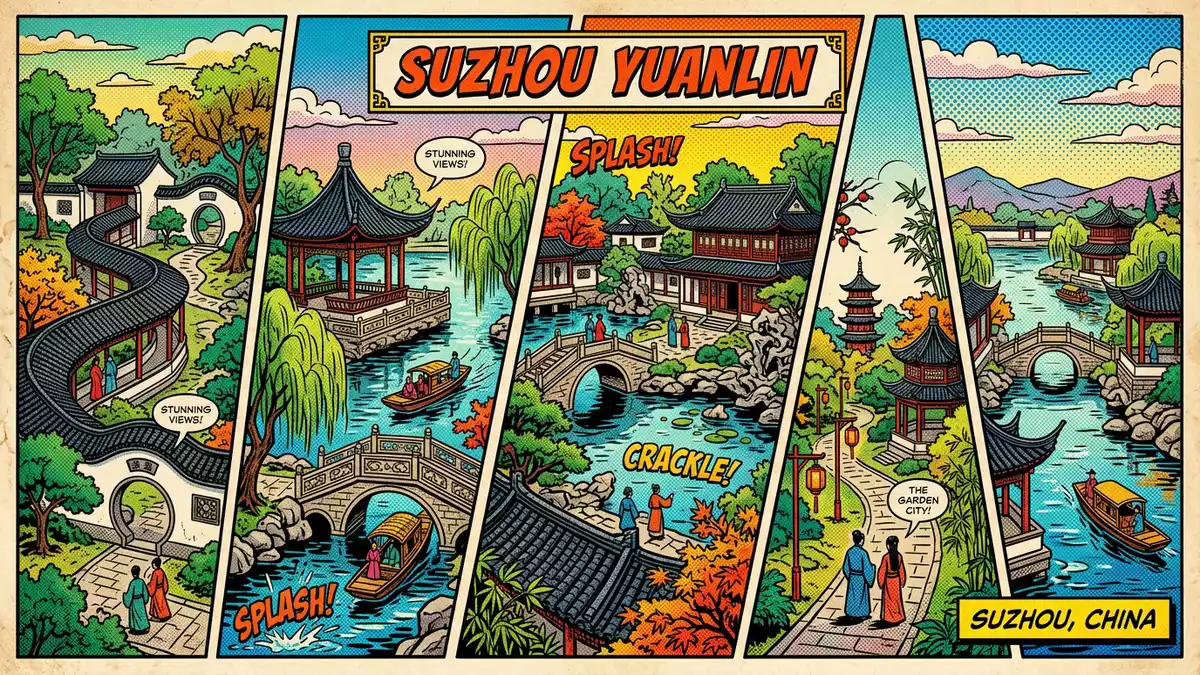
Suzhou Yuanlin, known in English as the Classical Gardens of Suzhou, is a group of historic Chinese gardens in Suzhou in eastern China, celebrated for their refined “mountain and water” landscapes and inscribed on the UNESCO World Heritage List in 1997. The ensemble includes renowned gardens such as the Humble Administrator’s Garden, Lingering Garden and Lion Grove Garden, created and refined between the eleventh and nineteenth centuries as private retreats that turned limited urban plots into idealised natural worlds.
Scholar gardens as miniature landscapes
The core idea behind Suzhou Yuanlin is the transformation of modest city plots into complete miniature landscapes, combining water, rock, architecture and planting in carefully composed scenes. Within the World Heritage inscription, nine gardens are recognised as outstanding examples of this tradition, among them the Humble Administrator’s Garden, Lingering Garden, the Garden of the Master of Nets and the Mountain Villa with Embracing Beauty, each balancing ponds, artificial hills and built structures to evoke larger mountains and rivers in small spaces.Classical Gardens of Suzhou The gardens developed over centuries as part of Suzhou’s identity as a city of scholars and merchants, whose homes often contained intricate gardens designed for contemplation, social gatherings and artistic pursuits.
The landscapes within Suzhou Yuanlin are organised around pools and winding paths, with pavilions and halls positioned to frame particular views and create a sequence of changing perspectives. Rocks, often arranged in dramatic piles, stand for distant peaks, while channels and ponds represent wider bodies of water, creating an interplay between solid and void that is characteristic of Jiangnan garden design.meticulous garden design In many of the gardens, bamboo, flowering trees and seasonal planting soften the stone and timber structures so that architecture appears embedded within a living landscape.
Humble Administrator’s Garden: largest of Suzhou Yuanlin
Among the Suzhou Yuanlin ensemble, the Humble Administrator’s Garden stands out as the largest classical garden in Suzhou, laid out during the Ming dynasty between 1368 and 1644 and occupying several hectares of the old city.Humble Administrator’s Garden It was created in the early sixteenth century by Wang Xiancheng, an imperial censor who returned to Suzhou and established a garden on the grounds of a former temple, structuring it into eastern, central and western sections linked by water and paths. In 1961 the garden was listed as a National Key Cultural Relics Protection Unit, and it entered the World Heritage List in 1997 as one of the core components of the Classical Gardens of Suzhou.
Walking through the Humble Administrator’s Garden reveals the layered structure typical of Suzhou Yuanlin: halls and pavilions stand beside lotus ponds, bridges cross narrow stretches of water, and galleries thread between courtyards to connect different scenic areas.UNESCO-listed Chinese garden The abundant use of water reflects the wider landscape of the Yangtze River Delta, while rock arrangements and carefully placed trees create contrasts of height and texture. Architectural details such as lattice windows, tiled roofs and carved stone thresholds frame views out to the planting and ponds, turning each opening or turn in the path into a composed picture.
Other classical gardens within Suzhou Yuanlin
Suzhou Yuanlin encompasses several other historic gardens whose names recur across guidebooks and World Heritage documentation, each with its own structure while sharing the common language of Jiangnan garden design. Lingering Garden is known for its compact yet richly articulated layout of courtyards, rockwork and halls, while the Garden of the Master of Nets packs an intricate series of scenes into a relatively small plot, demonstrating how tightly organised such gardens can be without losing their sense of space.acme of landscape garden design Lion Grove Garden, with its maze of weathered rocks, is particularly associated with dramatic rock formations that invite exploration along twisting paths and through narrow passages.
Further gardens recognised within the Classical Gardens of Suzhou include Canglang Pavilion, the Garden of Cultivation, the Couple’s Garden Retreat and the Retreat and Reflection Garden, all laid out in different periods and preserving variations on the same fundamental vocabulary of ponds, rocks, trees and built structures.World Heritage ensemble Across these sites, visitors encounter features such as covered walkways along water, small towers or belvederes overlooking ponds, and framed views out to nearby canals and streets of Suzhou, so that the gardens feel both secluded and connected to the wider city.
Visiting Suzhou Yuanlin: what travellers from Western Europe should know
- Suzhou Yuanlin lies within the historic city of Suzhou in Jiangsu Province in eastern China, reached by rail services from Shanghai and by local buses and taxis within the city.
- Many of the gardens occupy level ground within old residential districts, but paths can be narrow, and stairs, stone bridges and uneven rockwork appear throughout the sites.
- The official language is Chinese and the currency is the Chinese yuan.
- Entry requirements depend on your nationality; UK travellers can check the FCDO travel advice at gov.uk/foreign-travel-advice, Irish travellers the Department of Foreign Affairs at ireland.ie.
Searching for Suzhou Yuanlin on social platforms
These links open searches for Suzhou Yuanlin on each platform.
Frequently asked questions about Suzhou Yuanlin
Where is Suzhou Yuanlin located?
Suzhou Yuanlin refers to the Classical Gardens of Suzhou, a group of historic gardens within the city of Suzhou in Jiangsu Province in eastern China.
What can visitors expect when exploring Suzhou Yuanlin?
Visitors encounter ponds, rock formations, pavilions and halls linked by winding paths and galleries, forming carefully composed miniature landscapes within the urban fabric.
What makes Suzhou Yuanlin distinctive among garden sites?
Its gardens form a UNESCO-listed ensemble created between the eleventh and nineteenth centuries, showcasing Jiangnan scholar garden design through intricate combinations of water, rock and architecture.


