
Sydney Opera House and its roof of interlocking shells
Published on 09/24/2026 at 04:36 | Editorial responsibility: Rafael Müller, Editor-in-Chief AD HOC NEWS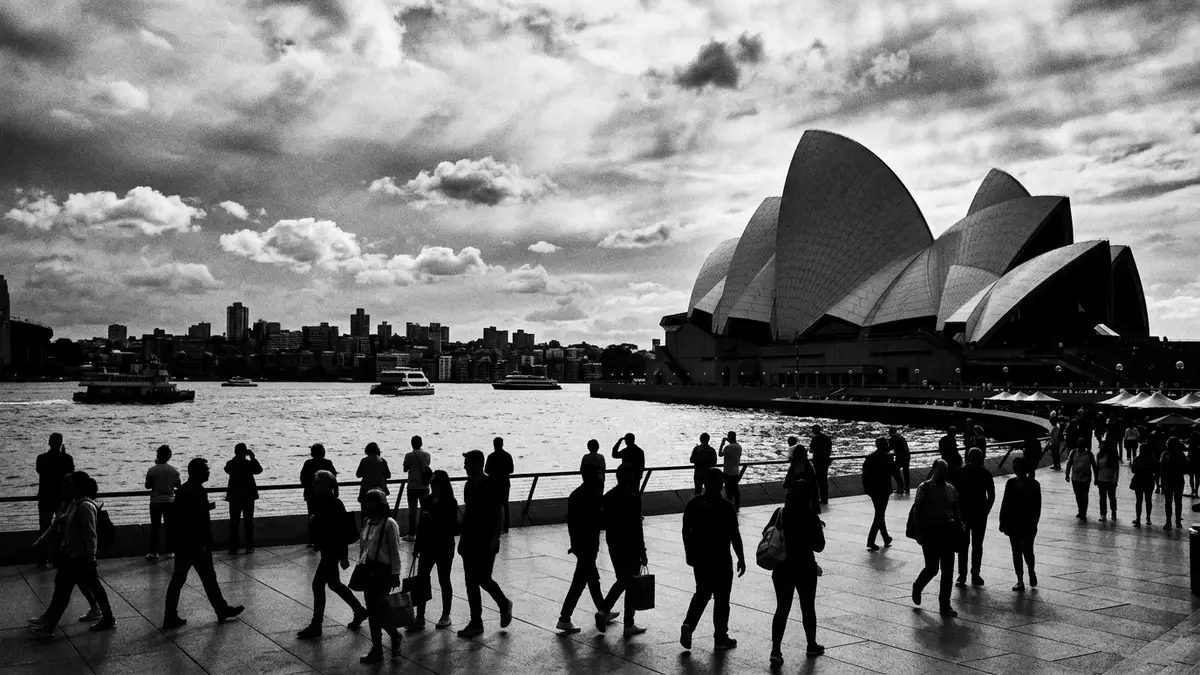
Sydney Opera House rises from Bennelong Point as a cluster of interlocking roof shells above a broad podium. Designed by Danish architect Jørn Utzon and inaugurated in 1973, the building joins performance spaces, terraces and harbour views in a single architectural composition.
Concrete shells above Sydney Harbour
The roof is formed from groups of vaulted shells that cover the principal halls and a restaurant. Their pale surfaces are tiled, while concrete ribs and prefabricated sections create the repeated curves visible from the harbour and the forecourt.
The shells sit on a large platform surrounded by terraces and pedestrian concourses. From close range, the roof is read through ribs, seams and ceramic tiles; from across the water, the separate forms combine into a continuous sculptural outline. The World Heritage description records the building as a major twentieth-century work of architecture and structural design.
Jørn Utzon’s spherical roof system
Utzon won the international competition for the building in 1957. Structural engineers Ove Arup and Partners worked with the architectural team on the roof, whose final geometry came from sections of a sphere.
The system gave the shells related curves while permitting different sizes across the roof groups. Pre-cast concrete ribs support the shell segments, and more than one million ceramic tiles cover the roof surfaces. The roof’s ceramic tiles form a finely textured skin above the concrete structure.
From national project to World Heritage landmark
Sydney Opera House was opened by Queen Elizabeth II on 20 October 1973. Its programme includes opera, theatre, dance, orchestral music, contemporary performance and public events across several venues.
Utzon’s work belongs to the history of modern architecture, yet the building remains closely tied to Sydney’s geography. Bennelong Point projects into the harbour beside the Royal Botanic Garden and near the Harbour Bridge. UNESCO added Sydney Opera House to the World Heritage List in 2007, recognising its architectural form, engineering and cultural role. The building’s architectural history continues through its stages, foyers, terraces and public spaces.
Visiting Sydney Opera House: what travellers from Western Europe should know
- Sydney Opera House occupies Bennelong Point beside Sydney Harbour, the Royal Botanic Garden and the Harbour Bridge.
- Circular Quay is the closest public transport hub, with trains, buses and ferries serving the area. From there, the building is reached on foot through the harbour precinct.
- The approach includes the broad Monumental Steps and sloping pedestrian areas across the podium. The site combines outdoor terraces with enclosed foyers and performance venues.
- The official language is English and the currency is the Australian dollar.
Searching for Sydney Opera House on social platforms
These links open searches for Sydney Opera House on each platform.
Frequently asked questions about Sydney Opera House
Where is Sydney Opera House?
Sydney Opera House is on Bennelong Point in Sydney Harbour, beside the Royal Botanic Garden and near the Harbour Bridge.
What can visitors find inside?
The building contains performance venues, foyers, terraces and public spaces. Its programme spans opera, theatre, dance, orchestral music and contemporary performance.
What makes the building distinctive?
Its roof consists of interlocking vaulted shells above a large podium. Jørn Utzon’s spherical geometry gives the shells related curves across different parts of the building.


