

Tafelberg: Cape Town’s flat-topped natural stage
Published on 08/29/2026 at 23:03 | Editorial responsibility: Rafael Müller, Editor-in-Chief AD HOC NEWS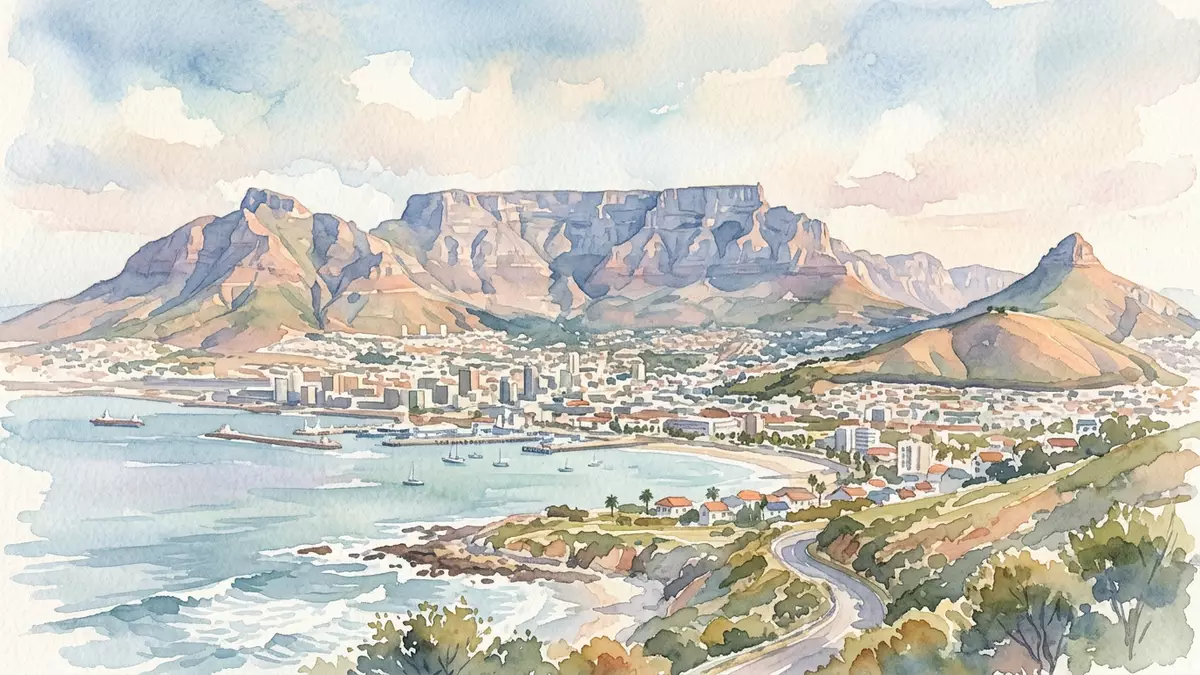
Tafelberg, known in English as Table Mountain, is the flat-topped sandstone massif that frames Kapstadt against the Atlantic and defines the city’s skyline as clearly as its harbour and historic streets. Rising above the northern end of the Cape Peninsula in South Africa, it forms a broad plateau high above the sea, turning the everyday life of the city into something that always plays out beneath a looming escarpment of rock and cloud.
A flat-topped plateau above the city bowl
Tafelberg stands immediately behind Cape Town’s central districts, forming a high, near-vertical wall of rock that separates the urban basin from the interior of the peninsula.flat-topped mountain Its plateau stretches for roughly 3 km (about 2 miles) from side to side, a long sandstone table edged by cliffs, gullies and weathered ledges rather than a single pointed summit.plateau is about 3km long The highest point of this table lies at Maclear’s Beacon, a stone cairn built as a survey marker in the nineteenth century and now surrounded by rough paths and outcrops on the eastern side of the plateau.Maclear’s Beacon
Tafelberg is part of a wider group of mountains that enclose the city bowl like a rocky amphitheatre, with Devil’s Peak on one side and Lion’s Head on the other, and lower ridges such as Signal Hill continuing the line towards Table Bay.flanked by Devil’s Peak and Lion’s Head From the plateau the view takes in the harbour, Robben Island offshore, the sweep of the Cape Peninsula towards the Cape of Good Hope and the curve of False Bay on the opposite coast, setting the city between two oceans and a chain of peaks.
Sandstone, age and the Cape Peninsula landscape
The bulk of Tafelberg consists of nearly horizontal layers of Table Mountain Sandstone resting on older granite and related rocks, a stack exposed by long, persistent erosion.horizontal layers of sandstone The sandstone is part of the Cape Supergroup and in places has weathered into pale cliffs, blocky tors and scattered boulders that give the plateau a broken, rugged surface. Geological studies place the formation of this massif on a timescale of tens of millions of years, and older remnants of related ranges on the peninsula have been dated to hundreds of millions of years, a reminder that the present plateau is the worn-down core of a once much higher mountain system.remaining remnants stood thousands of meters high
Tafelberg forms the northern part of a chain that runs along the Cape Peninsula for roughly 52 km, ending at the Cape of Good Hope, and it gives its name to Table Mountain National Park, which links this escarpment with surrounding peaks, coastal cliffs and fynbos heathland.lies in the northern part of a mountain range on the 52 km long peninsula The vegetation on and around the plateau belongs mainly to the Cape fynbos biome, with proteas, ericas and restios adapted to the nutrient-poor sandstone soils. Steep ravines cut into the flanks and small reservoirs on the back table, such as the Woodhead and Hely-Hutchinson dams, record earlier efforts to draw water from this high catchment for Cape Town’s growing population in the late nineteenth and early twentieth centuries.five dams opened on the Back Table between 1896 and 1907
Names, history and a modern protected landmark
The mountain carries several names that reflect different periods and languages at the Cape. In Afrikaans it is Tafelberg, while English-speaking travellers and locals know it as Table Mountain.englisch Table Mountain, afrikaans Tafelberg Khoekhoe speakers used names such as Hoerikwaggo, often translated as “mountain of the sea” or “sea-emerging”, capturing the way the plateau rises abruptly from low ground near the coast.KhoiKhoi named it Hoerikwaggo In the eighteenth century the French astronomer Nicolas-Louis de Lacaille honoured the massif by naming the southern constellation Mensa after it, from the Latin for “the table mountain”, which is one of the few constellations directly linked to a terrestrial feature.named the southern constellation Mensa
European seafarers used the silhouette of Tafelberg as a navigation mark after they began rounding the Cape in the fifteenth and sixteenth centuries, and early accounts describe António de Saldanha climbing the mountain in 1503 and applying the Portuguese name that became “Table Mountain” in English later on.first European to land in Table Bay in 1503 and named it Table Mountain During the period of British control in the late eighteenth century blockhouses were built on its slopes for defence, and the massif was gradually integrated into a wider system of conservation on the Cape Peninsula. In 1998 the protected area along the peninsula was renamed Table Mountain National Park, and in 2011 the mountain was included in a global list known as the New7Wonders of Nature after an organised international vote.renamed to Table Mountain National Park in 1998
Visiting Tafelberg: what travellers from Western Europe should know
- Tafelberg rises on the Cape Peninsula directly behind Cape Town’s central districts, and is reached from the city by road towards the lower cableway station and by marked mountain paths.
- The ascent from the city side involves steep gradients on rock and stone steps, and paths on the plateau cross uneven sandstone surfaces with exposed edges and sudden drops.
- The mountain forms part of Table Mountain National Park in South Africa. The official language is Afrikaans and the currency is the South African rand.
- Travellers from Western Europe outside the EU, including the UK and Ireland, face different entry rules for South Africa. Entry requirements depend on your nationality; UK travellers can check the FCDO travel advice at gov.uk/foreign-travel-advice, Irish travellers the Department of Foreign Affairs at ireland.ie.
Searching for Tafelberg on social platforms
These links open searches for Tafelberg on each platform.
Frequently asked questions about Tafelberg
Where is Tafelberg located?
Tafelberg stands directly behind central Cape Town on the northern part of the Cape Peninsula in South Africa, overlooking Table Bay and the city bowl.
What can visitors expect on a visit to Tafelberg?
Visitors encounter a high sandstone plateau reached by steep paths or the cableway, with cliff edges, rocky steps and extensive views over the city, bays and surrounding peaks.
What makes Tafelberg distinctive among urban mountains?
The mountain combines a broad, flat-topped summit, a long escarpment above a major city, a fynbos-covered national park and a role as both geological landmark and cultural symbol.


