Tallinna vanalinn's medieval streets and layered skyline
Published on 08/09/2026 at 15:00 | Editorial responsibility: Rafael Müller, Editor-in-Chief AD HOC NEWS
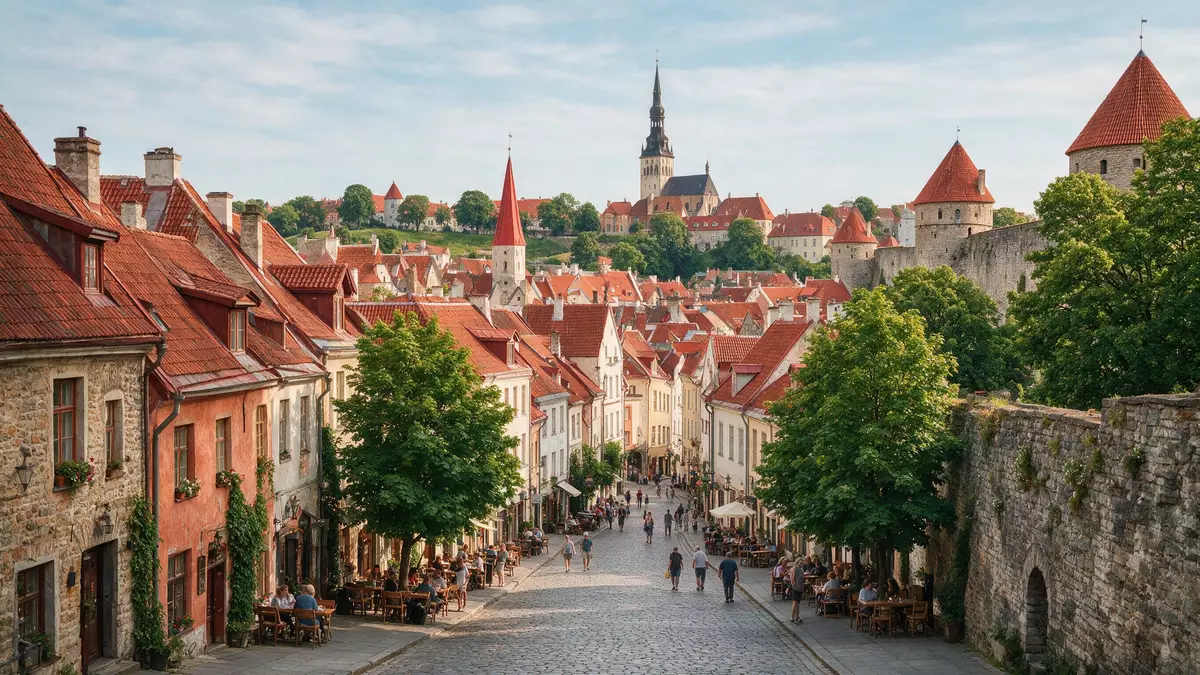
Tallinna vanalinn is Tallinn’s medieval old town, a compact centre of stone streets, church spires and defensive walls. Its profile is shaped by Toompea Hill, the lower town and the harbour-facing edge of the city.
Medieval streets on a hill and below it
The old town divides into two linked parts: the upper town on Toompea and the lower town around the market streets. The contrast is visible in the route from broad viewpoints to narrower lanes lined with guild houses and merchant façades.
St Olaf’s Church, the Church of the Holy Spirit and Tallinn Town Hall are among the names most closely tied to this area. Their stone and brick forms anchor the streetscape and give the district its clear historical focus.
Walls, towers and the old city edge
Fragments of Tallinn’s city wall and several towers remain around Tallinna vanalinn. The defensive line gives the district a clear boundary, with gates, bastions and lookout points marking the edge of the old centre.
The streets inside that line are dense and walkable, with short connections between squares, churches and museums. That compact plan is one reason the district reads as a complete historic quarter rather than a scattering of monuments.
A trading town with Baltic connections
Tallinna vanalinn reflects the period when Tallinn was part of the Hanseatic world. Merchant houses, warehouse fronts and the Town Hall Square preserve the memory of a port city linked to Baltic trade.
Layers from the Danish, German and Swedish past of the city remain visible in the architecture and street pattern. The result is a place where civic, religious and commercial buildings stand close together across a long historical span.
Visiting Tallinna vanalinn: what travellers from Western Europe should know
- Tallinna vanalinn is in central Tallinn, within walking distance of the rail station, the port and the harbour area.
- Admission arrangements and opening hours are set by the site's operator and change with the season; the official website is the only binding source.
- Late spring, summer and clear winter days suit walking the streets and climbing the viewpoints.
- The old town has cobbles, slopes and some steep steps, especially around Toompea Hill.
- English is widely understood in visitor-facing places, and card payment is common, though small cash purchases may still appear.
- Entry requirements depend on your nationality. UK travellers should check the FCDO travel advice at gov.uk/foreign-travel-advice; Irish travellers the Department of Foreign Affairs at ireland.ie; EU and EEA citizens their own national foreign ministry.
Searching for Tallinna vanalinn on social platforms
These links open searches for Tallinna vanalinn on each platform.
Frequently asked questions about Tallinna vanalinn
Where is Tallinna vanalinn?
It is the historic centre of Tallinn, on the north coast of Estonia. The old town sits between Toompea Hill and the lower streets around the main squares.
What does a visit involve?
Expect a walk through narrow streets, paved squares and hillside viewpoints. The area is compact, but the cobbles and slopes make comfortable shoes useful.
What makes it distinctive?
The district combines medieval walls, church towers and merchant streets in one surviving urban core. Its clear division between upper and lower town gives it a strong shape on the ground.