
Te Puia’s geothermal valley and M?ori arts centre in Rotorua
Published on 08/15/2026 at 14:53 | Editorial responsibility: Rafael Müller, Editor-in-Chief AD HOC NEWS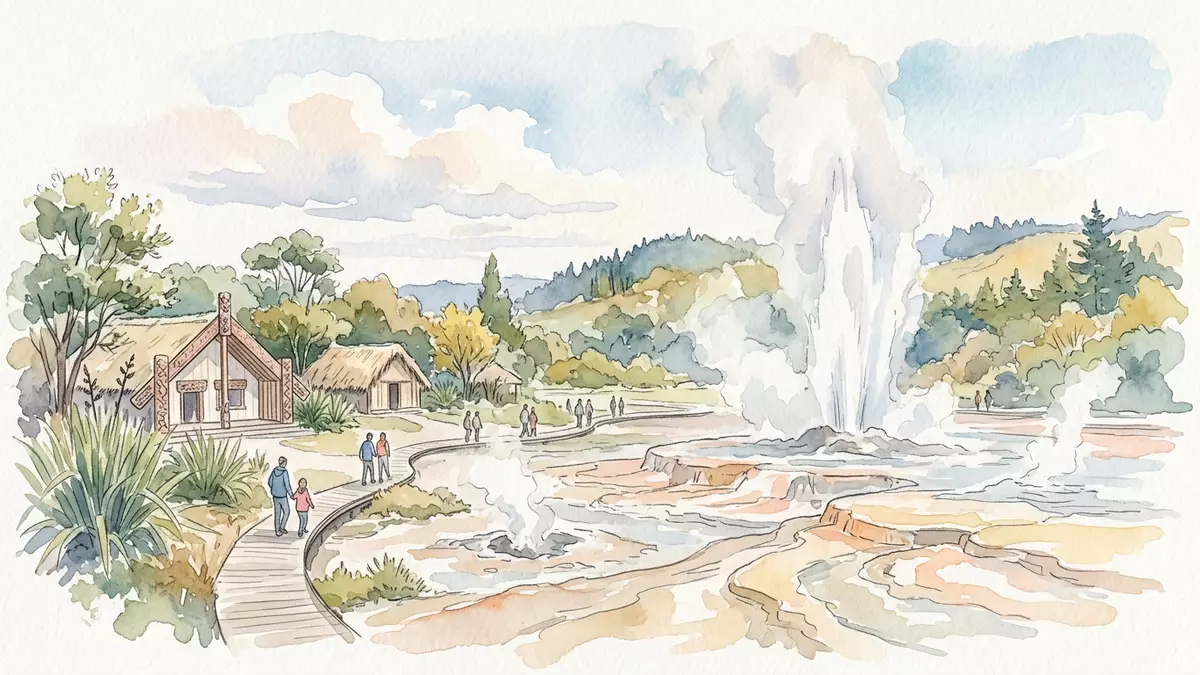
Te Puia in Rotorua is a rare combination of an active geothermal valley and a national centre for M?ori arts and crafts, set within the historic Te Whakarewarewa landscape on New Zealand’s North Island. The complex covers a broad swathe of hot ground with geysers and mud pools and houses the New Zealand M?ori Arts and Crafts Institute, a cultural institution established in 1926 to preserve and teach traditional carving and weaving.
Geothermal valley and the power of P?hutu
Te Puia sits in the Te Whakarewarewa geothermal valley on the southern side of Rotorua, where naturally heated water and steam rise through the ground in visible vents, pools and terraces.Te Whakarewarewa geothermal valley Within this landscape, geothermal features occupy a large area of land, giving Te Puia its characteristic terrain of mineral-stained earth and constantly shifting steam plumes.
The best-known geothermal feature in the valley is the P?hutu Geyser, which sends columns of hot water and steam high into the air and forms an unmistakable focal point for the site.P?hutu Geyser in the southern hemisphere Around P?hutu, paths lead across the geothermal zone to viewpoints over mud pools, hissing vents and other active features, with the valley floor showing layers of silica and other deposits built up over time. The geothermal area lies within sight of Rotorua’s urban edge, yet its steaming ground and sulphurous textures create a setting that feels markedly different from the surrounding city streets.
New Zealand M?ori Arts and Crafts Institute at Te Puia
At the core of Te Puia stands the New Zealand M?ori Arts and Crafts Institute, a national wananga (education facility) dedicated to teaching traditional M?ori carving and weaving.New Zealand M?ori Arts and Crafts Institute The institute was formally established in 1926 with the aim of nurturing time-honoured practices, and since then it has trained generations of artists in disciplines such as wood carving, flax weaving and stone or bone work.legislated in 1926
Workshops and studios within Te Puia function as living schools, where tauira (students) and pouako (tutors) produce carvings, woven panels and other pieces that draw on ancestral designs. Visitors can see these arts in progress and encounter carved gateways, meeting houses and other structures that display the institute’s work across the site.wananga and schools of learning Te Puia’s marae (meeting place) and carved wharenui (meeting house) give the geothermal valley a distinctly cultural frame, with architectural elements whose patterns and stories are grounded in M?ori heritage.
Kiwi conservation and cultural experiences
Beyond its geothermal and artistic roles, Te Puia also houses a Kiwi Conservation Centre, allowing visitors to encounter New Zealand’s native kiwi bird in a controlled environment that reflects its nocturnal habits.Kiwi Conservation Centre The presence of the kiwi enclosure links the valley to New Zealand’s wider natural heritage, adding a wildlife element to a visit that otherwise focuses on hot ground and built structures.
Te Puia integrates cultural performances and guided experiences with these physical settings. Guided walks introduce the geothermal landscape, the kiwi centre and the arts institute in a single circuit, while haka performances, waiata (songs) and storytelling take place in carved spaces on site.guided experiences and haka Together, these elements turn Te Puia into a place where geothermal activity, cultural practice and conservation are encountered side by side rather than in separate venues.
Visiting Te Puia: what travellers from Western Europe should know
- Te Puia lies in the Te Whakarewarewa geothermal valley on the southern edge of Rotorua, with its main entrance on Hemo Road and the valley extending beyond the built structures.
- Paths through the geothermal area cross uneven ground with natural mineral deposits, and viewing areas near P?hutu Geyser involve walking over sections of hot terrain with steps in places.
- Rotorua is reached overland from other centres on New Zealand’s North Island, and Te Puia stands a short distance from the city’s central districts, with local roads connecting directly to the site.
- The official language is English and the currency is the New Zealand dollar.
- Entry requirements depend on your nationality; UK travellers can check the FCDO travel advice at gov.uk/foreign-travel-advice, Irish travellers the Department of Foreign Affairs at ireland.ie.
Searching for Te Puia on social platforms
These links open searches for Te Puia on each platform.
Frequently asked questions about Te Puia
Where is Te Puia located?
Te Puia is located in the Te Whakarewarewa geothermal valley on the southern side of Rotorua on New Zealand’s North Island, with its entrance on Hemo Road.
What can visitors expect on a visit to Te Puia?
Visitors encounter an active geothermal landscape with geysers and mud pools, a Kiwi Conservation Centre and the New Zealand M?ori Arts and Crafts Institute, all within one integrated site.
What makes Te Puia distinctive among Rotorua attractions?
Te Puia stands out for combining a major geothermal valley centred on P?hutu Geyser with a national M?ori arts and crafts institute and a kiwi enclosure in the same location.


