
teamLab Planets turns water, light and flowers into art
Published on 09/23/2026 at 19:27 | Editorial responsibility: Rafael Müller, Editor-in-Chief AD HOC NEWS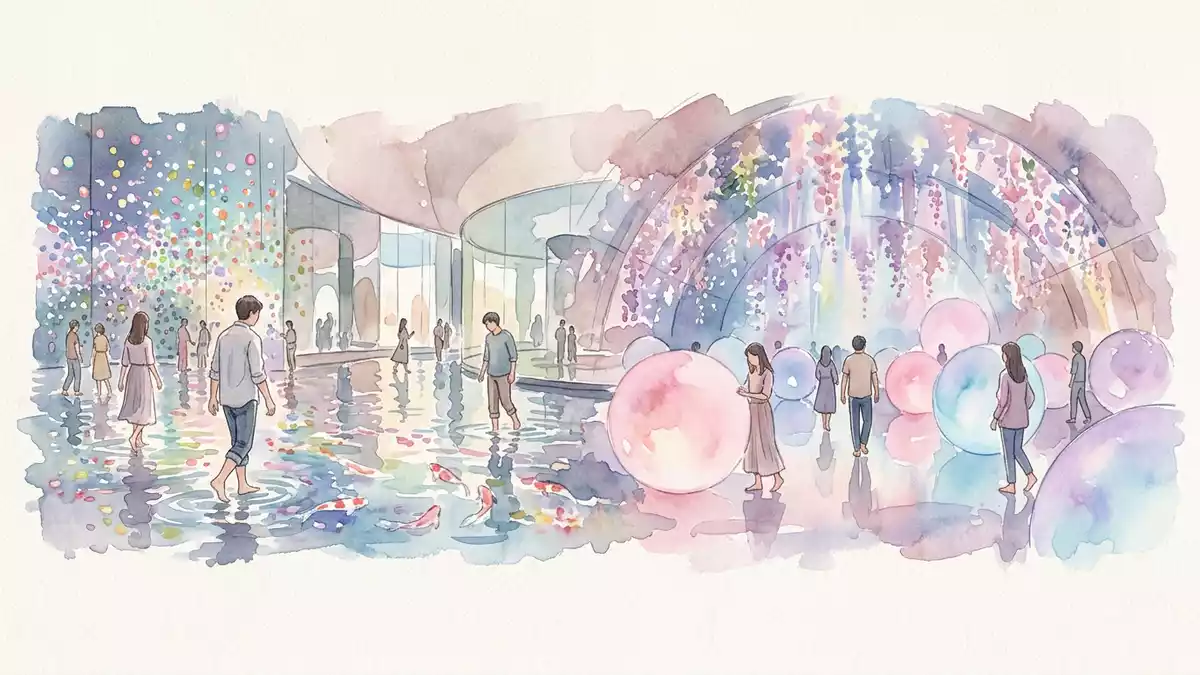
teamLab Planets in Tokio is an art museum built around physical movement through water, darkness, light and planting. Opened in Toyosu in July 2018, it was created by the Japanese art collective teamLab, whose installations surround the visitor rather than remaining on a distant wall.
teamLab Planets begins with water underfoot
The visit moves through a sequence of rooms in which the body becomes part of the setting. Bare feet meet shallow water in the Water Area, while projected images, sound and reflections occupy the surrounding surfaces. The museum describes itself as a place where visitors walk through water, a phrase that captures its most direct physical feature.
One installation presents koi moving across the water surface. The digital fish respond to bodies in the space, then change into flowers when contact occurs. The work carries the title Drawing on the Water Surface Created by the Dance of Koi and People – Infinity, and its imagery remains tied to the water beneath it.
Light fills the rooms at Toyosu
teamLab Planets also includes rooms in which light replaces recognisable architecture as the main material. The Infinite Crystal Universe uses hanging points of light and reflections to form an installation that extends across the visitor’s field of view.
Another work, Floating in the Falling Universe of Flowers, places digital flowers in an apparently continuous field. The flowers appear, develop and disappear within a dark environment, while sound forms part of the installation. teamLab identifies the work as an interactive digital installation created between 2016 and 2018.
A garden of living orchids
The Garden Area changes the material palette from projected light to living plants. Floating Flower Garden: Flowers and I are of the Same Root, the Garden and I are One contains more than 13,000 orchids suspended within the installation. The plants rise and shift as part of a room that joins horticulture with digital art.
Other garden works combine moss, light and small-scale forms. The museum therefore moves between water, mirrors, darkness, flowers and illuminated structures without separating art into framed objects. The rooms remain distinct, but each makes the visitor’s body part of the visible composition.
Visiting teamLab Planets: what travellers from Western Europe should know
- teamLab Planets stands at 6-1-16 Toyosu, Koto-ku, Tokio. Shin-Toyosu Station on the Yurikamome Line is the nearest railway station.
- The route includes water, and visitors experience the Water Area barefoot. Clothing that can become wet is relevant to the physical layout.
- The museum contains both a Water Area and a Garden Area. The garden includes living orchids alongside digital installations.
- The official language is Japanese and the currency is the Japanese yen.
Searching for teamLab Planets on social platforms
These links open searches for teamLab Planets on each platform.
Frequently asked questions about teamLab Planets
Where is teamLab Planets?
teamLab Planets is in Toyosu, within Koto-ku in Tokio. Its address is 6-1-16 Toyosu, near Shin-Toyosu Station on the Yurikamome Line.
What can visitors expect inside?
The museum combines water, projected imagery, sound, mirrors and living plants. Several rooms are experienced barefoot, including spaces where shallow water forms part of the installation.
What makes teamLab Planets distinctive?
Its artworks use the visitor’s physical presence as part of the scene. Water, digital light and more than 13,000 orchids turn the museum into an environment rather than a collection of separate wall displays.


