
Teatro Amazonas and its colourful Renaissance Revival dome
Published on 09/22/2026 at 05:50 | Editorial responsibility: Rafael Müller, Editor-in-Chief AD HOC NEWS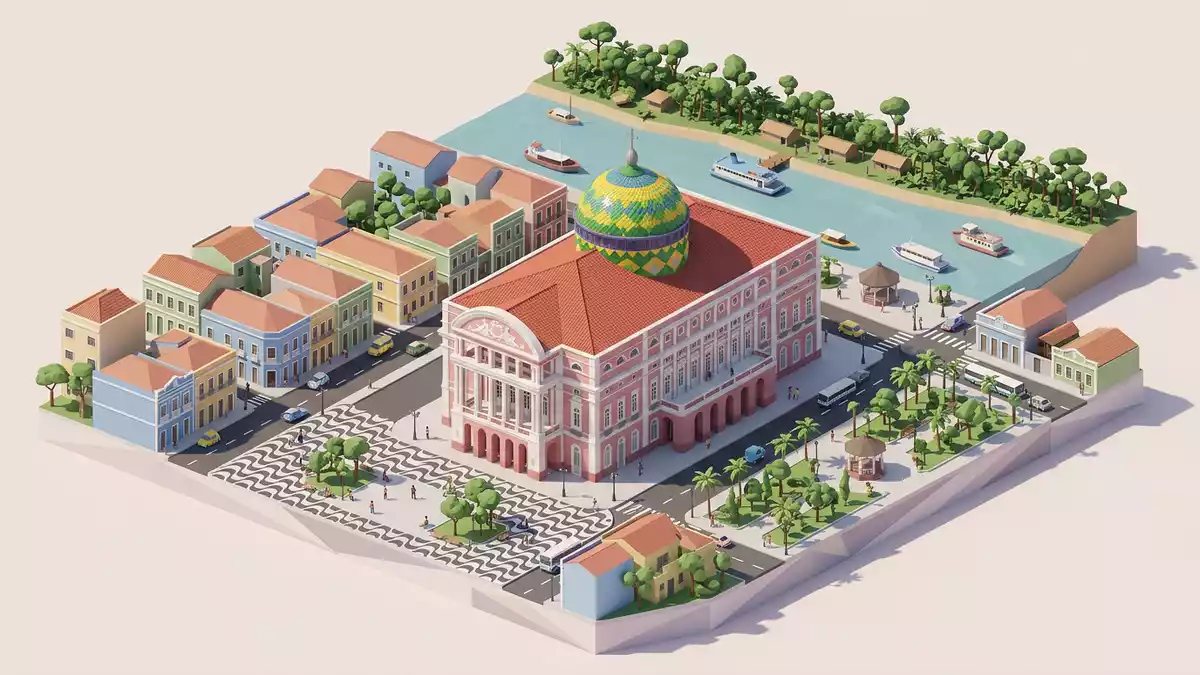
Teatro Amazonas rises above Praça São Sebastião in Manaus with a colourful dome and a Renaissance Revival exterior. Inaugurated on 31 December 1896, the opera house preserves the architectural language of Brazil’s rubber-boom era in a city deep within the Amazon region.
A dome above Manaus
The building’s most visible feature is its dome, formed from coloured ceramic tiles arranged in bands of green, yellow and blue. Its palette echoes the Brazilian flag and gives the roof a strong presence above the surrounding historic centre.
Teatro Amazonas combines masonry, metalwork, painted surfaces and imported decorative materials. Carrara marble appears in the grand staircase, while European furnishings and fittings accompany Brazilian woods and forest-inspired motifs throughout the interior. The result is a theatre with a European architectural vocabulary and an unmistakable Amazonian setting.
Renaissance Revival in the rubber-boom era
The project belongs to the late nineteenth century, when latex exports transformed Manaus into a major commercial centre. Antônio José Fernandes Júnior introduced the proposal in 1881, and the architectural project came from the Gabinete Português de Engenharia e Arquitectura in Lisbon.
Construction began in 1884 under the Italian architect Celestial Sacardim. The building follows Renaissance Revival principles, with a formal façade, a theatre auditorium, ornate decoration and a roof whose colours contrast with the pale exterior walls. Teatro Amazonas history remains closely connected with Manaus’s nineteenth-century expansion and its cultural institutions.
Rooms, paintings and theatrical detail
The auditorium forms the centre of the building, surrounded by richly finished public rooms and circulation spaces. Painted ceilings, chandeliers, carved details and patterned flooring continue the theatre’s Belle Époque character.
Interior decoration includes work associated with Domenico de Angelis and Crispim do Amaral. A ceiling painting presents an allegory of the arts, while the theatre’s materials connect the stage and ceremonial rooms with craft traditions from Brazil and Europe. the Portuguese design office reflects the transatlantic character of the project.
The theatre opened with its inauguration on 31 December 1896. The first performance followed in January 1897 with Amilcare Ponchielli’s opera La Gioconda. The building therefore belongs both to Manaus’s urban history and to the international opera culture of its period.
Visiting Teatro Amazonas: what travellers from Western Europe should know
- Teatro Amazonas stands at Praça São Sebastião in central Manaus, beside the historic square and near the city’s older civic buildings.
- Manaus is reached by air or by river transport, and the theatre lies within the central urban area rather than beside the Amazon rainforest.
- The official language is Portuguese and the currency is the Brazilian real.
- The building contains staircases, an auditorium, decorated halls and painted ceilings, so a visit involves movement through historic interior spaces.
Searching for Teatro Amazonas on social platforms
These links open searches for Teatro Amazonas on each platform.
Frequently asked questions about Teatro Amazonas
Where is Teatro Amazonas?
Teatro Amazonas is in Praça São Sebastião in central Manaus, the capital of Amazonas state in Brazil.
What can visitors expect inside?
The interior contains an auditorium, decorated halls, painted ceilings, chandeliers, marble elements and historic staircases.
What makes Teatro Amazonas distinctive?
Its Renaissance Revival architecture, colourful dome and 1896 inauguration combine European theatre design with the history of Manaus during the rubber-boom era.


