
Teatro Colon: a grand opera house at the heart of Buenos Aires
Published on 08/16/2026 at 14:40 | Editorial responsibility: Rafael Müller, Editor-in-Chief AD HOC NEWS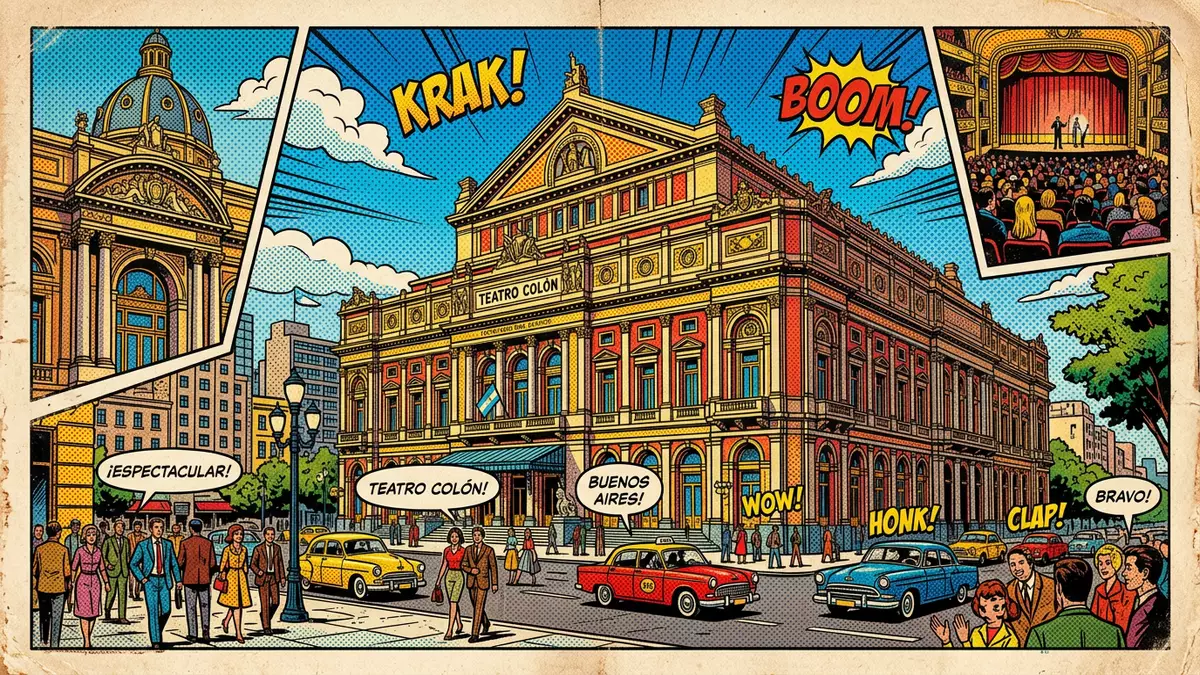
Teatro Colon in Buenos Aires is an opera house where an eclectic façade and a horseshoe-shaped main auditorium form one of the city’s most recognisable cultural ensembles. Opened in 1908, it represents a moment when Argentina projected European-style grandeur into its capital through architecture, music and design.
From nineteenth-century plans to a 1908 inauguration
The present Teatro Colon stands on Plaza Lavalle in central Buenos Aires, occupying a city block defined by formal street frontages and a prominent corner entrance. The theatre belongs to a line of performance spaces that began with an earlier opera house opened in 1857 on Plaza de Mayo under architect Charles Henri Pellegrini, which operated there for more than three decades before closing in 1888.earlier opera house In the late nineteenth century, the decision was taken to build a new theatre on a different site, and work on the current building extended over roughly twenty years until it opened on 25 May 1908.constructed between 1885 and 1908
The design process brought together several architects from Europe working in Buenos Aires. Italian architect Francesco Tamburini prepared the initial scheme, followed by his collaborator Víctor Meano, and the project was later completed under Belgian architect Jules Dormal.Tamburini, Meano and Dormal The building has been described in terms of neoclassical and Renaissance influences, and its exterior composition reflects that heritage in ordered columns, sculptural decoration and an emphasis on symmetry along its principal elevations.neoclassical and Renaissance influences
A horseshoe-shaped auditorium and backstage labyrinth
Inside, the main auditorium is organised in a horseshoe form, a layout associated with late nineteenth-century Italian and French classical theatre design.classical theatre standards The room rises through multiple levels of boxes and galleries above an orchestra floor, bringing balconies, private boxes and upper tiers into a compact vertical stack. Decorative finishes include gilded surfaces, sculpted balustrades and extensive use of red upholstery, setting a formal, theatrical atmosphere around the stage opening.
Behind the auditorium stretches a complex of technical and rehearsal spaces that support opera, ballet and orchestral performance. The stage house incorporates fly towers and workshop areas, while separate rooms accommodate vocal and instrumental rehearsals and production work.workshop and rehearsal spaces Additional foyers and circulation routes link the entrance halls with the seating levels, combining staircases, corridors and reception rooms into a route that frames the transition from street to performance space.
Teatro Colon as a national cultural monument
Teatro Colon has long held a central place in Argentina’s cultural life. Its opening with Giuseppe Verdi’s opera “Aida” on 25 May 1908 marked the arrival of a grand opera house designed to host major international companies and artists.opening with “Aida” Over the twentieth century the theatre received conductors, singers and dancers associated with leading companies from Europe and the Americas, and its programme drew on the main operatic and symphonic repertoire.
The building itself is recognised for its heritage value and architectural quality. It has been described as an emblematic historic monument of Argentina, and it combines European academic styles with local craft traditions in stone, metal and interior painting.emblematic historical monument Declared a National Historic Monument in 1991, the theatre’s protected status underlines its importance not only as a venue but also as a piece of architecture in Buenos Aires.National Historic Monument
Visiting Teatro Colon: what travellers from Western Europe should know
- Teatro Colon stands beside Plaza Lavalle in central Buenos Aires, with its principal frontage on Cerrito and secondary entrances on surrounding streets including Libertad.address on Cerrito The area is served by city buses and the Buenos Aires underground railway.
- Inside the historic building, circulation to the upper seating levels involves staircases and corridors that climb through several storeys, so movement between foyer and higher tiers includes flights of steps.
- The theatre lies in the dense grid of Buenos Aires’ downtown, a short walk from Plaza de Mayo and near other civic buildings, making it easy to combine with visits to neighbouring streets and squares.
- The official language is Spanish and the currency is the Argentine peso.
- Entry requirements depend on your nationality; UK travellers can check the FCDO travel advice at gov.uk/foreign-travel-advice, Irish travellers the Department of Foreign Affairs at ireland.ie.
Searching for Teatro Colon on social platforms
These links open searches for Teatro Colon on each platform.
Frequently asked questions about Teatro Colon
Where is Teatro Colon located in Buenos Aires?
Teatro Colon stands alongside Plaza Lavalle in central Buenos Aires, with its main address on Cerrito and additional access on streets such as Libertad.
What can visitors expect when entering the building?
Visitors pass through formal entrance halls into foyers and staircases that lead to a richly decorated horseshoe-shaped auditorium with multiple levels of boxes and seating.
What makes Teatro Colon distinctive among opera houses in Argentina?
Its long construction period, eclectic neoclassical and Renaissance-inspired architecture, horseshoe plan and status as a National Historic Monument give it a distinctive role in Argentina’s cultural life.


